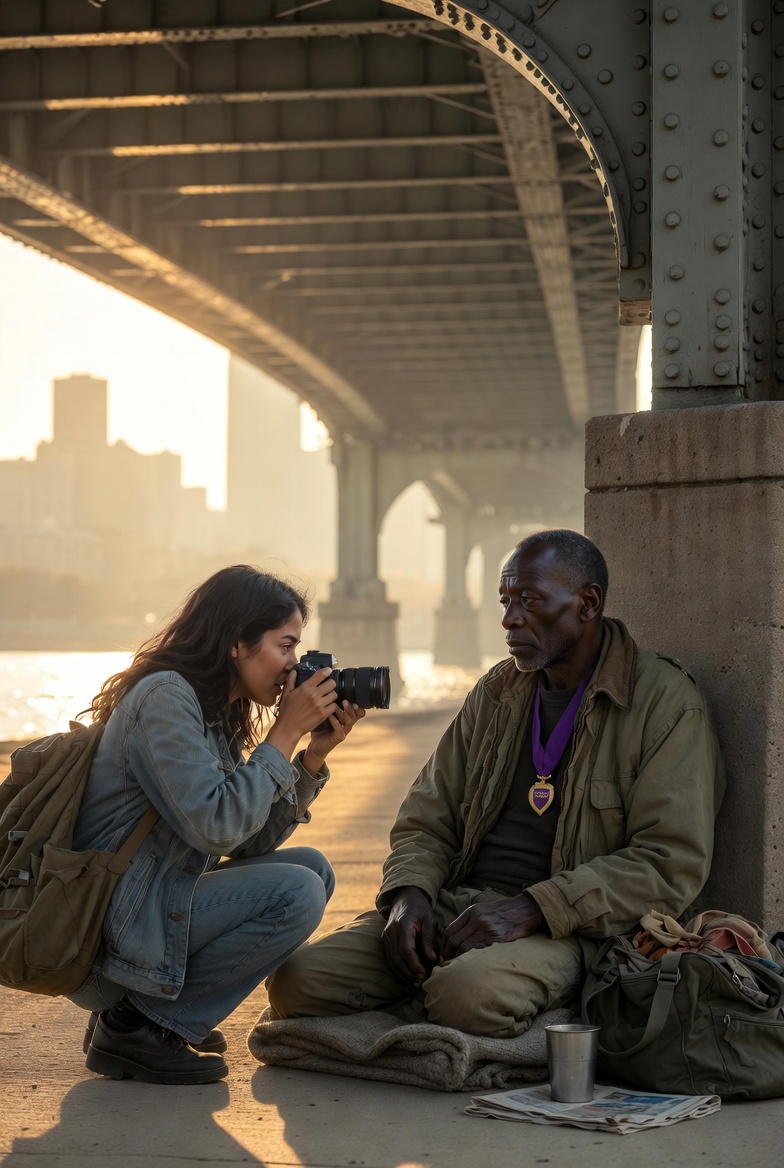
It was a 19-year-old photography student named Priya who changed everything. She had been assigned a documentary project — “Faces of the City” — and was moving through downtown with her camera when she saw James sitting on an overpass wall, morning light catching the medal on his chest like a small flame.
She asked if she could photograph him. He shrugged. “Nobody’s stopping you.”
She sat with him for three hours instead of three minutes. She asked questions. He answered in short sentences at first, then longer ones, then in the kind of unguarded honesty that comes when someone finally feels heard after a decade of invisibility.
Her photograph — James in profile, medal glinting, eyes fixed somewhere far away — won her school’s citywide competition. The local paper ran it. Then a veterans’ advocacy page shared it. Then it was everywhere.
Within 72 hours, a veteran housing nonprofit had identified James by name. Within two weeks, he was off the bridge. Within a month, he was in a studio apartment with a VA caseworker, a therapist, and a benefits package that should have reached him forty years earlier.
He wept when they handed him the keys. Not from gratitude — or not only that. From exhaustion. From the particular grief of finally being seen after so long.
Priya framed a copy of the photograph for his new apartment. He hung it on the wall above the small dining table, next to a window that looked out over the city.
He told her once, quietly: “I survived the war. I just didn’t know surviving this part was allowed.”
He’s still in that apartment. He still wears the medal — but differently now. More like a man who remembers, less like a man who has nothing left. 🕊️
🎖️ The Purple Heart Veteran Living Under a Bridge