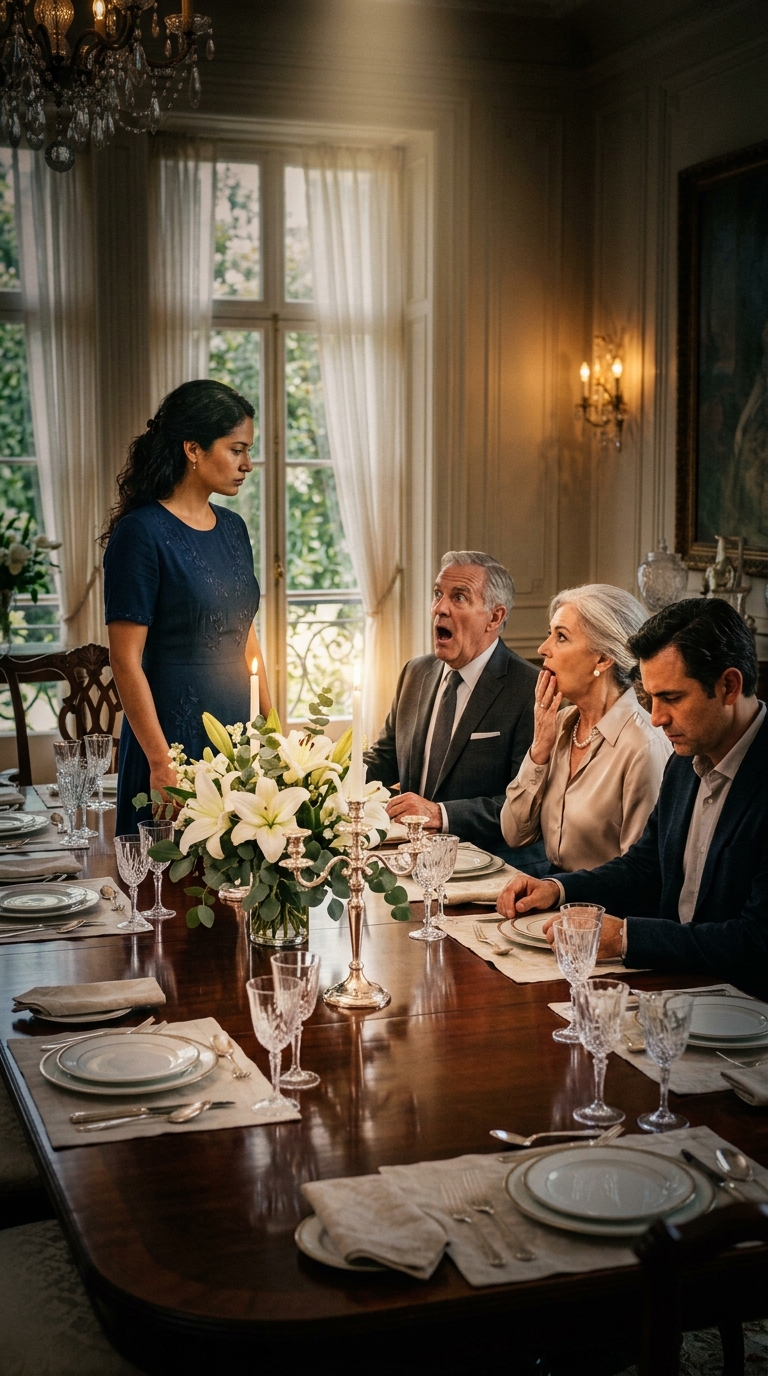
The table went quiet in the specific way that tables go quiet when someone has said something that cannot be unsaid.
Eleanor laughed first — the reflexive laugh of someone who has defaulted to dismissal for so long it is now involuntary. “Oh, she’s funny,” she said to Thomas. “David, your wife is funny.”
David was not laughing. David had gone the particular shade of pale that comes from standing in two places simultaneously — between the truth and the version of events he had been living inside — and understanding for the first time that the distance between those places was about to become publicly visible.
“I own the house, Eleanor,” I said, with the same tone I used when I was the calmest person in an emergency room. “The deed is in my name. It has been since we purchased it. I have paid the mortgage for nine of the twelve years David and I have been married. I have documentation for all of it.”
Thomas made a sound that was trying to become a laugh and didn’t quite get there.
Eleanor looked at David.
“Is this true?”
David’s answer — a silence that lasted long enough for everyone at the table to understand it as confirmation — was the most honest thing he had communicated to his family in years.
What followed that Christmas dinner was a reckoning that arrived in stages rather than all at once.
The immediate aftermath was the drive home — David and I in the car, the neighborhood lights passing, neither of us speaking for a long time. When we finally talked it was the kind of talking that happens when a structure that has been under strain for years develops its first visible crack. Everything that had been held in the walls came out.
He had known what his family said. He had told himself it was harmless. He had told himself I was strong enough to absorb it. He had told himself that saying something would create conflict that wasn’t worth the cost — and in telling himself this, had calculated my dignity against his comfort and chosen his comfort every time.
I told him this. Directly. Without anger, which surprised him, because he had been braced for anger. But I had spent twelve years in rooms where I had to be the calmest person present and I was very good at it.
“I don’t need you to have fought every battle,” I said. “I needed you to fight one. One time. In twelve years. Just to show me that you saw what they were doing.”
He had no answer for that. Which was, in itself, an answer.
We separated in the spring. Not dramatically — quietly, with the mutual understanding of two people who have looked at something clearly and recognized that what they see does not constitute a foundation worth continuing to build on.
The house remained mine. This required no legal action — my name was on the deed, the mortgage was current, and David had no claim that held up to the simplest examination. His attorney apparently reviewed the paperwork and advised him directly that any contest would be both expensive and unsuccessful.
He moved into an apartment. I stayed in the house.
Eleanor called once, three weeks after Christmas. I let her leave a voicemail. She said the family had been confused by my announcement and that she hoped we could clear the air. She did not apologize. She did not acknowledge twelve years of holiday dinners. She wanted the confusion cleared because confusion was uncomfortable and apology would have required her to see me differently than she had decided to see me before I ever walked through her door.
I did not call back.
Thomas sent a text four months later asking if David and I had considered reconciliation. I replied that I appreciated his concern and had nothing further to share. He did not respond.
My mother-in-law — my former mother-in-law — has not contacted me since the voicemail. I think about her occasionally. Not with bitterness exactly. With the specific sadness of someone who watches another person choose smallness when they could have chosen something larger and realizes the choice was made long ago and won’t be unmade now.
I work the same hospital I have worked for fourteen years. Charge nurse. The patients don’t know about Eleanor or the mortgage or the Christmas table. They know I am calm when things are difficult and that I will tell them the truth about what is happening and that I will stay.
My colleagues know I bought my house myself. They know because I told them recently, for the first time, the full story — over lunch, on a Tuesday, because I was tired of keeping it contained and they were people who deserved to know who they were sitting with.
They were not surprised. That was the most clarifying thing. They looked at me across the table and nodded with the expressions of people for whom this information confirmed what they had already understood.
“We knew you owned everything you walked into,” my colleague Diana said. “You always have.”
I thought about the maid joke. Twelve years of it.
I thought about Eleanor’s face when the table went quiet.
I thought about David’s silence in the car and the silence before that and the silence that had cost us both something real.
Then I finished my lunch and went back to work.
The house was still mine when I got home.
It always had been.
— As told by the maid who owned every room they laughed in.