Part 1: The Abandonment
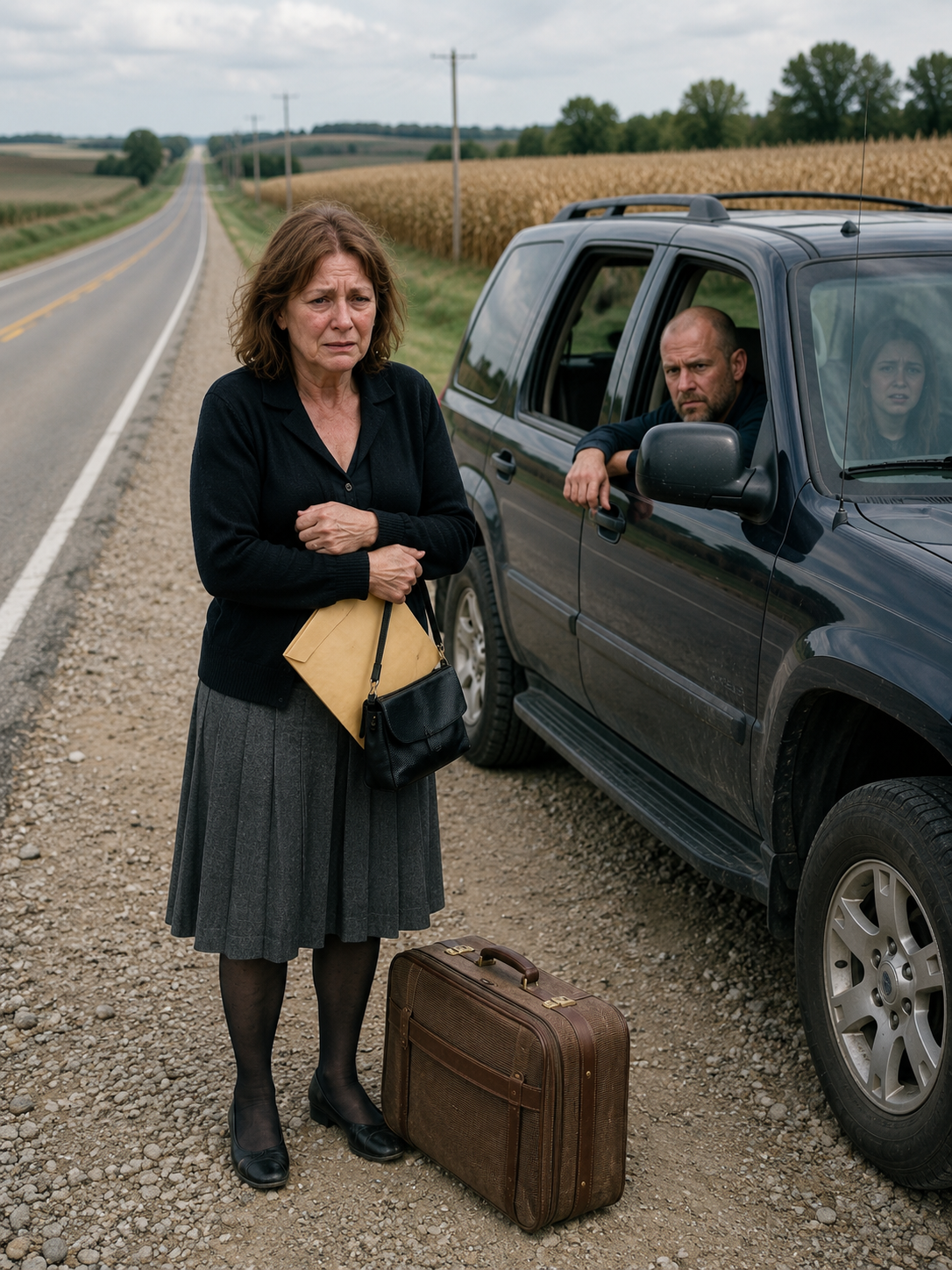
The gravel under my funeral shoes sounded like teeth breaking. Dust climbed my black stockings, and the damp smell of early spring came up from the ditch, the same smell my husband, Robert, used to notice after hard winters. He would stand on our back porch with his coffee cooling in one hand and say, “The ground’s trying again.”
I watched our son’s SUV roll forward, pause for half a breath, then disappear around the bend where the fields swallowed the road. I did not chase him. I did not scream his name. My throat was too dry for begging, and my hands were too steady for panic.
Three days earlier, I had stood beside Robert’s grave with a folded funeral program crushed in my palm. The paper was soft from my thumb rubbing the same line over and over. At home, neighbors had left Costco trays on the kitchen counter, foil pans on the stove, and paper plates stacked near the sink like nobody knew what else to do with sorrow except feed it.
My children arrived like grief was something they had to fit between appointments. My son, Daniel, kept his phone facedown on the dining table, but his eyes kept sliding toward it. He talked about flights, traffic, meetings, payroll, and the business, as if his father had not built that company one invoice, one handshake, one 3 a.m. worry at a time. My daughter, Ashley, hugged me without really touching me, her expensive sunglasses still pushed into her hair, her black blouse smooth and careful. She kissed the air near my cheek and said, “Mom, we just want this to be manageable.”
Manageable.
For thirty-two years, that house had been my whole address in the world. I had packed school lunches at that counter, signed permission slips on that table, folded Robert’s work shirts in the laundry room, and sat beside him through two recessions, one cancer scare, and the night our first warehouse almost burned. I had given Daniel keys, passwords, introductions, account access, and every benefit that comes with being trusted.
Trust is a strange inheritance. Some people receive it and mistake it for ownership.
That first night after the funeral, I made coffee because my hands needed something ordinary to do. The refrigerator hummed. The sink smelled like lemon dish soap. In the living room, Robert’s recliner still held the deep dent where he used to fall asleep during Sunday football, the remote balanced on his chest like a little flag of surrender.
Then Daniel opened his laptop on my dining table and said, “We should talk about next steps.”
Next steps. Not “Mom, have you eaten?” Not “Do you want me to stay tonight?” Just next steps, as if I were a folder he wanted closed before his return flight. They spoke gently, which somehow made it worse. Ashley used words like safe and easier. Daniel used practical three times before midnight.
At 6:40 the next morning, Ashley handed me a suitcase I did not recognize and said we were only going to “look at a place” that might be “good for me.”
“I’m not going anywhere,” I said.
Daniel smiled like he had been waiting for that exact sentence. “Just come take a look, Mom. It’s easier if we do this calmly.”
Calmly. That is the word people use when they have already made a cruel decision and want you to lower your voice while they carry it out.
So I walked through my own house like a visitor. Past the hallway pencil marks that still measured my children’s heights. Past the framed photo from the day Robert opened the second office. Past the junk drawer where he had kept bank envelopes, tax letters, and handwritten notes from our attorney, Mary Caldwell.
I picked up my purse. It was heavier than it looked.
In the SUV, Ashley stared out the passenger window. Daniel drove with no music. Nobody mentioned the assisted-living brochure tucked into the seat pocket. Nobody mentioned the power-of-attorney form printed from Hamilton County Legal Services and left beside my coffee mug.
Then Daniel turned away from town. The blinker clicked too loudly in the stillness. Two lanes. No shoulder. Fields on both sides. A sky so wide it made a person feel easy to erase.
Then he pulled over. He turned to me and said, calm as a weather report, “This is where you get out.”
Ashley’s mouth opened, then closed. No argument. No refusal. Just that thin little silence people hide behind when they want the benefit of cruelty without the stain of doing it themselves.
I stepped out. Dust clung to the hem of my dress. The unfamiliar suitcase hit the gravel beside my shoes. The door shut behind me with a soft, final click.
No phone. No cash. Or so they believed.
I watched the SUV shrink into the distance until it was only a dark shape, then nothing. For the first time since Robert died, my chest loosened. Not because it did not hurt. Because I finally understood what this was. A clean cut. A release.
I reached into the deepest pocket of my purse and felt the sharp corner of the sealed envelope Robert and I had signed at 2:13 p.m. on February 8, witnessed by Mary Caldwell and notarized in blue ink.
The wind lifted dust around my shoes. Then headlights appeared at the far end of the road. A black sedan slowed beside me, close enough for me to see the county courthouse parking sticker on the windshield. The passenger window lowered, and Mary Caldwell looked first at my dusty shoes, then at my face.
Her voice was steady. “Did he say the words?” she asked.
Part 2: The Envelope
“Yes,” I said to Mary. “He said the words.”
She nodded slowly, as if she had been expecting this. “Get in. We have work to do.”
I climbed into the passenger seat, and Mary drove me to her office. The courthouse parking sticker on her windshield caught the afternoon light, and I felt something I hadn’t felt in days: hope.
Inside her office, I opened my purse and pulled out the sealed envelope. Robert and I had signed it at 2:13 p.m. on February 8, witnessed by Mary and notarized in blue ink. I had been carrying it ever since, waiting for the moment when I would need it.
Mary broke the seal and read the documents carefully. Her expression shifted as she turned each page. Then she looked up at me with something close to admiration.
“Eleanor,” she said, “you and Robert were thorough.”
The documents inside were simple but devastating. A codicil to the will, signed and witnessed, transferring full ownership of the house, the business, and all accounts to me—and only me. A trust agreement that had been quietly established years ago, ensuring that nothing could be transferred without my explicit consent. And a letter from Robert, written in his own hand, explaining everything.
“He knew,” I said quietly. “He knew they would try something like this.”
Mary nodded. “He loved you, Eleanor. He wasn’t going to let anyone take what was yours—not even his own children.”
I read Robert’s letter that afternoon. In it, he wrote about his love for our children, but also his disappointment. He had seen the entitlement growing in Daniel, the coldness in Ashley. He had tried to talk to them, to teach them, but they had stopped listening. So he had made other arrangements.
“I don’t want them to hate you,” Robert had written. “But I want you to be safe. I want you to be secure. You were my partner in everything, Eleanor. You deserve to keep what we built together.”
I folded the letter carefully and placed it back in my purse. “What happens now?”
Mary smiled. “Now, we let them find out the truth. And we do it on your terms.”
Part 3: The Reckoning
Two days later, I walked into my house with a set of new keys and Mary by my side. The house was quiet, but it was my quiet now. Daniel and Ashley had no idea I had returned. They were still under the impression that I was stranded somewhere without a phone or cash, powerless and defeated.
They were wrong.
Daniel called me from what he thought was my old number. But I had already canceled that phone and activated a new one. He left messages. “Mom, we’ve been so worried. Where are you? Please call us.” There was something hollow in his voice—a performance of concern that didn’t reach his eyes. I didn’t answer.
On the third day, I drove to the business. Daniel was in the main office, shuffling papers, looking every bit like he had already taken over. He looked up when I walked in, and his face went pale.
“Mom? How did you—”
“Hello, Daniel,” I said calmly.
“This is a surprise. We thought you had—”
“I know what you thought,” I interrupted. “You thought I was gone. You thought you and Ashley could just take everything and move on without me. But you were wrong.”
He tried to smile, but it didn’t reach his eyes. “Mom, we never meant to abandon you. It was just—we thought it would be best if you had a little help. You’re not as young as you used to be.”
“I’m not as stupid as you think I am either,” I said. “I know about the power-of-attorney forms. I know about the assisted-living brochures. I know about the trust fund you tried to access.”
His face tightened. “You had no right to—”
“I had every right,” I said. “Because I’m the trustee. And I’m the one who decides what happens to this company.”
That shut him up.
I pulled out the documents from my purse. “Your father and I updated our will before he passed. Everything is in my name. The house. The business. The accounts. And this is what’s going to happen: you’re going to leave. Both of you. And you’re going to think about what you did.”
“You can’t do this,” Daniel said, his voice rising with anger. “I built this company. I sacrificed everything—”
“You sacrificed nothing,” I said. “Your father built this company. You just showed up after it was done and acted like you deserved it. And when he died, instead of helping me, you tried to take it all.”
“Mom, please—”
“I’m going to give you one chance,” I said. “You’re going to apologize. You’re going to leave. And you’re not going to come back until you’ve earned the right to call yourself my son.”
He didn’t apologize. He just grabbed his jacket and walked out. Ashley followed, her face red with anger. I watched them go and felt nothing but relief.
That night, I sat in Robert’s old recliner, looking at the dent his head had left in the headrest. I spoke to him aloud. “I told them, Robert. It’s done.”
I wasn’t angry. I wasn’t sad. I was at peace.
Over the following months, I took control of the business. I hired a new manager. I learned the accounts. I made sure everything ran smoothly, not because I had to, but because I wanted to. The business was my legacy too. I wasn’t going to let my children’s greed destroy it.
Daniel and Ashley called occasionally. They left messages full of apologies and accusations, sometimes both in the same sentence. I listened to them, but I didn’t answer. Not yet. I needed time to heal. I needed time to figure out if they could ever truly change.
Then, one winter afternoon, Daniel showed up at my doorstep. He looked different—older, humbler, like a man who had been humbled by life. His voice was quiet when he said, “Mom, I’m sorry.”
I invited him inside.
He sat on the couch, just like he used to as a boy. But this time, he wasn’t demanding anything. He was just… present.
“I was wrong,” he said. “I was so wrong. I thought I was entitled to everything because I was the son. I didn’t see you as a person. I saw you as an obstacle. And I’m so ashamed of that.”
I listened. I didn’t interrupt.
“I’ve been going to therapy,” he continued. “I’ve been trying to understand why I did what I did. I’m not making excuses. I just want you to know that I’m trying to be better.”
I nodded slowly. “That’s a start.”
“Can I come back?” he asked. “Can I be part of your life again? I know I don’t deserve it. But I want to earn it.”
I looked at him, my son, the boy I had raised. I thought about all the years, all the love, all the sacrifice. And I made a decision.
“I’m not going to give you the business,” I said. “Not now. Maybe not ever. But I can give you a second chance. That’s what your father would have wanted.”
Daniel cried. For the first time in years, I saw real emotion on his face.
“Thank you, Mom,” he whispered. “Thank you.”
Ashley came back too, though it took longer. She had her own journey of self-discovery, her own reckoning. When she finally showed up, it was with a letter she had written, apologizing for everything. I read it and saw the same sincerity I had seen in Daniel.
“You can come back,” I said. “But you have to prove it. Every day.”
She nodded. “I will.”
Over the years, the business continued to thrive. Daniel worked his way back into a position of responsibility, not as a leader, but as a contributor. Ashley started helping with community outreach, using her PR skills to make a real difference. I remained the head of the company, the matriarch, the one who had been underestimated and forgotten—and who had risen anyway.
I stayed in the house I had shared with Robert. I kept his recliner in the living room, exactly where he left it. And every morning, I stood on the back porch with my coffee, feeling the same spring air, the same damp earth, the same smell that Robert had loved.
“The ground’s trying again,” I would whisper. And I would know that he was with me.
Sometimes, the people we love betray us. Sometimes, the ones we trust the most let us down. But that doesn’t mean we stop believing in second chances. That doesn’t mean we stop opening our hearts to the possibility of change.
My children weren’t perfect. But they were my children. And after everything, I chose to give them another chance—because that’s what family does. That’s what love does.
And in the end, love was the one thing they couldn’t take from me. ❤️