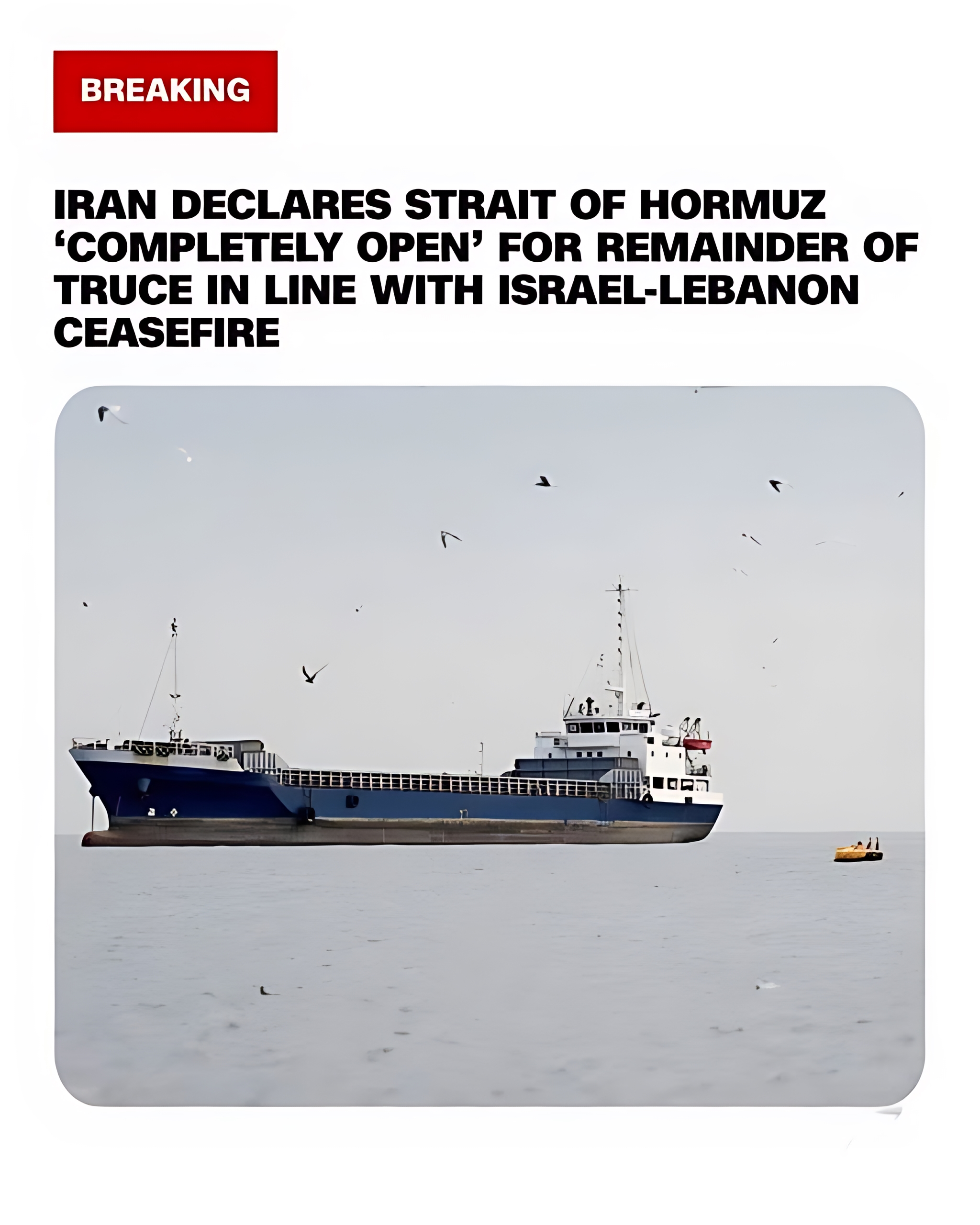
TEHRAN / WASHINGTON — Iran announced Friday that the Strait of Hormuz is now “completely open” for all commercial and civilian maritime traffic for the duration of the current regional truce, aligning its position with the newly established Israel–Lebanon ceasefire. The declaration marks a significant shift after months of heightened tensions, naval confrontations, and partial closures that rattled global energy markets.
The announcement was delivered by Iran’s Armed Forces spokesperson, who said the decision was made “in support of regional de‑escalation efforts” and in coordination with mediators involved in the Israel–Lebanon agreement.
“For the remainder of the truce period, the Strait of Hormuz will remain completely open,” the spokesperson said. “This is a gesture of stability and responsibility.”
The move comes as international monitors work to verify compliance with the 10‑day ceasefire between Israel and Lebanon, brokered with U.S., French, and Qatari involvement.
LIVE UPDATES
Iran Says Naval Forces Ordered to Stand Down From Interdictions
Iran’s navy has reportedly been instructed to suspend vessel inspections and halt all non‑essential patrols in the strait. Officials said only “standard defensive operations” will continue.
Oil Markets React Immediately
Global oil prices fell modestly in early trading following the announcement, with analysts noting that even a temporary guarantee of safe passage eases pressure on shipping insurers and energy importers.
U.S. Welcomes Move but Remains Cautious
A senior U.S. defense official said Washington “acknowledges the announcement” but will continue monitoring Iranian naval activity closely.
“Words are one thing. Behavior at sea is another,” the official said.
Israel and Lebanon Both Signal Compliance With Ceasefire
Israeli officials said the truce is holding “for now,” while Lebanese authorities confirmed no major violations have been reported along the border.
Shipping Companies Begin Rerouting Back Through the Strait
Several major carriers said they are preparing to resume normal routes after weeks of diversions around the Arabian Peninsula.
Analysts: Iran Seeking Diplomatic Leverage
Middle East analysts say Iran’s decision is likely aimed at demonstrating goodwill while also positioning itself as a stabilizing actor during the ceasefire window.
“This is a calculated move,” one regional expert said. “Iran wants to show it can turn the temperature down — and up — depending on the diplomatic moment.”
UN Maritime Monitors Increase Presence
The United Nations confirmed it has deployed additional maritime observers to verify safe passage and ensure no party uses the truce to reposition military assets.
What Comes Next
The Strait of Hormuz will remain fully open only for the duration of the truce, which is tied to the 10‑day Israel–Lebanon ceasefire. Diplomats say the next several days will be critical in determining whether the calm holds — and whether Iran’s gesture becomes a stepping‑stone toward broader regional de‑escalation.
If you want, I can also create a headline thumbnail, a breaking‑news banner, or a timeline graphic showing how the truce unfolded.