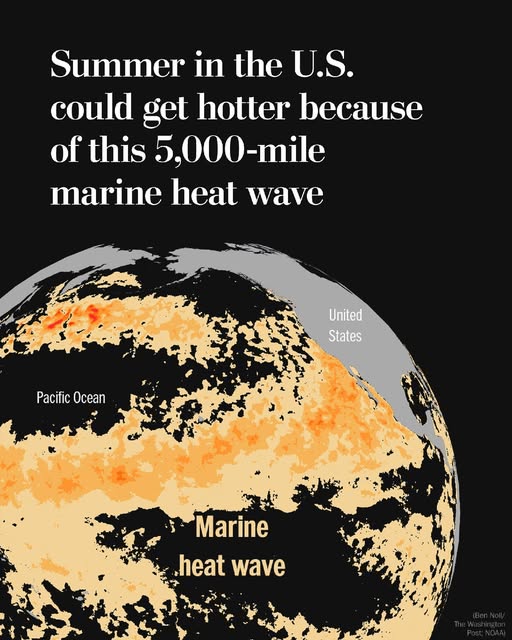
WASHINGTON — Climate researchers are tracking what NOAA calls the largest active marine heat wave on record, stretching from the Gulf of Alaska to the coast of Central America. The anomaly, labeled NEP25A, covers nearly one‑third of the North Pacific and has driven ocean temperatures 6 to 8 °F above normal, a level unseen since satellite monitoring began in 1981.
The phenomenon is already altering atmospheric circulation, energizing the subtropical jet stream and increasing moisture transport toward the western U.S. — a setup that could bring humid heat waves, stronger Pacific storms, and early wildfire risks.
“This is the largest annular warming pattern we’ve observed in 40 years,” said Tao Lian of China’s Second Institute of Oceanography, noting that the ocean is storing more heat than it releases — a precursor to a potential El Niño later this year.
Immediate and Seasonal Impacts
In the short term, the hot spot is expected to boost humidity and overnight temperatures across California and the Southwest, reducing relief from daytime heat. Meteorologists say the same oceanic energy could fuel tropical systems farther north than usual, similar to 2023’s Tropical Storm Hilary.
NOAA’s Climate Prediction Center projects a 70 percent chance of El Niño developing by mid‑summer, which would amplify the marine heat wave’s effects — strengthening hurricanes in both the Pacific and Atlantic and shifting jet‑stream patterns that govern U.S. weather.
Ecological Consequences
Marine biologists warn that prolonged warmth is already stressing ecosystems. Fish are migrating north or deeper, kelp forests are thinning, and seabird die‑offs have been reported along California’s coast as prey species vanish.
“We’re seeing emaciated pelicans and cormorants washing up on beaches,” said marine ornithologist Tammy Russell. “They’re starving because their food has moved to cooler waters.”
These disruptions echo the 2014–2016 event known as “the Blob,” which collapsed salmon runs and triggered toxic algal blooms. Scientists fear recovery times are shrinking as heat waves recur almost yearly.
A Preview of a Hotter Future
Experts say the Pacific’s current state could reshape summer across North America, producing wetter conditions in some inland areas but more extreme heat and humidity along the coast. The anomaly also underscores a broader trend: marine heat waves now cover nearly 45 percent of the world’s oceans, driven by climate change and cyclical patterns like El Niño.
As one NOAA scientist summarized, the Pacific’s 5,000‑mile hot zone is not just a regional curiosity — it’s a warning sign of how rapidly Earth’s oceans are absorbing and redistributing heat, with consequences that will ripple from the sea surface to the skies above the American West.