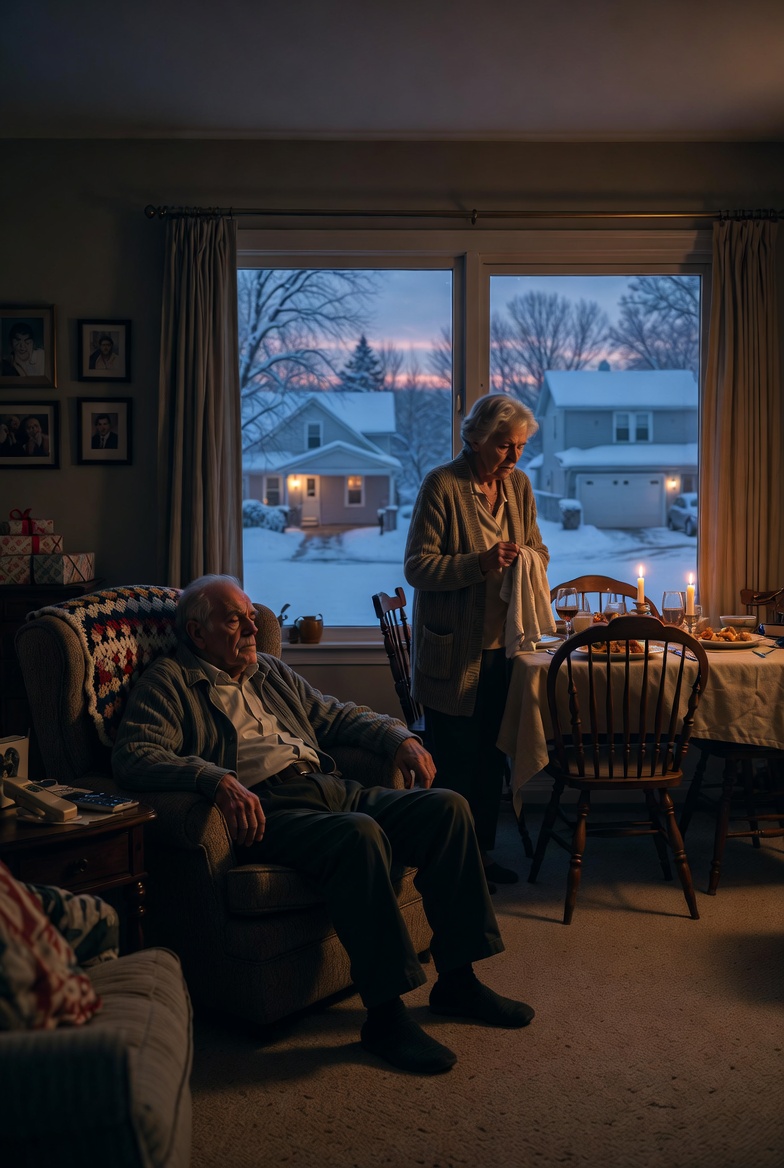
George Ramirez had never been afraid of silence. He grew up with it — long factory nights, empty streets, the hum of machines that drowned out everything except his own thoughts. But the silence inside his home at seventy‑four felt different. It wasn’t peaceful. It was the kind that pressed against the walls, heavy and accusing, reminding him of everything that used to fill the space.
He sat in his usual spot by the living‑room window, the phone placed beside him like a fragile promise. Outside, Ohio’s winter sky sagged low, the kind of gray that made the whole neighborhood look tired. He watched the street the way some men watched the news — waiting for something to change, knowing it wouldn’t.
Linda shuffled in from the kitchen, wiping her hands on a dish towel. She still moved with the gentle rhythm of a woman who had spent her life caring for others. Her hair, once thick and auburn, was now soft and silver, tied back loosely as if she didn’t want to admit how much it had thinned.
“You think they’ll call today?” she asked, her voice hopeful in the way only mothers can be.
George didn’t answer right away. He didn’t want to lie. He didn’t want to crush her hope either.
“Maybe,” he said finally.
Linda nodded, pretending that was enough.
She returned to the kitchen, where a pot of soup simmered quietly. She made it every Thursday — Emily’s favorite. Even though Emily hadn’t visited in eight months.
The house smelled warm, lived‑in, familiar. But the chairs around the table sat untouched, their cushions still firm, their surfaces still polished. No fingerprints. No crumbs. No signs of life.
Just waiting.
Chapter Two: The Excuses That Became a Pattern
Their children had once filled the house with noise — slammed doors, laughter, arguments, the chaos of growing up. George and Linda had lived for it. They worked overtime, skipped vacations, saved every dollar so their kids could have the life they never did.
And the kids did have it. College degrees. Good jobs. Homes in nicer neighborhoods.
But success had a strange way of erasing the past.
Emily became “too busy with the kids.” Jason said he “couldn’t handle the stress” of visiting. Mark complained that they were “too slow now,” that conversations took too long, that he didn’t have the patience.
The excuses came like clockwork. Predictable. Cold. Practiced.
And slowly, the visits stopped.
Chapter Three: The Holiday That Broke Them
On Thanksgiving, Linda set the table for five. She ironed the tablecloth, polished the silverware, and placed the good plates — the ones she only used when the kids came home.
George carved the turkey early, just the way Jason liked it. He even put on the old record player, letting soft jazz drift through the house.
They waited.
Six o’clock. Seven. Eight.
By ten, the candles had melted into small pools of wax. The food had gone cold. The music had stopped.
Linda sat down slowly, her hands trembling.
“Maybe they got stuck in traffic,” she whispered.
George reached across the table and took her hand. He didn’t tell her the truth — that no one was coming, that no one had even called.
At midnight, Linda blew out the candles. The room went dark.
The next morning, Emily posted online: “Wonderful Thanksgiving with the family! Feeling blessed.”
Linda saw it. George saw it. Neither spoke.
Some heartbreaks don’t need words.
Chapter Four: The Quiet Realization
Days passed. Then weeks. Then months.
George stopped sitting by the window. Linda stopped cooking extra portions. The house grew quieter, not because it was empty — but because hope had finally left.
One evening, as snow fell softly outside, Linda whispered, “Do you think they even remember us?”
George didn’t answer. He simply placed his hand over hers.
Because the truth was too cruel to speak aloud:
Parents in America aren’t forgotten all at once. They’re forgotten slowly — one excuse, one ignored call, one empty holiday at a time.
And the saddest part?
They still loved their children anyway.