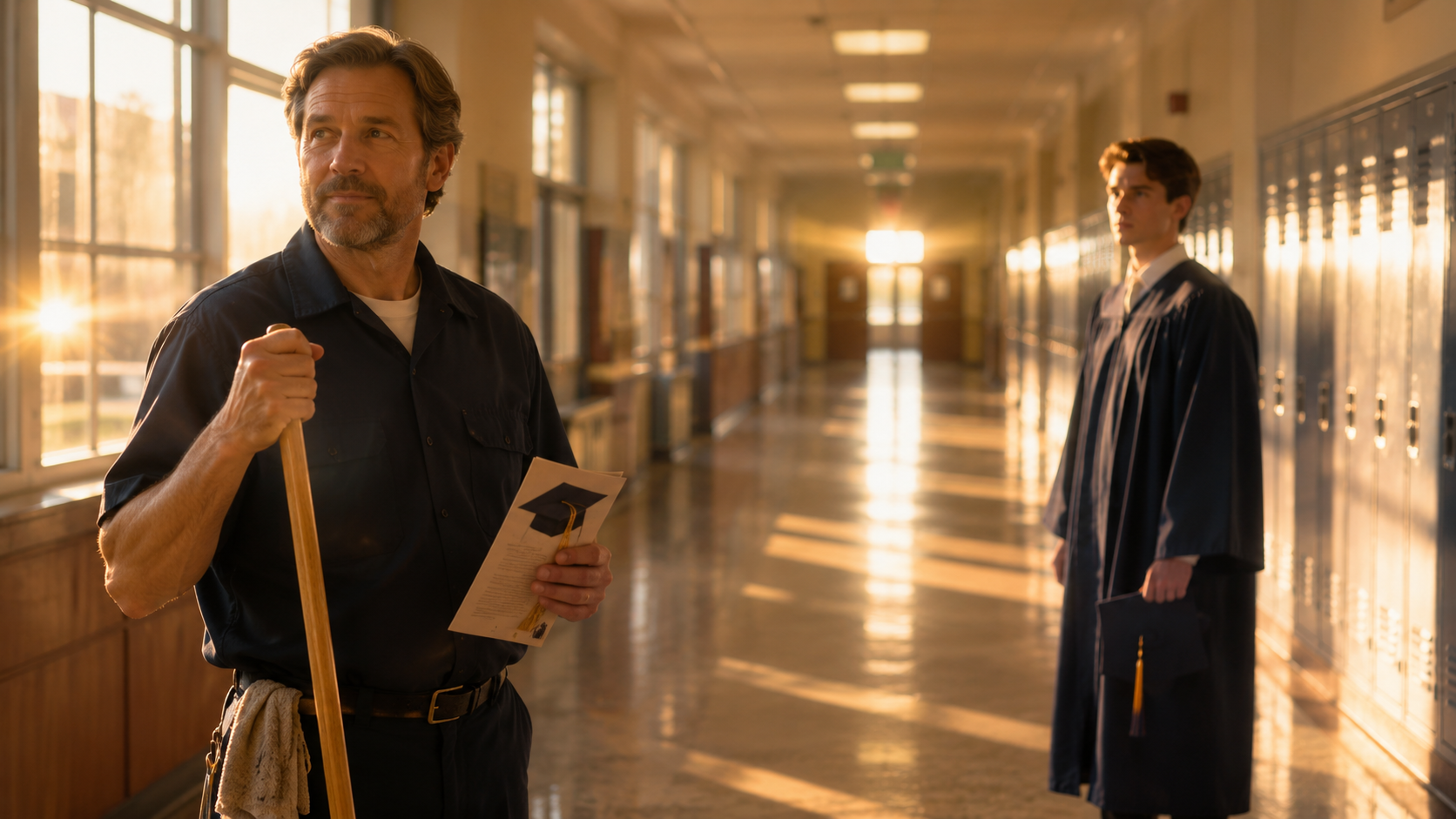
In many American towns, the school building is more than a place of learning. It is a community landmark, a space where generations pass through the same hallways, sit in the same classrooms, and carry the same hopes for a better future. For Malik Turner, a quiet eighth‑grader with a bright mind and a restless heart, the school was also the place where his greatest source of pride and his deepest source of shame lived under the same roof.
His father, James Turner, worked as the school’s head custodian. James was a tall, steady man in his late forties, known for his warm greetings and the way he hummed old Motown songs while pushing his mop bucket down the hall. To him, the job was honest work. It paid the bills, kept his son fed, and allowed him to be present in Malik’s life every single day. He believed that being close to his son was a blessing, not a burden.
But Malik didn’t see it that way.
At thirteen, he was caught in the fragile space between childhood and adulthood, where peer approval often feels more important than family loyalty. When classmates joked about “the janitor” or pointed out the man sweeping the cafeteria floor, Malik felt a sting he didn’t know how to explain. He loved his father deeply, but he feared the judgment of others even more.
As graduation approached, James grew excited. He bought a suit—slightly outdated but carefully pressed—and polished his shoes until they shined. He told coworkers he couldn’t wait to see his son walk across the stage. For him, it was a milestone not just for Malik, but for both of them. A symbol of everything they had survived together.
Graduation day arrived with folding chairs, proud families, and the smell of cafeteria cookies drifting through the gym. Malik spotted his father immediately. James stood near the entrance, smiling broadly, adjusting his tie with nervous pride. But Malik also noticed a group of boys from his class whispering and glancing in his father’s direction.
Fear tightened in his chest.
When James approached, Malik stepped forward quickly, lowering his voice. “Dad… maybe you should sit in the back. People will… you know… see you.”
James paused. The request hit him harder than Malik realized. He looked at his son—his only child, the boy he had raised alone—and saw not malice, but fear. Fear of judgment. Fear of association. Fear of being seen as the janitor’s son.
With a quiet nod, James stepped back. “If that’s what you want, son,” he said softly.
During the ceremony, Malik walked across the stage to applause, but the moment felt hollow. When he looked toward the back of the gym, he saw his father standing alone near the exit, hands clasped, eyes lowered. The empty seat beside the other parents felt heavier than the diploma in his hand.
Afterward, Malik found his father in the custodial supply closet, sitting on an overturned bucket. The suit jacket was still on, but the pride was gone from his face.
“I never wanted to be the reason you felt small,” James said quietly. “I clean floors. I fix things. I keep this place safe. That’s honest work. But I didn’t know it made you ashamed.”
The words broke something open inside Malik. He realized that the shame he carried wasn’t about his father—it was about himself. His fear. His insecurity. His inability to see the dignity in the man who had sacrificed everything for him.
“I’m sorry,” Malik whispered, tears rising. “I’m so sorry.”
James placed a hand on his son’s shoulder. “You’ll understand one day,” he said. “And when you do, you’ll stand taller than you ever thought you could.”
Years later, at his high‑school graduation, Malik did understand. He walked off the stage, took his father’s hand, and pulled him into the spotlight.
“This is my dad,” he said proudly. “The hardest‑working man I know.”
And this time, there was no shame—only honor.