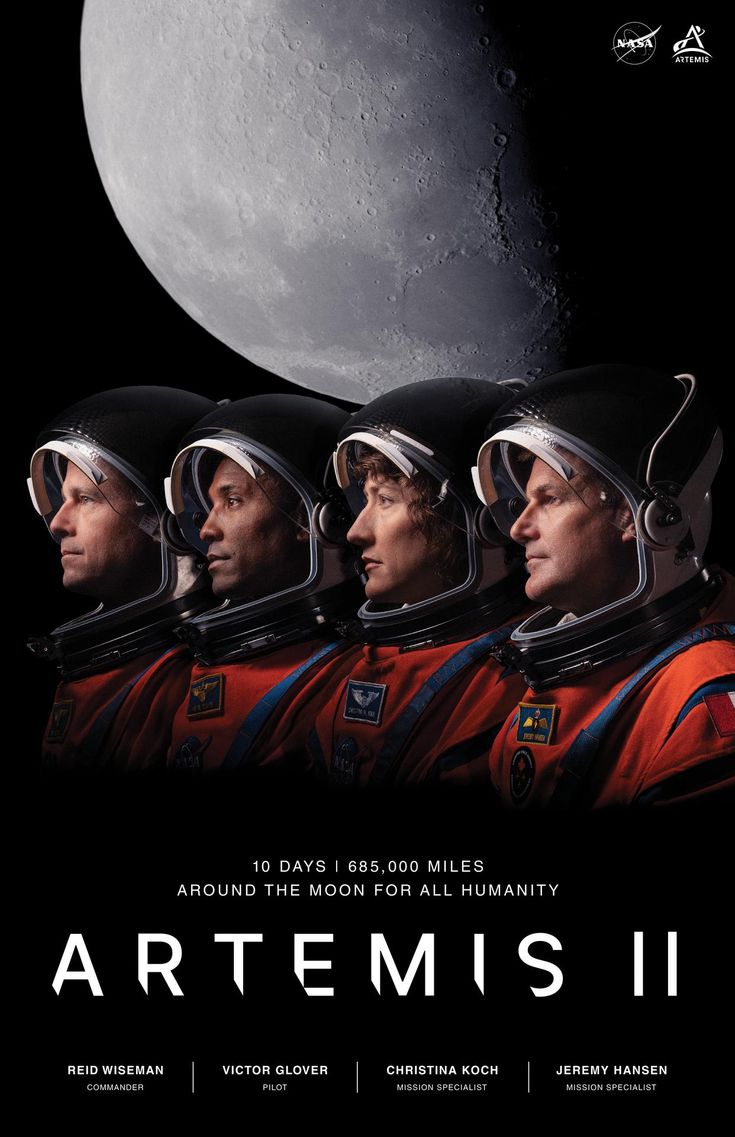
The crew of NASA’s Artemis II mission has officially traveled farther from Earth than any humans in more than half a century, surpassing a distance record that stood since the Apollo era.
At 1:58 p.m. Eastern on Monday, the Orion spacecraft reached 248,000 miles from Earth, looping behind the far side of the Moon in a sweeping arc that placed the astronauts farther from home than any crewed mission since Apollo 13 in 1970.
NASA confirmed the milestone in a live broadcast, calling it a “historic moment for a new generation of lunar explorers.”
A Historic Loop Around the Moon
The four‑person Artemis II crew — Commander Reid Wiseman, Pilot Victor Glover, Mission Specialist Christina Koch, and Mission Specialist Jeremy Hansen — completed the lunar free‑return trajectory, a maneuver that slingshots the spacecraft around the Moon using gravity rather than propulsion.
As Orion disappeared behind the lunar horizon, the crew experienced a full communications blackout, just as Apollo astronauts did decades earlier. When the spacecraft re‑emerged, the crew reported “spectacular views” of the Moon’s cratered far side — a region never visible from Earth.
“It’s humbling to be this far from home,” Wiseman said during the downlink. “You feel the scale of what humanity is capable of.”
Breaking Apollo 13’s Record
The previous record was set during the tense Apollo 13 mission, when astronauts Jim Lovell, Fred Haise, and Jack Swigert traveled roughly 248,655 miles from Earth while looping around the Moon after an onboard explosion crippled their spacecraft.
Artemis II’s trajectory was planned to exceed that distance by several hundred miles, marking the first time humans have ventured this far into deep space in more than 50 years.
NASA officials emphasized that the milestone is not just symbolic — it validates Orion’s systems for future missions, including Artemis III, which aims to land astronauts on the lunar surface.
A Mission Paving the Way Back to the Moon
Artemis II is the first crewed flight of NASA’s next‑generation deep‑space program, designed to return humans to the Moon and eventually send astronauts to Mars. The mission is testing:
- Life‑support systems
- Deep‑space navigation
- Thermal protection during re‑entry
- Crew operations in lunar‑distance conditions
NASA Administrator Bill Nelson called the achievement “a major step toward America’s return to the lunar surface.”
“This crew is carrying the hopes of the world with them,” Nelson said. “Artemis is how we build the bridge from the Moon to Mars.”
What Comes Next
Over the next several days, the crew will perform additional system checks before beginning the return journey to Earth. Orion is expected to splash down in the Pacific Ocean later this month, completing a mission that marks the most ambitious human spaceflight since Apollo.
For now, the Artemis II astronauts hold a title once reserved for the legends of the space age: the farthest humans from Earth in more than five decades.