Helen Brooks, sixty‑three, widowed, and living alone outside Cleveland, had spent years rebuilding her life after the death of her husband, Patrick. The silence of her home had once been unbearable, but sewing became her refuge — a way to keep her hands busy, her mind steady, and her heart connected to the people she loved.
Money was tight, but her gifts were never about cost. They were about care, time, and intention. Every stitch carried memory, grief, and love.
II. The Gift Made of Love, Not Money
For her granddaughter Lily’s fifth birthday, Helen spent nearly three weeks crafting a handmade doll — the most beautiful she had ever made.
A soft pink dress.
Tiny embroidered shoes.
Curly yarn hair stitched through arthritic pain.
A miniature pillow with Lily’s name sewn into it.
It was not expensive.
But it was priceless.
When Helen arrived at her son David’s home, her confidence faltered. The yard looked like a wedding venue — balloon arches, professional décor, designer cake, and mountains of expensive gifts.
Her plain brown paper bag suddenly felt small.
Insignificant.
Out of place.
David greeted her warmly, but even he admitted Amanda — his wife — had gone overboard. Appearances mattered to her. Social media mattered to her. Perfection mattered to her.
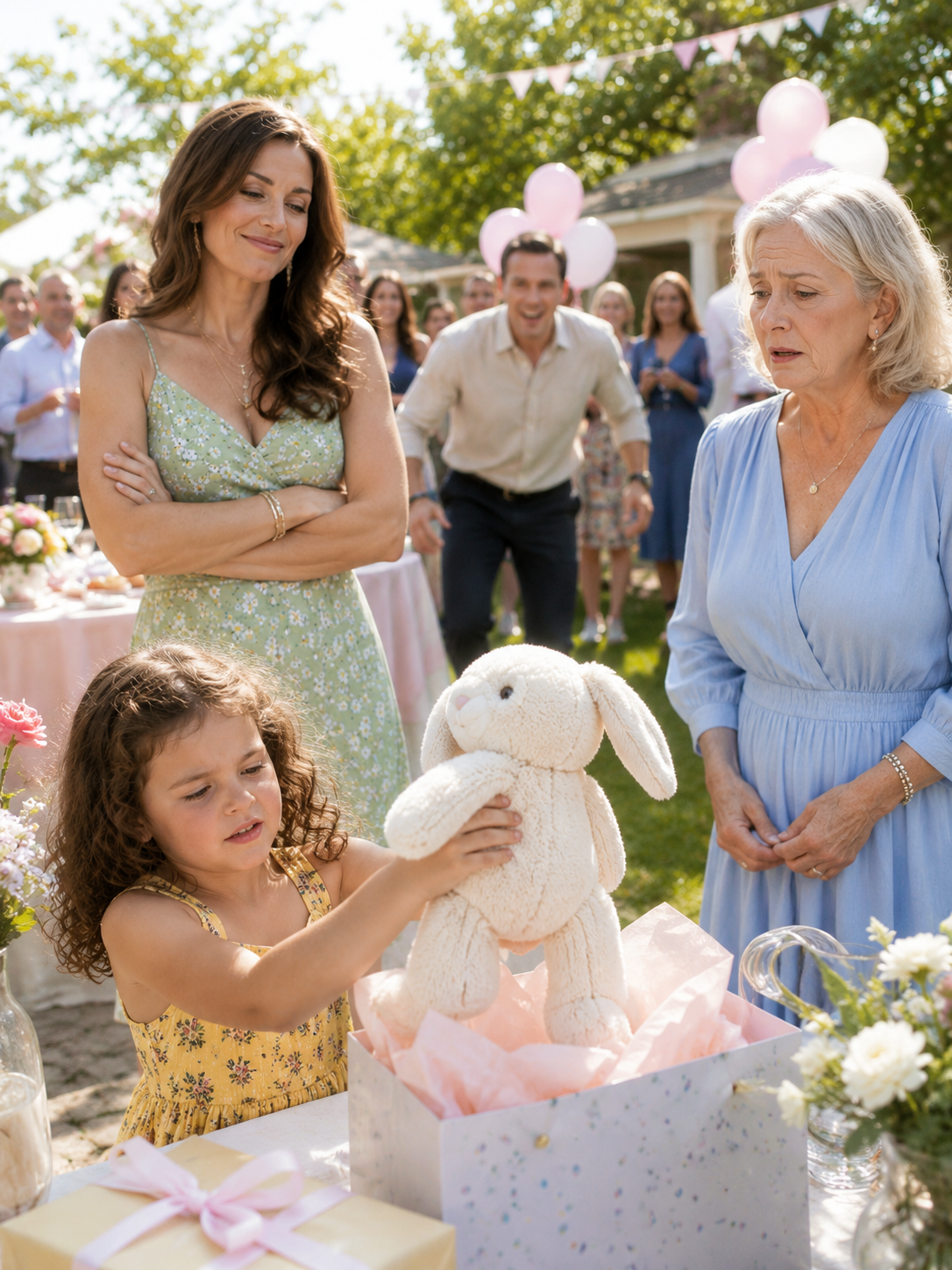
Lily ran to Helen with joy, asking about her present. Helen proudly revealed the handmade doll. Guests gathered. David admired the craftsmanship.
Helen waited for Lily’s face to light up.
Instead, the room froze.
Lily looked at the doll, then repeated words she should never have heard:
“Mom says you only give cheap things because you want people to feel sorry for you.”
The silence was immediate and suffocating.
Wine glasses paused mid‑air.
Conversations died.
Even the children stopped moving.
Helen felt the sting — not because a child had spoken them, but because she knew exactly whose voice was behind them.
Amanda’s.
A woman who valued price tags over meaning.
A woman who believed handmade meant “less than.”
A woman who had forgotten that love is not measured in dollars.
Helen did not lash out.
She did not defend herself.
She simply stood there, holding the truth of what her daughter‑in‑law had planted in her granddaughter’s heart.
VI. The Quiet Strength of a Woman Who Has Survived Worse
Helen had endured grief, loneliness, financial strain, and the slow ache of aging. She had survived the death of her husband and the hollowing silence that followed.
She would survive this too.
But she would not forget it.
And she would not allow it to continue.
The insult was not just about a doll.
It was about dignity.
About respect.
About the erosion of values in a home where appearances mattered more than sincerity.
Helen realized something in that moment:
Amanda had made a mistake.
A mistake that would echo far beyond a birthday party.
A mistake that would eventually cost her the one thing she valued most — control over the narrative.
This story is not about revenge.
It is about recognition.
It is about a grandmother who poured love into every stitch, only to have that love dismissed by someone who never understood it.
It is about the quiet power of handmade things.
The dignity of effort.
The legacy of care.
And it is about the moment Helen decided she would no longer shrink herself to fit into someone else’s idea of worth.
What comes next — the confrontation, the consequences, the shift in family dynamics — is the story’s next chapter.
But this moment, this birthday party, this single sentence spoken by a child, is the spark.
The beginning of a reckoning.
The moment Helen stopped apologizing for who she was — and started reclaiming the respect she