Two months later, Ethan died.
A heart attack. At twenty‑seven.
One moment he was texting me a grocery list. Hours later, I was standing in a hospital hallway, staring at a doctor whose lips were moving but whose words didn’t make sense. The world blurred. My legs felt hollow. My body felt like it was floating outside itself.
The funeral passed in a haze. People hugged me. People cried. People said he was too young. I held Owen through all of it because if I let go, I feared I might disappear too.
Deborah cried the loudest. Her grief was theatrical, almost performative, as if she needed witnesses to validate her pain. I tried to believe she was mourning her son. I tried to believe she would soften toward me now that we were both grieving.
I was wrong.
A week later, she came to the apartment. The lease was tied to Ethan’s family trust — something she knew well. She used her key and walked inside without knocking.
“You need to leave,” she said.
I stared at her, stunned. “Deborah… I just buried your son.”
“And now you need to move out.”
“Where am I supposed to go?”
She looked at Owen. The birthmark on his face seemed to harden her expression.
“Not my problem.”
She turned and walked out.
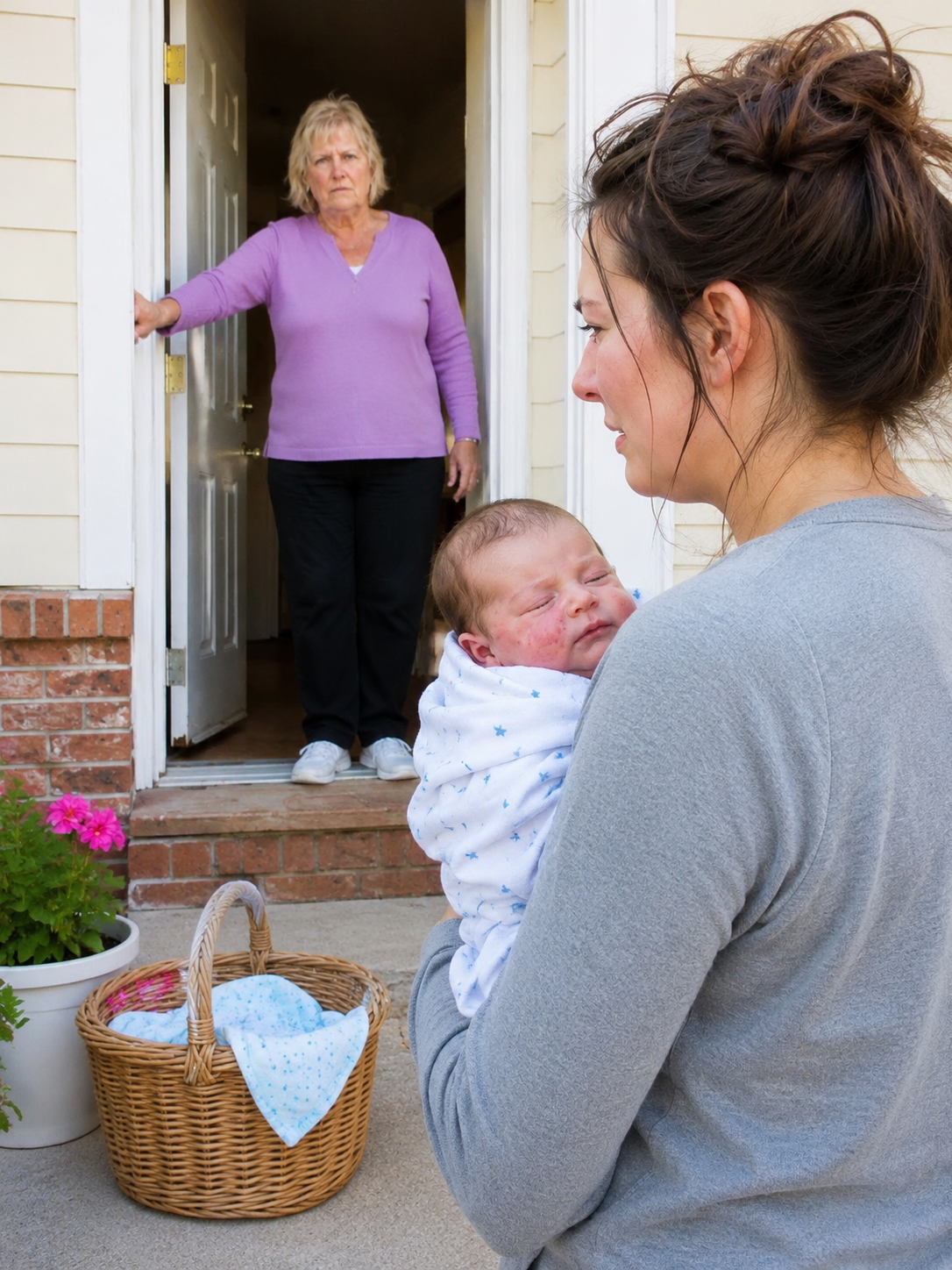
And that is how I ended up standing in the hallway with a newborn, a suitcase, and a hoodie that still smelled like the man I loved. I walked away because there was nothing else to do. I walked away because the only thing left to protect was the child in my arms.
I didn’t know then that by evening, Deborah would be calling me through tears, begging for one meeting.
I didn’t know then that the truth behind her hatred would unravel everything I thought I knew about my husband’s family.
I didn’t know then that the door she slammed in my face was only the beginning.
But that is where the story begins — with a widow in a hallway, a newborn crying softly against her chest, and a future she never asked for waiting on the other side of a slammed door.