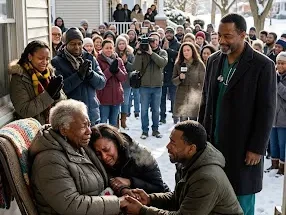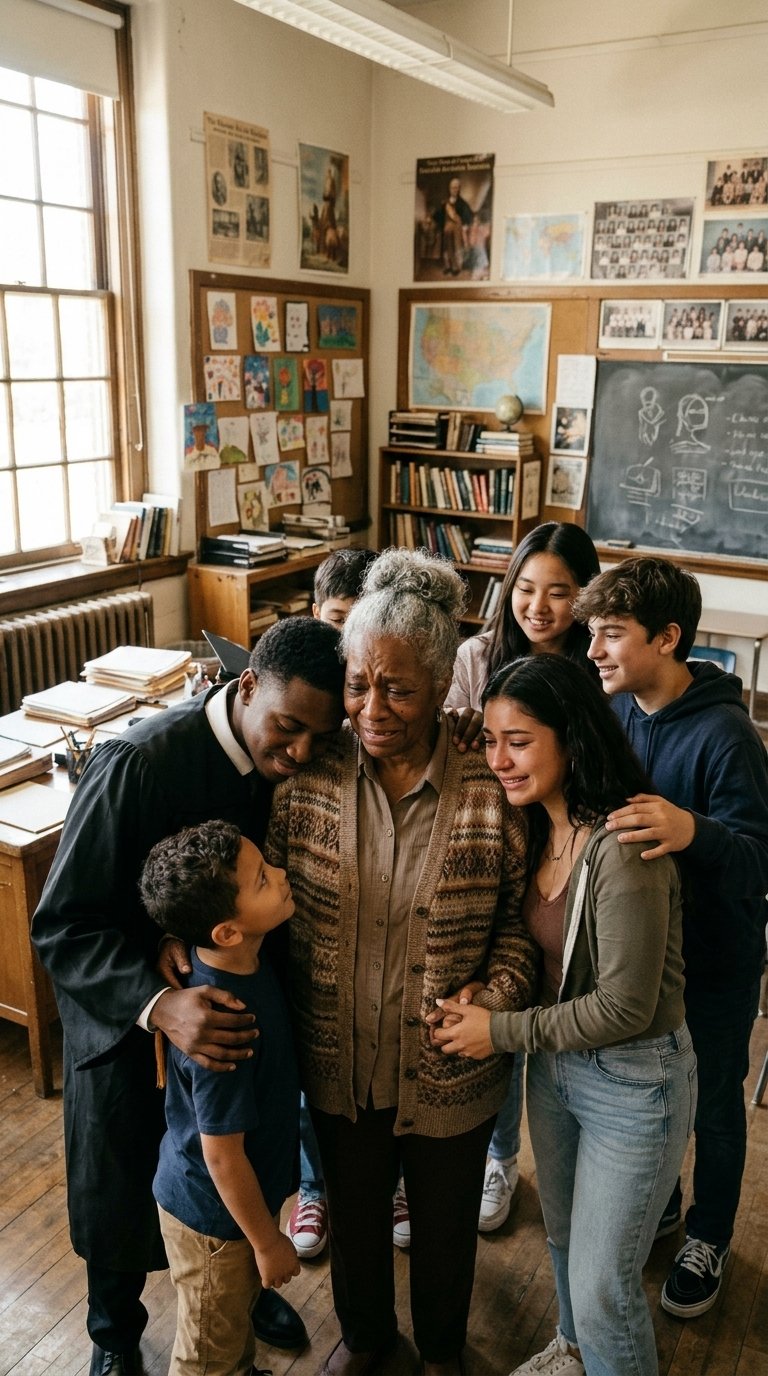
Samuel read the first line of David’s letter.
Dear Mr. Carter,
I don’t know if I will ever have the courage to tell you this in person. You probably think you only helped me pass your class, but you did something much bigger.
Samuel stopped reading.
His vision blurred.
David had been seventeen when he entered Samuel’s classroom. His mother was seriously ill, his father was absent, and the family was struggling to pay rent.
David frequently arrived late, slept through lessons, and sometimes went several days without completing his assignments.
Other teachers considered him lazy.
Samuel discovered that David was working evenings at a grocery store to help his family afford food.
One afternoon, Samuel asked him to stay after class.
“David, what do you want to do after graduation?”
The boy shrugged.
“Whatever pays enough to keep the lights on.”
Samuel studied his face.
“That is what you need to do right now. But it doesn’t have to be the only thing you ever do.”
David looked away.
“College isn’t for people like me.”
Samuel had heard those words too many times.
He refused to let another student surrender before receiving a fair chance.
He helped David research scholarships, complete applications, and prepare for entrance examinations.
When David struggled to afford transportation to a college interview, Samuel quietly helped arrange a ride.
He also contacted a local scholarship organization and wrote a detailed recommendation explaining David’s circumstances and determination.
Eventually, David received an offer to attend college with financial assistance.
But the acceptance letter arrived during a terrible week.
David’s mother had been hospitalized, and the family was behind on rent. David was considering declining the offer so he could work full-time.
Samuel visited him after school.
“You cannot solve every problem in your family’s life by giving up your own future,” he told him.
David became angry.
“You don’t understand! If I leave, who is going to help my mother?”
Samuel did not argue.
Instead, he helped David contact the college’s financial aid office and a local community organization that supported students experiencing family emergencies.
They worked together to identify available assistance and develop a realistic plan.
David eventually enrolled.
He graduated several years later and found stable work. He supported his mother, built a family, and became a mentor to young people facing the same obstacles he had once known.
Samuel received a brief letter announcing David’s graduation.
He kept it in a drawer.
He had no idea that David had spent years trying to find a way to thank him properly.
Now, in the auditorium, Samuel continued reading.
I need you to know that when you helped me, you never made me feel like a charity case. You never told the class about my problems. You never used my struggles to make yourself look generous.
You treated me like a person who deserved a future.
Samuel pressed the letter against his chest.
Denise waited patiently while he gathered himself.
Then he continued.
I wanted to come back and tell you what happened, but I kept postponing it. I thought I needed to become more successful first. I wanted to return with something impressive enough to make you proud.
I understand now that you were never waiting for me to become rich or important. You were waiting for me to believe that my life mattered.
Samuel lowered the paper.
He remembered David as a determined young man who had once sat in the back of his classroom with his head down.
He had never known the boy carried so much gratitude.
The letter continued.
If you ever read this, please understand that you did not save me because you were perfect. You saved me because you noticed when everyone else had stopped looking.
I hope you know how many lives can change when one person refuses to look away.
The final paragraph was dated several years before David died.
I am writing this because I have been diagnosed with a serious illness. I don’t know how much time I have. I wanted to thank you while I still could, but I was afraid of making the conversation sad.
If I never get the chance to see you again, please keep teaching people to believe in themselves. And please, when you grow old, do not believe that your work has disappeared simply because the children have grown up and moved away.
We carry you with us.
With gratitude,
David.
Samuel could no longer hold back his tears.
The auditorium remained completely silent.
Denise stepped beside him.
“David passed away several years ago,” she said softly. “His wife found a copy of this letter among his belongings. She gave it to us after learning about tonight’s ceremony.”
Samuel closed his eyes.
He had attended many funerals during his life. He had lost colleagues, relatives, friends, and eventually his beloved wife.
But learning that a former student had spent his final years remembering him brought a different kind of grief.
It was grief mixed with gratitude.
For decades, Samuel had wondered whether the long hours, difficult conversations, and quiet sacrifices had made any real difference.
Now he understood that he had never seen the complete picture.
Denise returned to the microphone.
“We discovered something else while preparing this ceremony,” she said.
The screen changed to a collection of photographs.
There was Michael, now a school counselor, standing beside teenagers he had helped graduate.
There was Marcus, visiting an engineering classroom and speaking to students about careers.
There was Denise, opening a community clinic that provided affordable healthcare.
There were dozens of other former students, each with a different story.
Some had become professionals.
Others were parents, skilled workers, small-business owners, or community volunteers.
Not all had become wealthy or famous. Some were still struggling. Some had experienced setbacks and difficult seasons.
But many remembered a teacher who had refused to reduce them to their worst moments.
Denise explained that they had spent months contacting former students.
They discovered that Samuel had helped far more people than anyone at the school had realized.
Some remembered the books he bought for them.
Others remembered how he defended them when they were unfairly labeled troublemakers.
One former student remembered that Samuel had sat with him after his father died because the boy was too embarrassed to cry in front of his classmates.
Another remembered that Samuel had encouraged her to become a teacher after someone told her girls from her neighborhood should choose less ambitious careers.
And one man remembered that Samuel had noticed his hearing difficulty and helped his family seek an evaluation rather than treating his silence as disobedience.
The stories differed, but they shared one important detail.
Samuel had looked beyond what other people saw.
Then Denise announced the center’s first initiative.
The Samuel Carter Center for Student Opportunity would partner with local schools and community organizations to help students access tutoring, school supplies, mentorship, and guidance about further education.
The program would also train volunteer mentors to recognize when children were struggling with circumstances outside the classroom.
Former students had contributed money, professional services, and time.
No single person could solve every problem facing children in their community. But together, they could make it easier for students to find help before giving up on themselves.
Samuel listened quietly.
Finally, he approached the microphone.
“I don’t know what to say,” he began.
The audience waited.
“I spent most of my life thinking that teaching was about preparing lessons, correcting assignments, and helping students pass examinations. Those things matter. But I have learned something tonight.”
He paused to wipe his eyes.
“Sometimes, a child walks into your classroom carrying a burden you cannot see. Sometimes, that child behaves badly, falls behind, or stops believing in the future. We must still hold children accountable. We must still teach them responsibility. But we must also ask ourselves whether we have truly understood what they are facing.”
He looked toward Denise.
“And we must never confuse a person’s circumstances with their worth.”
The audience rose again.
Samuel lifted one hand, asking them to sit.
“I also want to say something about the prejudice I experienced throughout my career.”
The room grew quiet.
“There were moments when I was judged because of the color of my skin. There were times when my abilities were questioned before my work was even examined. There were opportunities I believe I deserved but did not receive.”
He took a breath.
“I will not pretend those experiences did not hurt. They did. Racism is not made harmless simply because someone tells you to ignore it.”
Several people nodded.
“But I do not want tonight to be remembered only as a story about what was done to me. I want it to be remembered as a story about what we can choose to do for one another.”
He looked across the auditorium.
“Every child deserves a fair chance. Every teacher deserves to be judged by the quality of their work. And every community has a responsibility to make sure that a child’s future is not limited by someone else’s prejudice.”
For several seconds, nobody moved.
Then the applause began again.
After the ceremony, former students surrounded Samuel. They shared photographs, memories, and stories about their lives.
Some introduced their children and grandchildren.
One little girl approached him holding a notebook.
“My mother says you helped her become a doctor,” she said. “Will you write something for me?”
Samuel smiled.
“What would you like me to write?”
The girl thought carefully.
“Something that will help me when school gets hard.”
Samuel opened the notebook and wrote:
You do not have to know your entire future today. You only need someone who believes you can take the next step—and the courage to take it.
He handed the notebook back.
The girl hugged him.
Across the room, Denise watched with tears in her eyes.
She knew the center would require years of work. It would face financial challenges, administrative difficulties, and the same complicated social problems that had affected the community for generations.
But it had a beginning.
And that beginning had started with a teacher who refused to believe that struggling children were hopeless.
Months later, the center opened its doors.
Samuel attended the opening ceremony, though he insisted on sitting among the guests instead of standing at the front.
Children arrived carrying backpacks and questions about homework. Volunteers organized books and supplies. Former students helped families understand educational opportunities available in their area.
On the wall near the entrance was a photograph of Samuel in his classroom, surrounded by students.
Beneath it was a simple sentence:
“A child’s future should never be decided by the prejudice of others—or by the hardship of the home they come from.”
Samuel visited the center regularly.
Sometimes he helped children with mathematics. Sometimes he simply listened while they talked about problems they were afraid to share elsewhere.
He never claimed that kindness alone could erase poverty, racism, or inequality. He knew those challenges required sustained effort, fair policies, resources, and people willing to speak up when something was wrong.
But he also knew that a person who feels seen may find the courage to ask for help.
One afternoon, a teenager entered the center and announced that he was going to drop out of school.
Samuel invited him to sit.
For nearly an hour, he listened to the boy explain his family’s financial problems and his fear that education would never change his circumstances.
When the boy finished, Samuel did not promise that everything would become easy.
Instead, he helped him identify the next practical steps: speak with a school counselor, explore available financial assistance, and make a plan for completing his studies.
The boy left with an appointment, a list of resources, and a little more hope than he had carried inside.
Samuel watched him walk through the door.
Then he smiled.
For the first time in years, he no longer wondered whether his life had mattered.
He understood that a teacher’s influence could continue long after the final school bell.
And when he returned home that evening, he placed David’s letter beside a photograph of his late wife, Evelyn.
“I think you were right,” he whispered to the empty room. “They remembered.”
He sat quietly for a moment.
Then he opened the letter again and read the final sentence.
We carry you with us.
Samuel finally understood that he had never truly been forgotten.
The students had grown up. Their lives had taken different paths. Some had struggled, some had succeeded, and some were no longer alive.
But the lessons he had offered in a modest Alabama classroom had traveled farther than he could ever have imagined.
And the teacher who once wondered whether anyone remembered his name had become the person an entire community wanted its children to remember.