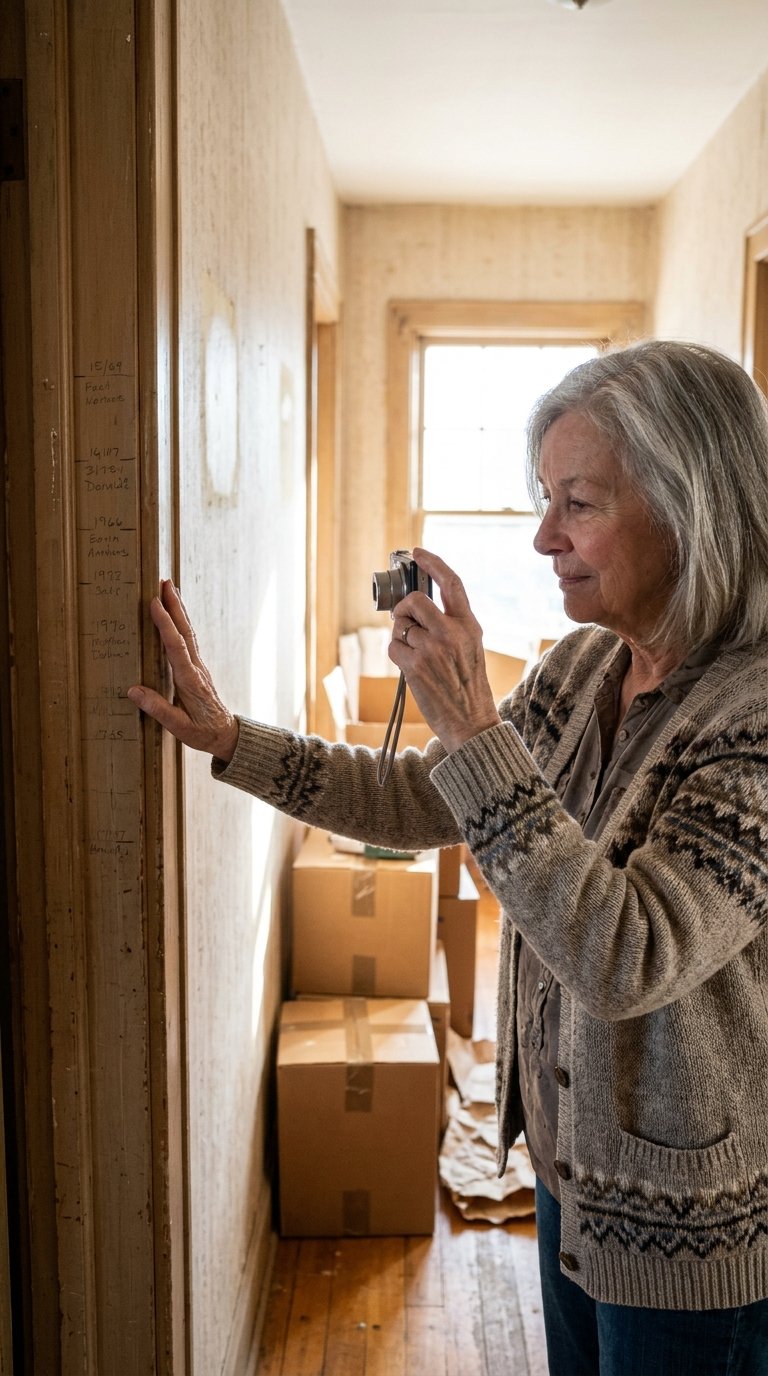
The eleven photographs of a doorframe started a conversation that three children had been avoiding for years. What they built from that conversation — and what Patricia found waiting for her six months later — is the ending the house on Cypress Lane deserved.
Mark stayed through Sunday.
He spent Saturday afternoon going through the arithmetic with his mother — not to understand what had happened, he understood that, but to understand the full picture of what the current situation looked like and what it required. He was methodical about it. He had his mother’s organizational precision and his father’s patience and he applied both to three hours at the kitchen table with Patricia’s bank statements and her monthly expenses and the Social Security income and the apartment costs.
When he finished he sat back and looked at the numbers.
“You’re managing,” he said.
“Yes,” she said.
“Barely,” he said.
“Yes,” she said.
“And one unexpected expense—”
“Would require a decision I don’t want to make,” she said. “Yes.”
Mark looked at Frank’s photograph on the sideboard — visible from the kitchen table, positioned where Patricia could see it from most of the apartment’s main spaces.
“Dad would be angry,” Mark said. “At us.”
“Your father,” Patricia said carefully, “would understand that his children have their own lives and their own obligations and that—”
“Mom,” Mark said.
She stopped.
“Dad would be angry,” he said. “And he would be right.”
Patricia looked at her son.
Mark had his father’s jaw. He always had. She had noticed it when he was seven years old and had kept noticing it across forty-seven years.
“What are you going to do?” she said.
“I’m going to call Susan and Jennifer tonight,” he said. “And we’re going to have the conversation we should have had before you sold the house.”
The conversation happened Sunday evening after Mark left for the airport.
All three of them. A video call — the first three-way call they had managed in Patricia’s memory, which told her something about the specific gravity of what the eleven photographs had produced.
Susan spoke first.
She said: “I want to say something before anything else. I knew, when Mom called about the house, that there was more I could have done. I made calculations about what I could afford to give and I landed on the check I sent for the move and I told myself it was what was available. And I’ve been uncomfortable about it since October and I’m not going to be comfortable about it anymore.”
Jennifer said: “I came for three days. I helped her pack. I flew home and told myself she was fine because she said she was fine. I knew she said she was fine the way she always says she’s fine and I went home anyway.”
Mark said: “I called the morning of the move and talked for twenty minutes about her adaptability and then I went back to my day.”
The three of them sat with this on a Sunday evening video call.
Then Susan said: “What do we do?”
What they did took six months.
Not dramatically — not with one large gesture that resolved everything. Deliberately, carefully, with the specific pace of people who are building something that needs to hold rather than something that needs to impress.
They established a shared contribution — equal thirds, automatic monthly transfer — into an account that covered the gap between Patricia’s expenses and her income and provided a buffer that meant the unexpected expense would not require a decision she didn’t want to make. Not charity. Not an allowance. A correction of the arithmetic that had been wrong for years and that all three of them had been aware of and had been finding reasons not to address.
Patricia had not wanted to accept it.
Mark had told her — on the Sunday before he left, sitting at her kitchen table — that accepting it was not weakness and not failure. It was allowing her children to do something they should have been doing and hadn’t.
“You spent our entire childhoods making sure we had what we needed,” he said. “You spent thirty-one years paying off a house so we would have something. You measured us on a doorframe every year so we would know we were growing. This is what growing looks like on our end. Let us.”
She had accepted it.
Susan flew to Florida in March.
Not for a crisis — for a visit. A real one, four days, the kind that had not happened since Frank died.
She arrived with Jennifer — they had coordinated without telling Patricia, which Patricia discovered when she opened the door to find both of them on the landing with their bags and the specific expressions of daughters who have planned something.
“You called each other,” Patricia said.
“We’ve been talking more,” Jennifer said. “Since November.”
Patricia looked at her two daughters on her doorstep.
“Come in,” she said.
They came in.
They sat at the kitchen table and talked for three days about the things that families talk about when they have stopped managing their conversations and have started having them. About Frank. About the house on Cypress Lane. About the arithmetic and what it had cost and what they wished they had done differently.
About the doorframe.
Susan had printed the photographs.
Not all eleven — the best one, the one where all the marks were visible despite the imperfect focus and the late afternoon light. She had printed it large, on good paper, in a frame she had bought before the trip.
She gave it to Patricia on the second evening.
Patricia sat at the kitchen table and held the framed photograph of a doorframe in a house she no longer owned.
Frank’s handwriting. Susan — June 1981. Mark — August 1984. Jennifer — June 1981.
The marks.
The specific record of three children growing in a house that had contained them — the most irreplaceable thing in a house that was no longer hers to keep, preserved in eleven imperfect photographs taken on a Thursday afternoon by a woman who had known, with the specific knowledge of someone who has lived long enough to understand what is worth keeping, that this was the thing that mattered.
She looked at her daughters.
“Your father measured you every year,” she said. “Every birthday. You would stand against the doorframe and try to stand taller than you actually were.”
“Did it work?” Jennifer said.
“Susan could add about half an inch,” Patricia said. “You were honest.”
Susan laughed.
Jennifer said: “I was honest or I was short?”
“Both,” Patricia said.
They laughed — the three of them, at the kitchen table in the apartment on Mercer Street — in the specific way of people who have been missing each other without fully acknowledging it and have found, in a shared joke about childhood height measurements, the specific warmth of what they have been missing.
Mark called the following week.
He had news.
He had been talking to a colleague — a woman who worked in senior housing advocacy — about the Florida property tax situation. About what had happened to Patricia and what was happening to thousands of elderly homeowners across the state in the same income bracket in the same market conditions.
The colleague had told him about a program.
A state-administered homestead protection expansion that had been passed in 2022 and that, properly applied, would have significantly reduced Patricia’s tax burden in the years that had preceded the sale. The application deadline had passed. The reduction would not have been retroactive in time to prevent the sale.
But.
“There’s a legal avenue,” Mark said. “A challenge to the reassessment based on fixed income status and the application of the protection that should have been communicated at the time of reassessment and wasn’t. Sandra — my colleague — knows a property tax attorney in Tallahassee who has done this successfully for three other clients.”
Patricia looked at her kitchen table.
“What would that mean?” she said.
“It means,” Mark said carefully, “that the reassessment that started the arithmetic might have been challengeable. And if it was challengeable, the damages from the failure to communicate the protection program might be—” He paused. “Potentially compensable.”
“Mark,” she said.
“I know,” he said. “It’s not the house. I know that. Nothing gets the house back. But it might mean something for where you are now and what the next years look like.”
Patricia sat with this.
She thought about the Friday afternoon in 2003 when she had written the check at the bank and driven home and made herself tea and told Frank they had done it.
The house was paid off.
The house was theirs.
She had believed it meant something permanent.
It had not been permanent. But it had been real. Forty-three years of real — of Frank and the children and the birthday measurements and the garden and the tomatoes and the chair by the window and thirty-one years of paying for something that was genuinely hers.
The permanence had not held.
The forty-three years had.
Nobody could challenge that.
“Call the attorney,” Patricia said.
The legal process is ongoing.
I want to say this clearly because the honest ending is not the tidy one — the case has been filed and is progressing with the specific pace of legal proceedings that involve bureaucratic failures and fixed-income claimants and a state that does not move quickly on things it would prefer not to move quickly on.
Patricia’s three children are paying the legal costs together. Equal thirds. Automatic transfer.
Patricia lives in the apartment on Mercer Street.
She has a new chair by the window. Not the old one from Cypress Lane — that one developed a structural issue in the move and had to be retired, which Patricia described as the chair having made a decision about its own future that she respected. The new chair is different but comfortable and the parking lot view from it has become, across several months, familiar in the way that things become familiar when you allow them to.
She has been to the community room twice. There is a woman named Dorothy who plays cards on Wednesday afternoons and who has Frank’s specific way of laughing too loudly at her own jokes and who Patricia has decided she likes for reasons she has not fully explained to herself.
Susan calls on Sundays. Mark calls on Wednesdays. Jennifer calls when she has something to say, which is more often than it used to be.
The framed photograph of the doorframe hangs in the kitchen — beside the window, at eye level from the kitchen table. Patricia can see it from her chair.
Frank’s handwriting. The marks. The children who tried to stand taller than they were.
She photographs it sometimes with her phone, though she already has eleven photographs and a framed print and does not need more.
She photographs it because some things deserve to be seen again and again — not because you have forgotten them but because seeing them reminds you of what you are carrying and why the carrying is worth it.
The house on Cypress Lane has new owners.
She drove past it once, in Mark’s rental car when he visited in February.
She did not stop.
She did not need to.
The house was in the past. The doorframe was on her kitchen wall.
She had taken what mattered when she left.
She had always known how to take what mattered.
— As told by the woman who measured her children against a doorframe every birthday and photographed every mark when she had to leave, and who built what she needed from what she carried.