PART 2
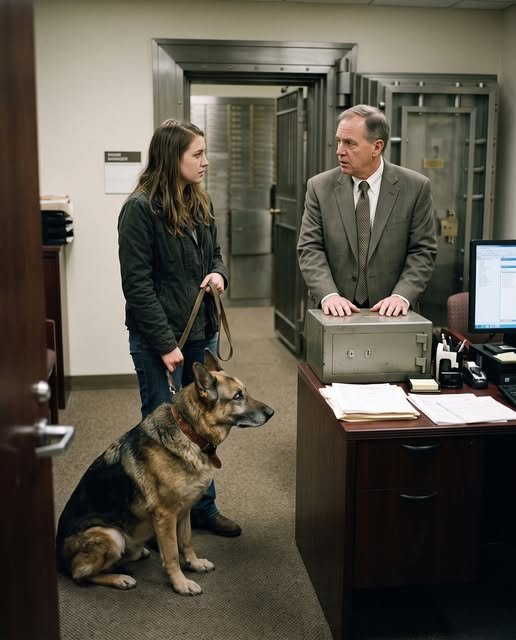
The first thing Daniel Mercer did when he saw Max was close his office door.
The second was kneel beside him.
“Hello, old friend,” he whispered.
Max lifted his graying muzzle. His cloudy eyes couldn’t see the man standing before him, but his ears twitched at the familiar voice. Then his tail began moving slowly against the polished floor.
I stared at the bank manager.
“You know my grandfather’s dog?”
Mr. Mercer looked up at me. His expression was so serious that I tightened my grip on Max’s leash.
“Miss Vance, your grandfather brought Max here several times during the final months of his life. He wanted me to recognize him.”
I swallowed. “Why?”
Mr. Mercer stood and glanced at the small brass key in my hand.
“Because Arthur believed there might come a day when someone would need to bring me that dog to prove they’d followed his instructions.”
He looked toward the door.
“Come with me, Ellie. Your family has no idea what your grandfather prepared.”
I followed him down a quiet corridor toward the bank’s private vault.
Max walked slowly beside me, his nose working constantly as he investigated the unfamiliar scents. Every few steps, he brushed his shoulder against my knee.
I’d been caring for him since his eyesight began failing. Grandpa used to say Max didn’t need to see the world as long as he knew who was walking beside him.
That morning, I wished Grandpa were there to explain what was happening.
Mr. Mercer stopped outside a private viewing room.
“Before we go any further, I need you to understand something,” he said.
I looked at him.
“Your grandfather didn’t leave you here to beg for help. He left you here because he trusted you with something extremely important.”
My heart began pounding.
“What?”
Mr. Mercer pointed toward the key.
“Let’s open the box first.”
Inside the viewing room, he placed a heavy safe-deposit box on the table. He completed the bank’s required verification procedures, then slid the box toward me.
I inserted the brass key.
It turned with a quiet click.
Inside were three things.
A thick folder tied with a blue ribbon.
A sealed envelope with my name written across the front.
And a flash drive labeled in Grandpa’s handwriting.
ARTHUR’S FINAL WORD.
I stared at the contents.
Then I looked at Mr. Mercer.
“What is all this?”
He pulled out a chair.
“Sit down, Ellie.”
I sat.
Max lowered himself beside my feet with a tired sigh.
Mr. Mercer opened the blue folder.
“Your grandfather established an irrevocable trust five months before his death. His attorneys completed the necessary transfers and placed his major assets under that trust’s ownership.”
I frowned.
“But yesterday, his lawyer read the will.”
“Yes.”
“Aunt Linda inherited the mansion. Brandon got three million dollars, and Vanessa got two million.”
Mr. Mercer nodded.
“That was the distribution your family believed would take effect.”
I felt cold.
“Believed?”
He turned the first page toward me.
“The document read yesterday came from an earlier version of Arthur’s estate plan. It did not reflect the later transfers and amendments your grandfather legally completed before his death.”
I stared at the page.
Then I saw my name.
ELEANOR GRACE VANCE.
Beneath it were the words:
Primary Beneficiary and Designated Successor Trustee.
I blinked.
Once.
Twice.
Then looked at Mr. Mercer.
“There must be a mistake.”
He shook his head.
“There isn’t.”
He turned another page.
“Arthur placed his controlling business interests, investment holdings, and the family estate under arrangements intended primarily for your benefit. The trust assets were most recently valued at approximately thirty-four million dollars.”
My breath caught.
Thirty-four million?
I looked down at Max.
He was sleeping peacefully beneath the table.
Yesterday, I hadn’t known whether I could afford his next veterinary appointment.
Now someone was telling me Grandpa had left me thirty-four million dollars.
I began shaking.
“But Linda has the mansion.”
Mr. Mercer looked at me.
“No, Ellie. The trust owns the mansion.”
I stared at him.
“And Brandon and Vanessa?”
“The substantial payments they were expecting are not distributions they can simply collect. The earlier paperwork doesn’t give them ownership of assets Arthur had already transferred elsewhere.”
I covered my mouth.
For six years, I had cleaned Grandpa’s house, cooked his meals, tracked his medication, and helped him through frightening nights when he couldn’t breathe.
I never asked how much money he had.
When he offered to pay me, I refused.
He eventually insisted on covering some of my groceries and transportation.
Even then, I felt uncomfortable accepting.
And now, apparently, he’d been making arrangements that would change the rest of my life.
My eyes filled.
“Why didn’t he tell me?”
Mr. Mercer’s expression softened.
“There’s something in the envelope that may answer that.”
I picked it up.
My name was written across the front.
The handwriting was unmistakable.
Grandpa always made his capital letters too large.
I opened the envelope.
Inside was a letter.
My dearest Ellie,
If you’re reading this, my old friend Max has successfully delivered you to the one place I knew you would never think to visit on your own.
A tear slipped down my cheek.
I continued.
I’m sorry for making you discover everything this way.
I know you’ll have questions.
You deserve answers.
For years, I watched the people closest to me speak about my possessions as though I were already gone. Linda wanted the mansion. Brandon wanted the company accounts. Vanessa wanted money for a life she’d never bothered to build.
And you?
You wanted me to eat my breakfast.
I laughed through my tears.
Grandpa had been terrible about breakfast.
He always claimed coffee counted.
I kept reading.
You worried when my ankles swelled. You noticed when my breathing changed. You remembered which medicine made me sick and which chair hurt my back.
When I was afraid of dying, you didn’t tell me not to be afraid.
You sat beside me until I felt less alone.
My hands shook.
I did not create this trust because you were poor or because I wanted to make other people jealous.
I created it because I wanted the person responsible for protecting what I built to understand that money is only useful when it serves something greater than itself.
I also knew that if you believed I was giving you a fortune, you would spend your final months with me worrying that someone might think you were doing it for the money.
I wanted you to have those months without that burden.
Tears rolled onto the paper.
The provisions concerning Max were my way of ensuring you would receive the instructions privately. Your interests were legally established before I died. You did not have to earn your worth by passing a game.
But I knew the way you cared for him would tell me something important about the woman you’d become.
Then came the sentence that made me break down.
“Ellie, I trusted you with my life long before I trusted you with my money.”
I pressed the letter against my chest.
For several minutes, I couldn’t speak.
Mr. Mercer waited.
When I finally looked up, he had tears in his eyes too.
“Your grandfather was a remarkable man,” he said.
I nodded.
“He was.”
Then I looked at the flash drive.
“What is that?”
Mr. Mercer pulled a laptop from the cabinet.
“Arthur asked that you watch this before making any decisions about the estate.”
He connected the drive.
A video appeared.
And suddenly, my grandfather was sitting in front of me.
Alive.
Wearing his favorite blue cardigan.
His silver hair combed neatly to one side.
Max resting beside his chair.
I covered my mouth.
“Grandpa…”
On the screen, Arthur smiled.
“Well, hello, Ellie.”
I began crying.
He continued.
“If Daniel’s doing his job, you’re probably sitting in a room wondering why your stubborn old grandfather couldn’t just write everything down properly.”
I laughed through my tears.
“That sounds like him,” Mr. Mercer whispered.
Grandpa leaned forward.
“First things first. Take care of Max. He has been my best friend for fourteen years, and I expect him to receive the same treatment I did.”
He paused.
“Actually, better treatment. That dog never complained about my cooking.”
I laughed again.
Then his expression changed.
“Ellie, I need to tell you something about Linda.”
My smile faded.
Grandpa looked down at a paper in his hands.
“Six months ago, your aunt came to see me with documents prepared by an attorney I didn’t know. She wanted me to give her immediate control over several properties and investment accounts.”
My stomach tightened.
“She told me it would simplify things when I died. But when I asked whether you would be protected, she said you were just hired help who happened to be family.”
I felt my chest tighten.
Grandpa continued.
“That was the day I understood how little she valued what you had done for me.”
He paused.
“I didn’t sign.”
Then he looked directly into the camera.
“I consulted my own attorneys. We reviewed my finances, my wishes, and how to protect the estate from decisions made under pressure.”
His voice softened.
“I knew there might be arguments after I died. There usually are when money is involved.”
He gave a sad smile.
“But I hoped there might also be a little decency.”
I wiped my cheeks.
“I’m sorry, Grandpa,” I whispered.
On the screen, he continued.
“Whatever happens, Ellie, don’t let the money make you hard. And don’t let anyone convince you that you must keep accepting cruelty to prove you have a good heart.”
He looked down toward Max.
“Take that old boy somewhere peaceful. Give him soft blankets and all the time he has left.”
Then he smiled.
“And get yourself a decent winter coat. I’ve seen that one you keep wearing. It isn’t fooling anybody.”
I laughed so hard I started crying again.
Grandpa’s expression became tender.
“One last thing, sweetheart.”
He leaned forward.
“Thank you for staying.”
The video ended.
I sat staring at the black screen.
For six years, I had believed I was giving Grandpa something small.
Meals.
Medicine.
Company.
An extra blanket.
A hand to hold when he was frightened.
But he had seen every bit of it.
And somehow, he’d understood what those years cost me.
I looked toward Max.
He lifted his head when I reached down.
I scratched behind his ears.
“We’re going to be okay, buddy.”
Mr. Mercer quietly closed the laptop.
Then he said something that brought me back to reality.
“Ellie, we need to discuss what happens next.”
I looked up.
“Linda?”
He nodded.
“And your cousins.”
I swallowed.
“Are they going to fight this?”
“Possibly.”
He adjusted his glasses.
“Your grandfather anticipated that. The trust was prepared with independent legal advice, documented asset transfers, and supporting records of his decision-making capacity.”
I nodded.
“There’s another matter involving the mansion.”
I looked at him.
“What?”
“Arthur arranged for certain outstanding obligations connected with the property to be handled through the trust. The records also identify substantial property-related liabilities and deferred maintenance, together approaching four hundred thousand dollars.”
I stared at him.
“Four hundred thousand?”
“Yes. Your relatives have been discussing the mansion as though it is an unrestricted prize. They don’t understand the legal ownership or the financial responsibilities attached to maintaining an estate of that size.”
He paused.
“They also don’t know that you control what happens next, subject to the trust’s terms.”
My hands began trembling again.
“Then what should I do?”
Mr. Mercer looked at Max.
Then back at me.
“Your grandfather hired good attorneys. Let them handle the legal process.”
He smiled faintly.
“And don’t make any decisions while you’re angry.”
That last sentence sounded so much like Grandpa that I almost expected to hear him laughing behind us.
But I was angry.
More than I’d been in my entire life.
I remembered Aunt Linda kicking Max.
I remembered Brandon laughing when I received his leash.
I remembered Vanessa taking photographs of the mansion’s dining room before Grandpa had even been buried.
I remembered walking out with one suitcase while my grandfather’s relatives celebrated becoming rich.
I wanted them to know.
I wanted them to feel what they’d done.
And that afternoon, they did.
Aunt Linda was hosting a celebration at the mansion when we arrived.
The circular driveway was filled with expensive cars.
A catering van stood beside the garage.
Through the front windows, I could see people carrying champagne glasses.
My grandfather hadn’t even been dead a week.
And his daughter was throwing a party.
Max stepped out of the taxi carefully.
I helped him onto the pavement.
Mr. Mercer stood beside me, carrying the documents we’d reviewed with counsel.
An estate attorney accompanied us.
Before approaching the house, he explained that the trust’s ownership and the family’s occupancy needed to be addressed through the proper legal procedures.
The necessary notices had been prepared.
Further court action would follow if Linda refused to cooperate.
I understood.
I didn’t want anyone claiming later that I’d acted unlawfully.
I wanted the truth established where nobody could erase it.
We walked toward the front steps.
Linda came outside holding a glass of champagne.
She stopped when she saw us.
“Well, look who crawled back.”
Brandon appeared behind her.
Vanessa stood beside him with her phone in her hand.
Linda looked down at Max.
Then smiled cruelly.
“Couldn’t find anyone willing to take that worthless animal?”
I felt Max press against my leg.
I tightened my grip on his leash.
Mr. Mercer stepped forward.
“Mrs. Miller, my name is Daniel Mercer. I represent First Heritage Bank in matters connected with your father’s trust.”
Linda frowned.
“Trust?”
He nodded.
“We need to discuss the legal ownership of this property and the estate assets.”
She laughed.
“Oh, please. The will was read yesterday.”
“Yes,” Mr. Mercer replied.
“And?”
“The assets you’ve been celebrating were transferred under legally completed estate-planning arrangements before Arthur’s death.”
Linda’s smile faltered.
“What are you saying?”
The attorney opened his folder.
“Mrs. Miller, the mansion is held by the Arthur Vance Family Trust. The earlier testamentary documents do not transfer it to you.”
For a moment, Linda simply stared.
Then she laughed again.
“That can’t be right.”
Brandon stepped forward.
“Grandpa left us millions.”
The attorney looked toward him.
“The anticipated distributions you’ve described are not supported by the currently effective documents governing those assets.”
Brandon’s face reddened.
“What?”
Vanessa stopped recording.
Mr. Mercer continued.
“Your grandfather established the trust five months before his death. The trust documents identify Eleanor Vance as the primary beneficiary and designated successor trustee, with professional assistance for the administration.”
Linda stared at me.
“Ellie?”
I said nothing.
Her expression changed.
Then she looked toward Max.
“No.”
Mr. Mercer remained calm.
“Yes.”
She shook her head.
“This is a joke.”
The attorney handed her the formal notice.
“You should obtain independent legal counsel. The ownership records and supporting documents can be reviewed through the appropriate proceedings.”
Linda looked at the pages.
Her hands began trembling.
“Arthur would never do this.”
For the first time, I spoke.
“Grandpa did.”
She turned toward me.
Her face twisted with anger.
“You manipulated him.”
I stared at her.
For six years, I’d helped Grandpa into bed, cleaned his wounds after surgery, managed his medication, and sat beside him during the nights when his breathing frightened us both.
Linda had visited twice.
And now she was accusing me of manipulation.
I took a slow breath.
“Linda, I didn’t even know about the trust until this morning.”
She laughed bitterly.
“You expect me to believe that?”
I looked at her.
“No. I don’t expect you to believe anything I say.”
Then I continued.
“But the documents exist, and Grandpa’s attorneys can explain them.”
Brandon stepped forward.
“You can’t take this house!”
I looked toward him.
“Brandon, I didn’t come here to take anything from you.”
He pointed toward the mansion.
“That’s our inheritance!”
I felt something inside me become very still.
“No,” I said quietly.
“It was Grandpa’s property. He had the right to decide what happened to it.”
Vanessa began crying.
“But he promised us money!”
I looked at her.
“Then you’ll need to discuss what was actually promised with the estate attorney.”
She wiped her eyes.
“Ellie, this is going to ruin everything.”
I remembered the laughter from the day before.
The way she’d looked at Max.
The way Brandon had made jokes about me living in a tiny apartment.
And I asked one question.
“Vanessa, did you worry about ruining my life when you watched your mother throw me and a blind dog out of Grandpa’s house?”
She went silent.
Linda suddenly stepped closer.
“Get off my property.”
The attorney looked at her.
“Mrs. Miller, the legal notices explain the ownership situation. We strongly recommend you speak with counsel before taking further action.”
She stared at him.
Then at Mr. Mercer.
Then at me.
For a moment, I thought she might start screaming.
Instead, she whispered, “Arthur loved me.”
My anger faltered.
Because beneath everything, that might have been true.
Grandpa had loved his daughter.
He’d spoken about her when she was little.
He’d kept her school photographs.
He’d remembered the day she learned to ride a bicycle.
But love hadn’t prevented him from seeing the woman she’d become.
I looked at Linda.
“I think he did love you.”
Her eyes filled.
“Then why?”
I swallowed.
“Maybe because he wanted you to remember that being his daughter wasn’t the same as being entitled to everything he owned.”
She stared at me.
I took Max’s leash and stepped away.
The legal process would continue.
The attorneys would handle the notices, the ownership records, and any challenges.
But there was nothing more I needed to say that afternoon.
As we walked back toward the waiting car, Max stopped.
He turned his head toward the house.
His nose moved slowly through the air.
Then he gave a small whine.
I knelt beside him.
“It’s okay, buddy.”
He rested his muzzle against my hand.
I looked toward the mansion.
For a moment, I imagined Grandpa standing on the porch, holding a coffee mug and calling Max inside.
My throat tightened.
Then I whispered, “I miss him too.”
The following weeks were not the triumphant celebration people might imagine.
I didn’t immediately move into the mansion.
I didn’t buy an expensive car.
I didn’t quit my job the moment I learned about the money.
I spent most of my time speaking with attorneys, reviewing documents, and trying to understand the responsibilities Grandpa had left me.
Mr. Mercer introduced me to an independent financial adviser.
We discussed the family businesses.
The trust’s holdings.
Taxes.
Property expenses.
And the importance of professional oversight.
I quickly learned that having access to a substantial estate was not the same as having thirty-four million dollars sitting in a checking account.
There were companies to manage.
Investments to review.
Employees whose jobs depended on responsible decisions.
And properties requiring maintenance.
Grandpa had spent a lifetime building those things.
I wasn’t going to destroy them because I suddenly had the authority to make decisions.
But Aunt Linda wasn’t finished.
Three weeks after the bank meeting, her attorney challenged the trust arrangements.
She claimed Grandpa had been too ill to understand what he was signing.
She accused me of exerting undue influence.
And she demanded an investigation into the changes.
The accusations hurt.
Not because I thought they’d succeed.
Because they turned the final months of Grandpa’s life into something ugly.
Every appointment.
Every hospital visit.
Every night I stayed beside him.
Linda’s lawyers wanted those moments examined as though caring for someone might have been part of a scheme.
Fortunately, Grandpa had prepared carefully.
His attorneys had documented the execution of the trust and his instructions.
Medical records and independent assessments supported his capacity at the relevant times.
The asset transfers had been completed while he was alive.
And the professionals involved were able to explain how the documents were prepared.
The video he’d left wasn’t the only proof of his wishes.
It was simply the most personal.
The dispute took months.
There were uncomfortable meetings.
Legal expenses.
And several occasions when I wanted to tell everyone they could keep the money if it meant leaving me alone.
But Mr. Mercer reminded me of something.
“Ellie, your grandfather didn’t ask you to fight because you’re greedy. He asked you to protect the decisions he made.”
That helped.
A little.
Eventually, the challenge was resolved in favor of the trust’s ownership and validity. Linda and her children received no claim to the millions they’d expected under the earlier plan.
By then, they’d already made financial decisions based on money they didn’t possess.
Brandon had placed a deposit on an expensive car.
Vanessa had begun planning a luxury vacation.
Linda had contacted contractors about remodeling the mansion.
Those decisions became their own problems to untangle.
The attorneys arranged an orderly process for Linda to remove her belongings from the house.
I insisted that nobody be humiliated or put at risk.
I knew what it felt like to stand outside with everything you owned in a suitcase.
I wasn’t going to become cruel simply because I finally had the power to be.
But I also wasn’t going to let Linda remain indefinitely in a property she had no right to control.
She eventually left.
And the mansion was quiet again.
The first time I returned alone, I brought Max.
The front door opened into the familiar entrance hall.
Grandpa’s old clock was still ticking.
The framed family photographs remained along the staircase.
And the air smelled faintly of cedar polish.
Max lifted his head.
Then began walking slowly.
He knew the house.
Not by sight anymore.
By memory.
By scent.
By the particular sounds his paws made on the polished floor.
He moved through the hallway and stopped outside Grandpa’s study.
I opened the door.
Max stepped inside.
Then went directly to the old leather chair beside the window.
He lowered himself onto the rug.
And sighed.
I stood watching him.
For fourteen years, that had been his place.
Grandpa used to read there every evening.
Max would lie beside him, waiting for the occasional biscuit or scratch behind the ears.
I remembered walking into that room after Grandpa’s first heart surgery.
He was sitting in the chair with a blanket over his knees.
Max rested beside him.
When he saw me, Grandpa smiled.
“Ellie, my two favorite people are here.”
I laughed.
“Max isn’t a person.”
Grandpa looked offended.
“Don’t tell him that. He’ll never forgive you.”
Standing in the empty study, I remembered his voice so clearly that my knees weakened.
I sat in the chair.
Max lifted his head.
Then nudged my hand.
I began crying.
“Oh, buddy.”
I scratched behind his ears.
“I don’t know how to do this without him.”
Max rested his chin against my knee.
And for a long time, we sat there together.
I had inherited money.
Property.
Businesses.
More responsibility than I’d ever imagined.
But the one person I wanted to ask for advice was gone.
And nothing in that vault could bring him back.
A month later, something happened that surprised me.
Vanessa called.
I almost didn’t answer.
But I remembered the little girl she used to be.
The one who spent summers at Grandpa’s house and insisted Max sleep beside her bed.
So I picked up.
“Hello?”
“Ellie?”
“Yes.”
Her voice trembled.
“Can we talk?”
I hesitated.
“About what?”
“Grandpa.”
That surprised me.
Not money.
Not the mansion.
Grandpa.
We met at a small café near my apartment.
Vanessa arrived wearing jeans and a plain sweater.
She looked tired.
Nothing like the confident woman who’d laughed during the will reading.
We ordered coffee.
Then she began crying.
“I’m sorry.”
I looked at her.
“For what?”
She wiped her eyes.
“For the way we treated you.”
I remained quiet.
She continued.
“I keep thinking about that day. Mom laughing. Brandon making jokes. Me standing there watching.”
Her voice cracked.
“And I didn’t say anything.”
I took a breath.
“No.”
She nodded.
“I know.”
For a while, we sat quietly.
Then she whispered, “I used to love Grandpa.”
My chest tightened.
“I know.”
She looked down.
“When I was little, he’d take me fishing. He’d bring me hot chocolate when it was cold. He used to say I was his favorite troublemaker.”
I smiled sadly.
“He said that about all of us.”
Vanessa laughed through her tears.
Then her expression fell.
“Somewhere along the way, I stopped visiting.”
I waited.
She continued.
“I was always busy. Work. Friends. Plans.”
Her voice broke.
“And whenever Mom talked about Grandpa, she talked about what he was going to leave us.”
I looked down at my cup.
Vanessa swallowed.
“I think I started seeing him the same way.”
Tears filled her eyes.
“Then he died.”
She covered her face.
“And the first thing I did was ask about the money.”
For the first time, I saw genuine shame in my cousin’s expression.
Not because she’d lost an inheritance.
Because she finally understood what she’d lost long before Grandpa died.
I reached across the table.
“Vanessa, Grandpa loved you.”
She began crying harder.
I continued.
“But he wanted to be loved while he was alive.”
She nodded.
“I know.”
Then she asked quietly, “Can I see Max sometime?”
I studied her face.
She wasn’t asking for access to the mansion.
Or the trust.
She was asking about an old dog.
The same dog she’d laughed at receiving as my inheritance.
I took a slow breath.
“Yes.”
She started crying again.
“Thank you.”
But I added something important.
“Vanessa, this doesn’t change the estate.”
She nodded quickly.
“I know.”
“And it doesn’t mean everything is forgotten.”
“I understand.”
I looked at her.
“Then we can start with coffee. And maybe a visit with Max.”
She smiled through her tears.
For the first time in months, I felt the faint possibility that one relationship in our family might become something healthier.
Not because I had money.
But because Vanessa had finally stopped talking about it.
Max’s health became my greatest concern.
He was fourteen.
Blind.
Arthritic.
And beginning to have trouble climbing stairs.
I took him to a veterinary specialist.
The veterinarian examined him carefully.
Then explained that Max’s age and medical conditions meant we should focus on keeping him comfortable.
There were treatments that could help his joints.
Changes we could make at home.
And signs I should watch for as he grew older.
I listened to every word.
Then I made a decision.
I wasn’t moving into Grandpa’s enormous mansion.
Not while Max was alive.
It had too many stairs.
Too many rooms.
Too many slippery floors.
Instead, I purchased a modest single-story house with a fenced backyard.
It had wide doorways.
A sunny living room.
And a small garden.
Nothing extravagant.
Just somewhere peaceful.
I placed rugs along the hallways to help Max navigate.
Set up his bed beside my own.
And made sure his food and water stayed in the same place every day.
The first evening we moved in, he wandered slowly through the rooms.
Sniffing.
Listening.
Investigating.
Then he found his bed beside the fireplace.
He circled three times.
Lay down.
And sighed.
I sat on the floor beside him.
“Well, buddy.”
I smiled.
“I think we’re home.”
I looked around the little house.
Then whispered, “Grandpa would’ve liked this.”
And I believe he would have.
Six months after Grandpa’s death, I made another important decision.
I was not going to spend the rest of my life simply managing investments.
I had worked as a nursing assistant for years.
I knew what it meant to care for people whose bodies could no longer do the things they once had.
I knew how frightening illness could be.
And I knew how often caregivers sacrificed their own health, careers, and financial security while looking after someone they loved.
During Grandpa’s final years, I sometimes worked an evening shift and then stayed awake all night monitoring his breathing.
There were days I barely ate.
Days I slept four hours.
Days I wondered whether I could continue.
But I did.
Because he needed me.
And because I loved him.
Now I had the chance to help people in similar situations.
With professional advice, I established a charitable foundation in Grandpa’s name.
The Arthur Vance Caregiver Support Fund.
Its first program offered financial assistance and respite services to family caregivers caring for older adults with serious medical needs.
A separate program supported the medical care and adoption of elderly dogs.
That part was for Max.
Grandpa had always been upset by the number of senior animals surrendered when their owners became ill or died.
He used to say, “People forget old dogs still have hearts.”
I wanted to honor that.
The first year, the foundation supported fourteen families and helped cover veterinary care for twenty-three senior dogs.
When Mr. Mercer brought me the report, I cried.
Not because of the numbers.
Because every family represented someone who might finally get a full night’s sleep.
And every dog represented an animal who might spend his final years somewhere warm instead of frightened and alone.
I placed Grandpa’s photograph on my desk.
Then whispered, “We’re doing something good with it.”
Max lived another eleven months.
They were good months.
He had soft beds.
Short walks.
Warm blankets.
And more attention than one dog could reasonably expect.
Sometimes Vanessa visited.
She brought treats approved by his veterinarian and sat beside him while we talked about Grandpa.
At first, she cried almost every time.
Eventually, we began laughing too.
We remembered Grandpa’s terrible jokes.
His stubborn insistence that he could fix anything.
The way he wore mismatched socks because he said nobody should waste time sorting them.
Those memories became something we could share without talking about the estate.
Linda never apologized.
Brandon sent one angry message after the legal dispute ended.
I didn’t respond.
Not every family relationship recovered.
I had to accept that.
But I stopped believing I needed everyone to approve of me.
Grandpa had left me a life that was mine to build.
And I wanted to spend it doing something other than defending myself from people who resented his choices.
One autumn evening, Max stopped eating.
He seemed tired.
More tired than usual.
I called the veterinarian.
We discussed his condition and examined him the following morning.
The news wasn’t good.
His body was failing.
There were ways to keep him comfortable for a little longer, but no treatment that could make him young again.
I brought him home.
Spread his favorite blanket beside the fireplace.
And sat with him.
That evening, rain tapped against the windows.
Max rested his head on my lap.
I scratched behind his ears.
“Hey, old buddy.”
His tail moved once.
I smiled through my tears.
“You did it.”
I looked down at his silver muzzle.
“You got me to the bank.”
Another small movement of his tail.
I began crying.
“You helped Grandpa take care of me.”
I bent forward and kissed his forehead.
“Now it’s my turn to take care of you.”
Over the following days, his comfort and dignity guided every decision.
When it became clear he was suffering and no longer had a reasonable chance of enjoying the things he loved, I made the hardest choice any person caring for an old animal has to make.
I arranged for the veterinarian to come to the house.
Max lay on his favorite blanket.
I sat beside him.
Held his paw.
And spoke softly.
I told him about Grandpa.
About the lake trips.
The long walks.
The evenings in the study.
And the way Grandpa used to sneak him biscuits even when I told him not to.
I kissed his head.
Then whispered, “Go find him, buddy.”
Max passed peacefully with me beside him.
Afterward, I stayed on the floor for a long time.
His collar rested in my lap.
The worn leather was soft from years of use.
And beneath the stitching was the little compartment that had changed my life.
I cried until I couldn’t cry anymore.
Not for the money.
Not for the mansion.
But for a dog who had loved one man for fourteen years and trusted me enough to spend his final months by my side.
A week later, I returned to Grandpa’s old house.
By then, I’d decided to sell the mansion.
It was too large.
Too expensive to maintain simply for appearances.
And every room reminded me of a life that had ended.
The family businesses would continue under appropriate management, with professional oversight.
But the mansion could become somebody else’s home.
Before the sale, I walked through Grandpa’s study one last time.
His leather chair was still beside the window.
The shelves were filled with books.
His reading glasses rested in the top drawer.
I sat down and opened my purse.
Inside was Max’s collar.
I placed it on the desk.
Then took out Grandpa’s letter.
Ellie, I trusted you with my life long before I trusted you with my money.
I read the sentence slowly.
For most of my life, I’d believed wealth was something other people had.
Something that made them powerful.
Important.
Better than someone who worked long shifts and lived in a tiny apartment.
Aunt Linda certainly believed that.
So did Brandon.
And Vanessa, for a while.
They looked at me and saw a nursing assistant.
Someone ordinary.
Someone who cleaned bedpans, prepared meals, and held an old man’s hand when he was frightened.
They thought that made me worthless.
Grandpa knew better.
He understood that money could purchase a mansion.
A beautiful car.
An expensive vacation.
But it couldn’t buy the kind of love that made someone sit beside a hospital bed at three in the morning simply because another person was afraid to be alone.
That kind of love had to be freely given.
I touched Max’s collar.
Then began crying.
“Thank you, Grandpa.”
My voice broke.
“For seeing me.”
Today, three years have passed since my grandfather died.
I’m thirty-four now.
The estate is still substantial, though I no longer measure my life by its estimated value.
I work closely with qualified advisers to protect the trust’s assets and carry out the responsibilities Grandpa left me.
I also returned to school and completed my nursing degree.
That was something I’d dreamed about for years.
But between work and caring for Grandpa, there had never been enough time or money.
Now I have both.
I work part-time in patient care because I still love nursing.
The people I meet don’t know much about my inheritance.
Most don’t know anything.
I’m simply Ellie.
The nurse who remembers how frightened people can become when they need help.
The woman who knows that sometimes the most important thing you can do is sit beside someone and stay.
The caregiver foundation has grown.
We now support families in several counties.
The senior-dog program has helped dozens of older animals receive treatment, find homes, or spend their final months in comfort.
And every year, on the anniversary of Grandpa’s death, I visit the small memorial garden we created.
There are two plaques.
One for Arthur Vance.
One for Max.
Grandpa’s plaque carries the words:
“A life is measured by what we give.”
Max’s simply says:
“Faithful until the end.”
Sometimes I bring flowers.
Sometimes I sit quietly.
Sometimes I talk to them both as though they’re listening.
Last month, Vanessa came with me.
We stood beside the memorial for a long time.
Then she looked at the plaque.
“Ellie?”
“Yes?”
“Do you ever wish Grandpa had divided the money differently?”
I considered the question.
Then answered honestly.
“Sometimes I wish the money had never become the most important thing in our family.”
She nodded slowly.
“Me too.”
She looked down.
Then whispered, “I wasted so many years.”
My throat tightened.
I reached for her hand.
“You can’t change those years.”
She nodded.
“But you can decide what to do with the ones you have left.”
Tears filled her eyes.
Then she squeezed my fingers.
We stood together quietly.
And for the first time, I felt that one part of our broken family was finally learning what Grandpa had wanted us to understand.
The money had never been the point.
Sometimes people ask whether I regret what happened the day the will was read.
I think about Aunt Linda laughing.
Brandon joking that I could sell Max’s collar for grocery money.
Vanessa standing beside them.
Mr. Harrison handing me the leash.
And the way Max leaned against my leg when Linda kicked him.
I remember how ashamed I felt walking out of that mansion.
Not because I’d received a dog.
I loved Max.
But because the people who were supposed to be my family had treated six years of love and care as though they were worth nothing.
I spent that night in my tiny apartment wondering whether Grandpa had forgotten everything I’d done.
Then Max kept nudging his collar against my hand.
I almost ignored him.
I was exhausted.
Grieving.
Frightened about his medical needs.
But he wouldn’t stop.
So I examined the collar.
Found the hidden note.
And followed Grandpa’s instructions.
The next morning, I walked into First Heritage Bank with an elderly blind German Shepherd.
I had no expensive clothes.
No powerful friends.
No lawyer beside me.
Just a small brass key and a dog who trusted me.
And inside that bank, I learned Grandpa had left me a future I never imagined.
But I also learned something more important.
He had been watching.
Not the way Aunt Linda watched his accounts.
Not the way Brandon watched his investments.
Not the way Vanessa watched the value of his properties.
Grandpa had been watching the ordinary moments.
The meals I cooked.
The medicines I remembered.
The nights I stayed.
The way I treated Max when he could no longer see.
And he’d decided that those moments mattered more than any grand promise someone might make about loving him.
I still have Max’s collar.
It’s kept in a wooden box beside Grandpa’s photograph.
Inside the box is the brass key.
And the little folded note.
Ellie, this was a test. You were the only one who passed.
I used to think Grandpa meant the test was whether I would take Max home.
But now I understand it differently.
The important test had happened long before the will was read.
It happened when Grandpa needed help getting out of bed.
When he forgot appointments.
When he couldn’t drive.
When his body became weak and his world grew smaller.
Linda saw those years as an inconvenience.
Brandon and Vanessa saw them as time to wait before receiving their inheritance.
I saw my grandfather.
And when he died, I saw an old dog who still needed somebody.
That’s why I took Max home.
Not because I knew there was money waiting.
Not because I expected a reward.
But because I couldn’t imagine abandoning someone Grandpa had loved.
Last Sunday, I visited the memorial garden alone.
It was a beautiful morning.
The flowers were blooming.
A breeze moved through the trees.
I sat on the bench beside the two plaques.
Then I took Max’s old collar from my bag.
I held it for a moment.
The leather was worn.
The stitching uneven where I’d opened the hidden compartment.
I smiled through my tears.
“Grandpa, you really were something else.”
I laughed softly.
Then looked toward Max’s plaque.
“And you, old boy.”
My voice broke.
“You were the best inheritance I could have received.”
Because the truth is, I didn’t become rich the day the bank manager showed me those documents.
I became financially wealthy that day.
There is a difference.
I had already spent six years learning how much love, patience, and loyalty were worth.
Grandpa simply made sure I would never have to struggle financially because I’d chosen to give him those things.
And every time I help another exhausted caregiver get a night’s rest, or another elderly dog find a warm place to sleep, I feel as though I’m keeping a promise to both of them.
My aunt inherited a mansion she didn’t truly own. My cousins celebrated millions they would never receive. And I walked away with a blind, fourteen-year-old German Shepherd.
They laughed because they thought I’d lost.
But Max led me to the truth.
The mansion was held in Grandpa’s trust.
The fortune had been protected.
And the man I’d spent six years caring for had quietly entrusted his legacy to me.
My family thought the old dog was worthless.
Grandpa knew Max was the one friend who would never betray him.
And I knew that too.
So when everyone else turned away, I took his leash.
I brought him home.
I cared for him until his final day.
And somehow, that small act of loyalty became the beginning of an entirely different life.
I inherited thirty-four million dollars.
But the greatest gift Grandpa left me was the chance to turn the love he had received into care for people and animals who needed it most.
And that is something I intend to spend the rest of my life doing.