PART 2
Inside my mailbox was a thick yellow envelope.
My name was written across the front in shaky blue handwriting.
FOR NORA ELLIS — PLEASE OPEN THIS TODAY.
Beneath my name, someone had drawn a little heart.
I recognized the handwriting immediately.
Mrs. Higgins.
The woman I’d spent three hours helping the afternoon before.
The woman the sheriff had just told me was dead.
My hands began shaking as I opened the envelope.
Inside was a folded letter, a small photograph, and a cashier’s check.
I looked at the check first.
Then I screamed.
$48,750.
Payable to me.
Nora Elizabeth Ellis.
For a moment, I couldn’t understand what I was seeing.
I had spent the previous evening staring at a foreclosure notice, wondering how I was going to keep a roof over my unborn daughter’s head.
Now I was holding a check large enough to cover my overdue mortgage payments and give me some breathing room.
And the woman who had left it in my mailbox was dead.
I looked at the sheriff.
“What is this?”
His expression remained serious.
“That’s what we’re trying to understand, ma’am.”
I stared at him.
“Mrs. Higgins gave me this?”
“Apparently.”
“But why?”
He glanced at the envelope.
“There’s a letter.”
I unfolded the paper.
The first line made my knees weaken.
Dear Nora,
If you’re reading this, I hope you’ve finally put your feet up like I told you yesterday.
Tears filled my eyes.
I could hear her voice.
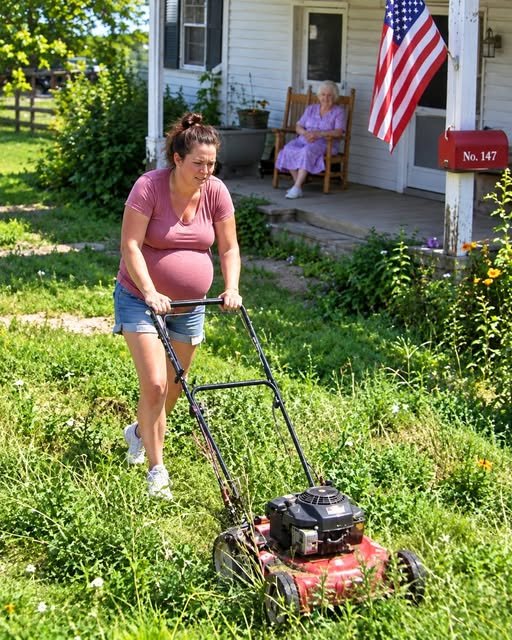
Yesterday afternoon, after I’d finished mowing, Mrs. Higgins had scolded me for working in the heat.
She’d brought me a glass of lemonade and made me sit on her porch until my breathing settled.
“You’ve got another little person to think about,” she’d said, nodding toward my stomach.
I’d laughed.
“So do you, Mrs. Higgins. You’re eighty-two. You shouldn’t be pushing that mower around in this weather.”
She’d smiled.
“Then I suppose we’re both stubborn.”
Now she was gone.
I continued reading.
I know you’ve been having a difficult time.
You’ve tried very hard to hide it, but I’m older than you think, and I’ve lived through enough trouble to recognize it when I see it.
I know about the mortgage.
I know the baby’s father left.
And I know you’ve been frightened.
My tears began falling onto the page.
Please don’t be angry that I noticed.
When I was your age, I needed help more than I wanted to admit.
Someone helped me.
It’s taken me a long time to understand that the kindness we receive isn’t meant to stop with us.
There’s something else I need to tell you. The check is only the beginning.
I stopped reading.
My heart began pounding.
The sheriff stepped closer.
“Miss Ellis, are you feeling all right?”
I nodded, though I wasn’t sure.
He looked at the letter.
“May I ask you to explain your relationship with Mrs. Higgins?”
I swallowed.
“She was my neighbor.”
“How long had you known her?”
“Almost three years.”
“Were you close?”
I hesitated.
“We talked. I brought her groceries sometimes. She brought me vegetables from her garden.”
I wiped my cheeks.
“Her husband died a few months ago. She’d been lonely.”
The sheriff glanced toward one of the deputies standing beside the patrol car.
Then looked back at me.
“Did Mrs. Higgins ever discuss giving you money?”
“No.”
“Did you ask her for any?”
I stared at him.
“Absolutely not.”
He nodded slowly.
“Did you know she had a substantial amount of money?”
“No.”
I looked at the check again.
“Sheriff, I didn’t even know she could afford something like this.”
He watched my face carefully.
Then said something that made the situation suddenly clearer.
“Mrs. Higgins’s nephew called us this morning. He’s claiming someone may have taken advantage of her before her death.”
My stomach dropped.
“What?”
“He says she was confused recently and had been giving money away.”
I stared at him.
Then whispered, “Does he think I did something?”
The sheriff took a breath.
“We haven’t reached any conclusions. We’re looking into the circumstances surrounding her death, and your interaction with her yesterday is relevant.”
I felt my baby move.
A strong kick beneath my ribs.
I pressed one hand against my stomach.
“I only mowed her lawn.”
My voice cracked.
“I didn’t take anything.”
He nodded.
“I understand that’s what you’re telling me.”
I looked down at the check.
And suddenly, the money didn’t look like a miracle anymore.
It looked like something that could destroy my life if people believed I’d manipulated a dying woman.
I held the envelope toward him.
“Please. Take it. I don’t want trouble.”
He shook his head gently.
“Let’s document what you found and how you found it. We may need copies of the letter and financial records as part of the investigation.”
I nodded.
Then he asked whether I would be willing to come to the station later and give a formal statement.
“Of course.”
He glanced at my stomach.
“But first, I want you to sit down. You look faint.”
I couldn’t argue.
I lowered myself onto the porch steps.
The sheriff stood nearby while one of the deputies brought me a bottle of water.
I kept staring at the letter.
Mrs. Higgins had been alive yesterday.
She’d held my hand.
Called me a good girl.
And told me not to forget it.
Now she was dead, her family apparently suspected me of stealing from her, and I was holding a check for more money than I’d seen in one place in my entire adult life.
Then I turned over the photograph.
And everything became even more heartbreaking.
It showed Mrs. Higgins as a much younger woman.
She was standing beside a man with dark hair and a broad smile.
Between them stood a little girl wearing a yellow dress.
On the back, in faded ink, were three names.
Martha, Henry, and Lily. Summer 1979.
I recognized Martha Higgins.
I assumed Henry was her late husband.
But I’d never heard her mention a daughter.
I looked at the sheriff.
“Who is Lily?”
His expression changed.
He glanced toward Mrs. Higgins’s house.
Then said quietly, “I think you’ll need to speak with her attorney about that.”
My name is Nora Ellis.
I’m thirty-one years old.
And until that Wednesday morning, I believed the worst thing that could happen to me was losing my home before my baby was born.
I was wrong.
There are losses much greater than a house.
I’d just experienced one.
Mrs. Higgins wasn’t technically family.
She was the elderly widow who lived next door.
The woman who wore the same pale blue cardigan almost every morning.
The woman who waved from her porch whenever I brought my trash bins inside.
She loved roses, lemon cookies, and old detective shows.
Her husband, Henry, had died three months earlier after fifty-six years of marriage.
I remembered the ambulance coming that morning.
I remembered seeing her standing in the driveway, wearing slippers and holding a blanket.
I went over to ask whether she needed anything.
She looked at me and whispered, “They took him.”
I held her while she cried.
After the funeral, I checked on her occasionally.
Sometimes I brought soup.
Sometimes she asked me to change a lightbulb or carry something heavy.
Mostly, we talked.
She asked about my pregnancy.
I told her it was a girl.
She smiled.
“Girls are wonderful.”
Then she looked away.
I didn’t realize why.
Not then.
When I told her the baby’s father had left, she didn’t offer advice.
She just reached across the porch table and squeezed my hand.
“You’ll find your way, sweetheart.”
I wanted to believe her.
But my situation was getting worse.
My ex-boyfriend, Jared, disappeared from our relationship almost as quickly as he’d entered it.
We’d been together for four years.
We bought the house when we were still talking about getting married, though the mortgage and title were in my name.
He helped with expenses while we were together.
Then I became pregnant.
At first, he seemed happy.
Two weeks later, he told me he wasn’t ready to be a father.
A week after that, he moved out.
He took his belongings.
His television.
His coffee machine.
Even the patio chairs we’d bought together.
I didn’t fight over any of it.
I was too frightened about the baby.
I had a full-time administrative job at a medical office.
But my income wasn’t enough to cover the mortgage, insurance, utilities, groceries, prenatal expenses, and everything else I’d previously shared with Jared.
I cut every expense I could.
Canceled subscriptions.
Stopped eating out.
Sold my jewelry.
Sold the second car I’d kept after my mother’s death.
But by the time I reached my third trimester, I was dangerously behind.
The foreclosure notice arrived Tuesday morning.
I had never felt so alone.
Then I saw Mrs. Higgins struggling with her lawn.
And for three hours, I forgot about my own problems.
I forgot about the bills.
The mortgage.
The calls I was afraid to answer.
All I could think about was an elderly woman in ninety-five-degree heat trying to push a mower she could barely control.
It wasn’t a sensible thing for me to do while heavily pregnant.
I should have called someone to help or offered to arrange lawn care.
I knew that.
But I was exhausted, overwhelmed, and desperate to feel useful to someone when I couldn’t seem to fix anything in my own life.
So I took the mower.
And I finished the lawn.
When Mrs. Higgins held my hand afterward, I had no idea it would be the last time I saw her alive.
That afternoon, after giving my statement, I returned home.
The sheriff told me the circumstances of Mrs. Higgins’s death were still being reviewed.
There were no immediate indications of violence, but because her nephew had raised concerns about her finances, the investigators needed to establish what had happened.
I understood.
I also felt sick.
I didn’t deposit the check.
I placed it in an envelope with Mrs. Higgins’s letter and waited.
At four o’clock, my phone rang.
An unfamiliar number.
I almost ignored it.
Then I answered.
“Hello?”
“May I speak with Nora Ellis?”
“This is Nora.”
“My name is Amelia Sutton. I’m an attorney representing the estate of Martha Higgins.”
I sat down.
“Mrs. Higgins?”
“Yes.”
She paused.
“First, I’m very sorry about what happened this morning.”
My eyes filled.
“Thank you.”
Then Amelia said something that made me grip the phone.
“Mrs. Higgins asked me to contact you if anything happened to her. We need to discuss the arrangements she made before her death.”
I swallowed.
“What arrangements?”
Amelia hesitated.
“I’d prefer to explain them in person. Would you be able to come to my office tomorrow?”
I looked toward the yellow envelope on my table.
“Yes.”
“Please bring the letter and the check. We’ll review everything together.”
I took a breath.
“Amelia, her nephew thinks I stole from her.”
There was a brief silence.
Then she said firmly, “Nora, Mrs. Higgins made her decisions with independent legal advice. We have documentation. You should let the investigation proceed and avoid discussing the allegations with her relatives.”
I felt a little of the pressure in my chest ease.
But then Amelia added something unexpected.
“And Nora?”
“Yes?”
“Martha spoke about you often.”
My eyes filled.
“She did?”
“Yes.”
Amelia’s voice softened.
“She was very fond of you.”
I began crying.
Because suddenly, I didn’t care about the check.
I wanted to hear Mrs. Higgins call me sweetheart one more time.
The following morning, I sat in Amelia Sutton’s office.
She was a woman in her late fifties with silver-streaked hair and a calm expression.
There were framed photographs of her family on the bookshelves.
A little wooden sign on her desk read:
Do the right thing, even when it is difficult.
For some reason, that made me feel safer.
Amelia offered me water.
Then opened a folder.
“Nora, how much do you know about Martha Higgins?”
I thought about it.
“She was eighty-two. Her husband died a few months ago. They lived next door.”
I swallowed.
“She was kind.”
Amelia nodded.
“Yes. She was.”
Then she asked, “Did Martha ever mention her daughter?”
I shook my head.
“No.”
Amelia looked toward the photograph I’d brought.
“Her name was Lily.”
My chest tightened.
“The little girl in the yellow dress?”
“Yes.”
I waited.
Amelia took a breath.
“Lily died when she was twenty-nine.”
My heart sank.
“Oh, no.”
“She was pregnant with her first child.”
I pressed one hand against my stomach.
Amelia continued gently.
“Lily and her husband were killed in a highway accident. The baby didn’t survive.”
For a moment, I couldn’t speak.
I looked down at the photograph.
The little girl.
The yellow dress.
The two proud parents standing on either side of her.
A whole family smiling in the summer sunshine.
I swallowed.
“Mrs. Higgins never told me.”
Amelia nodded sadly.
“Martha found it difficult to speak about her.”
I looked away.
Suddenly, several things made sense.
The way Mrs. Higgins’s eyes filled when I told her I was having a girl.
The way she always asked about my appointments.
The way she’d look at my stomach and smile, then quickly change the subject.
For three years, I had thought she was simply a kind neighbor.
Now I understood there had been a grief inside her that I had never seen.
Amelia continued.
“After Lily died, Martha and Henry never had another child.”
She paused.
“They had nieces and nephews, but none they were particularly close to.”
I thought about the sheriff’s questions.
“Her nephew?”
Amelia nodded.
“His name is Curtis. He’s Henry’s nephew.”
She folded her hands.
“He became very interested in Martha’s finances after Henry died.”
My stomach tightened.
“What do you mean?”
Amelia sighed.
“He wanted to know whether he would inherit the house, the investments, and Henry’s remaining assets.”
I stared at her.
She continued.
“Martha was upset by the way he spoke about her belongings. She had already begun reviewing her estate plan.”
I looked down.
“Did she change it because I mowed her lawn?”
Amelia shook her head.
“No, Nora.”
I felt a strange mixture of relief and confusion.
“Martha’s major estate-planning decisions were made several weeks ago. What happened Tuesday didn’t cause her to suddenly give away everything she owned.”
I nodded.
“Then why did she leave me the check?”
Amelia opened another folder.
“Because she’d been concerned about you for some time.”
I swallowed.
“She knew about the foreclosure?”
“Yes.”
“How?”
Amelia hesitated.
“Martha told me you’d mentioned struggling with bills, and she noticed how frightened you’d become whenever your phone rang.”
I looked down.
I remembered one afternoon when she’d invited me over for tea.
I’d received three calls from my mortgage servicer while we sat together.
I’d silenced them.
Mrs. Higgins had pretended not to notice.
Apparently, she had.
Amelia continued.
“Your neighbor also knew you were working extra hours while pregnant. She worried about you.”
Tears filled my eyes.
Then Amelia opened a small binder.
“She asked me to help her arrange financial assistance for you without creating any uncertainty about her intentions.”
I stared at her.
“The check?”
“Yes. She authorized it from her own funds. The bank issued it before she passed away. We have the records.”
I looked down.
“Why forty-eight thousand seven hundred and fifty dollars?”
Amelia smiled sadly.
“Martha asked me to help calculate what she believed would give you a chance to address the mortgage arrears and have a financial cushion. It wasn’t meant to be a reward for mowing the lawn.”
My eyes filled.
“She was planning to help me before Tuesday?”
“Yes.”
I covered my mouth.
Amelia continued.
“Tuesday simply gave Martha the opportunity to hand you something personal. She told me she’d leave a letter for you.”
I remembered the sheriff standing beside my mailbox.
The envelope.
The check.
The handwriting.
And I began crying again.
But Amelia wasn’t finished.
“Nora, Martha’s will also makes provisions that affect you.”
I looked up.
“What?”
She slid a document across the desk.
“Her house was placed into her estate plan with instructions that, after administration and resolution of any valid obligations or challenges, it should pass to you.”
I stared at her.
The room seemed to go silent.
“Her house?”
Amelia nodded.
“The house next door.”
I shook my head.
“No.”
Her expression softened.
“Yes.”
I stared at the document.
“No, she can’t have.”
Amelia waited.
I continued.
“Mrs. Higgins barely knew me.”
She shook her head gently.
“Nora, she knew you for almost three years.”
I swallowed.
“She saw you when you brought her groceries. She saw you clear the branches after last year’s storm. She saw you visit when Henry was ill.”
My eyes filled.
“She saw you return after his funeral, when almost everyone else had gone back to their own lives.”
I covered my face.
Amelia continued.
“Sometimes you don’t need to know every detail of someone’s life to recognize their character.”
I began crying harder.
Then I whispered, “But why me?”
Amelia turned to another document.
“Martha left a letter explaining that.”
She handed it to me.
I unfolded the paper carefully.
Dear Nora,
If Amelia has given you this letter, then I’m no longer here to say these things myself.
I’m sorry about that.
I would have liked to meet your little girl.
I pressed my hand against my mouth.
For more than fifty years, Henry and I lived in the house next door.
We raised Lily there.
We watched her learn to walk, ride a bicycle, and drive.
When she died, we thought we would never feel joy in that house again.
But life has a way of sending people to your doorstep when you least expect them.
Tears fell onto the paper.
I watched you move in.
I watched you plant flowers by your porch.
I watched you carry groceries for a neighbor who could no longer manage the steps.
And after my Henry died, you were one of the few people who remembered that I was still alive.
I began sobbing.
You didn’t have much money.
You were frightened about your future.
And yet you still stopped to help an old woman when you could have walked past.
Please don’t think the house is a prize you won by mowing my lawn.
I made my plans before that afternoon.
Your kindness simply reminded me that I’d chosen someone who would understand why the house mattered.
I wiped my eyes.
Then I read the final paragraph.
“Nora, I cannot give my daughter the home she deserved to raise her child in. But I can help you give your daughter something I once gave mine: a safe place to grow.”
I couldn’t finish.
I folded forward over the desk and cried.
Amelia quietly handed me tissues.
For a long time, she said nothing.
Then I whispered, “She didn’t even get to meet my baby.”
Amelia’s eyes filled.
“No.”
I looked down at my stomach.
My daughter moved beneath my hand.
A small, familiar kick.
I began crying again.
Because suddenly, the house next door wasn’t just a house.
It was a place where another little girl had once grown up.
A place filled with memories.
And a woman who had lost her only child wanted to help me protect mine.
The next several weeks were complicated.
The medical examiner’s findings supported that Mrs. Higgins had died from natural causes associated with her longstanding heart condition.
The sheriff’s office also reviewed her financial records and the allegations raised by Curtis.
There was no evidence that I’d coerced her or taken anything unlawfully.
The cashier’s check had been obtained through documented instructions.
The estate documents had been prepared with independent legal advice.
And Amelia had records showing that Mrs. Higgins understood the decisions she’d made.
But Curtis wasn’t willing to accept any of it.
He called me twice.
The first time, I answered without knowing who he was.
“You’re Nora Ellis?”
“Yes.”
His voice was angry.
“You think you can trick an old woman into giving you her money?”
I went cold.
“Excuse me?”
“You heard me.”
I sat down.
“Curtis, I didn’t ask her for anything.”
He laughed bitterly.
“Then why did she leave you her house?”
My throat tightened.
“That’s something you’ll have to discuss with her attorney.”
His voice rose.
“Don’t pretend you’re innocent.”
I ended the call.
Then I contacted Amelia.
She advised me to preserve the messages and allow the estate’s legal representatives to address his concerns through the appropriate process.
I didn’t answer his second call.
Curtis eventually challenged the estate arrangements.
That meant delays.
Documents.
Court filings.
More uncertainty than I wanted during the final weeks of pregnancy.
I was frightened.
Sometimes I wondered whether I should refuse everything and walk away.
But Amelia reminded me of something important.
“Martha made these decisions while she was alive, Nora. Respecting her wishes isn’t taking advantage of her.”
I tried to remember that.
Meanwhile, my mortgage was still in trouble.
The check didn’t magically cancel foreclosure proceedings.
I worked with the mortgage servicer, a housing counselor, and a lawyer to review the amount required to reinstate the loan and the available options.
After the financial institution verified and accepted the cashier’s check, and the necessary arrangements were completed, I was able to bring the loan current.
For the first time in months, I could open my mail without feeling sick.
But I knew the larger problem remained.
Even without the overdue balance, my monthly mortgage payment was difficult to manage alone.
I’d have to make another decision once the baby arrived.
For once, though, I had time to think.
And time was something I desperately needed.
My daughter was born on a rainy Thursday morning.
Three weeks before her due date.
I named her Lily Martha Ellis.
I had chosen Lily before speaking with Amelia.
It was my grandmother’s name.
But after learning about Mrs. Higgins’s daughter, it felt like an extraordinary coincidence.
Martha was for the woman next door.
The woman who had seen me struggling.
The woman who had offered help without making me feel ashamed.
When the nurse placed my daughter against my chest, I began crying.
She was tiny.
Warm.
With a little patch of dark hair and fists that opened and closed against the blanket.
I looked down at her.
“Hello, Lily.”
She made a small sound.
I kissed her forehead.
“It’s just you and me, sweetheart.”
Then I corrected myself.
“Actually, I think we’ve had more help than I realized.”
I thought about Mrs. Higgins.
I wished she could have seen the baby.
Held her.
Told me whether she had my nose or her father’s eyes.
But she was gone.
And all I could do was carry the memory of her kindness into the life I was building.
A few days later, Amelia visited.
She brought a little gift bag.
Inside was a pale yellow baby blanket.
Hand-knitted.
Soft.
Beautiful.
There was a note attached.
For the little girl next door.
I stared at it.
Amelia smiled sadly.
“Martha started knitting it after you told her you were expecting.”
My eyes filled.
“She made this?”
Amelia nodded.
“She didn’t finish the final border. Her friend at church completed it after she passed.”
I pressed the blanket against my face.
For a moment, I could almost smell Mrs. Higgins’s lavender soap.
I began crying.
Amelia touched my shoulder.
“She was very excited about your baby.”
I looked down at Lily.
Then whispered, “I wish she’d had the chance to meet her.”
Amelia nodded.
“So do I.”
Five months later, the estate dispute was resolved.
Curtis’s challenge did not succeed.
The documents and supporting evidence established that Mrs. Higgins had made her decisions knowingly and voluntarily.
The estate still required administration, expenses had to be settled, and the property transfer had to be completed properly.
But eventually, the day arrived.
Amelia called me on a Monday morning.
“Nora?”
“Yes?”
“The house transfer is complete.”
I stopped moving.
For a moment, I couldn’t breathe.
“What?”
“Martha’s home is now yours.”
I looked toward the window.
There it stood.
The pale yellow house next door.
White porch railings.
The little flower beds Mrs. Higgins had loved.
The lawn I’d mowed the day before she died.
My eyes filled.
“Are you sure?”
Amelia laughed softly.
“Yes.”
I covered my mouth.
Then began crying.
A few weeks later, I made the difficult decision to sell my original house.
The mortgage had been brought current, and I worked with a real estate professional to understand the sale and remaining loan balance.
I wasn’t abandoning it because I didn’t care.
I was choosing financial stability.
Mrs. Higgins’s house was paid off.
It was smaller.
Easier to maintain.
And had a sunny little bedroom that would be perfect for Lily.
I walked through my old house one final time.
I remembered moving in with Jared.
The plans we’d made.
The nursery I’d begun preparing alone.
The nights I’d spent crying over bills.
For a moment, I felt sad.
Then Lily made a small noise from her stroller.
I looked at her.
And smiled.
“Ready to go home, sweetheart?”
She blinked up at me.
I laughed.
“I’ll take that as a yes.”
We crossed the narrow strip of grass between the houses.
And I carried my daughter through Mrs. Higgins’s front door.
Living in that house felt strange at first.
Every room held traces of Martha and Henry.
The old grandfather clock in the hallway.
The framed photograph of their wedding.
The faded blue curtains in the guest bedroom.
The little ceramic birds lined up on the kitchen windowsill.
I didn’t want to erase them.
But I also needed to make the house feel like ours.
So I changed a few things.
Painted the nursery a soft cream color.
Bought a comfortable rocking chair.
Installed safety gates.
And planted lavender beside the porch.
I kept the photograph of Martha, Henry, and Lily in the living room.
The little girl in the yellow dress.
The family who had once filled that house with love.
I wanted my daughter to grow up knowing their names.
Not as strangers who left us money.
As people whose kindness helped change our lives.
One evening, after Lily fell asleep, I sat in the old porch swing.
The air smelled of freshly cut grass.
The sky was turning pink.
I looked toward the yard.
Then remembered the last afternoon I saw Mrs. Higgins alive.
The heat.
The rusted mower.
Her trembling hands.
The glass of lemonade.
And the way she held my hand before I left.
You’re a good girl. Don’t forget that.
I began crying.
Because the strangest part of the story was that I had nearly walked past her.
I had been exhausted.
Scared.
Angry at the world.
And convinced nobody cared whether I made it through another month.
I had every reason to go back inside.
But I stopped.
And while I could never know exactly what was going through Mrs. Higgins’s mind that day, I did know what she had written.
She had seen me.
Noticed my struggles.
And decided I was worth helping.
That mattered more than I could explain.
A year after Mrs. Higgins died, I received an unexpected letter.
It was from Curtis.
I hesitated before opening it.
For months, I’d associated his name with angry telephone calls, legal documents, and accusations that made me frightened to leave my house.
But this letter was different.
Dear Nora,
I don’t expect you to forgive how I treated you.
I was angry when Aunt Martha died.
And I was angry when I discovered she had left so much to someone outside the family.
I told myself you had manipulated her because that was easier than asking why she hadn’t trusted me.
I stopped reading.
Then continued.
I’ve spent a lot of time thinking about the last few years.
After Uncle Henry died, I called to ask about the estate.
I didn’t call to ask how Martha was managing.
I didn’t visit.
I didn’t help with the house.
And when she died, my first question was about her money.
My throat tightened.
I was wrong to accuse you.
I’m sorry.
You don’t have to respond.
But I hope you and your daughter are doing well.
I sat with the letter for a long time.
Then I placed it in a drawer.
I didn’t immediately write back.
I wasn’t ready.
His apology didn’t erase the stress he’d caused.
But I appreciated that he’d finally admitted the truth.
Some people change when they are forced to face themselves.
Others don’t.
I hoped Curtis would become someone better.
But I no longer felt responsible for finding out.
Today, Lily is three years old.
She has dark curls, endless questions, and a remarkable ability to leave toys in the one place I am most likely to step.
She’s healthy.
Happy.
And absolutely convinced that every butterfly in our garden belongs to her.
I still work at the medical office, though my schedule is more manageable now.
I still worry about ordinary things.
Groceries.
Childcare.
Car repairs.
The cost of replacing our aging water heater.
Mrs. Higgins didn’t leave me an endless fortune.
What she gave me was more practical.
A home without a mortgage.
Financial breathing room.
And the chance to raise my daughter without waking every morning terrified that we’d lose everything.
That changed my life.
But I didn’t want the kindness to stop there.
So I started doing something small.
Once a month, I volunteer with a local organization that helps families facing housing insecurity.
Sometimes I help sort donations.
Sometimes I prepare meals.
Sometimes I simply sit with someone who needs to talk.
I know what it feels like to stare at a foreclosure notice and wonder how you’re going to survive.
I know what it feels like to be pregnant and alone.
And I know how much it matters when somebody notices you’re struggling without treating you like a failure.
I can’t give everyone forty-eight thousand dollars.
I can’t give everyone a house.
But I can help in the ways available to me.
And I can teach Lily to do the same.
Last summer, the little boy across the street fell off his bicycle.
Nothing serious.
Just a scraped knee and a lot of tears.
Lily saw him sitting on the sidewalk.
She ran inside.
Then came back carrying one of her favorite stuffed animals.
She offered it to him.
“For you,” she said.
The boy looked surprised.
Then took the toy.
His mother thanked us.
I smiled.
But later, when Lily asked why I looked sad, I knelt beside her.
“I’m not sad, sweetheart.”
She frowned.
“Your eyes are wet.”
I laughed through my tears.
“Sometimes happy things make people cry too.”
She considered that.
Then asked, “Because I helped?”
I smiled.
“Yes.”
I kissed her forehead.
“Because you helped.”
Every Tuesday, I still think about Mrs. Higgins.
Especially when I mow the lawn.
I bought a safer, lighter mower after moving in.
And these days, I make sure I take breaks, drink water, and don’t try to prove anything by pushing myself beyond what my body can manage.
Sometimes I smile remembering how stubborn we both were.
She had been eighty-two.
I had been thirty-one and heavily pregnant.
Neither of us had any business mowing grass in ninety-five-degree heat.
But that afternoon, somehow, we met each other in the middle of two very different kinds of loneliness.
She had lost her husband.
I had lost the future I thought I was going to have with mine.
She was afraid of growing old alone.
I was afraid of raising a child alone.
Neither of us could fix the other’s grief.
But we could offer a little kindness.
And for one afternoon, that was enough.
I keep her last letter in a wooden box beside my bed.
Sometimes, when life feels difficult, I take it out and read it.
There is one sentence I always return to.
“The kindness we receive isn’t meant to stop with us.”
I think about those words often.
Because Mrs. Higgins could have spent her final years worrying only about herself.
She had every reason to.
She had lost her daughter.
Her grandchild.
And eventually, the husband she’d loved for more than fifty years.
But even after all that loss, she was still capable of seeing somebody else’s pain.
She saw mine.
And she helped.
Not because I was family.
Not because she owed me anything.
But because she knew what it felt like to need someone.
Last week, Lily found the photograph of Martha, Henry, and their daughter.
She brought it to me while I was folding laundry.
“Mommy?”
“Yes, sweetheart?”
“Who’s this little girl?”
I looked down.
Lily Higgins.
The child who had grown up in this house long before my daughter was born.
I smiled sadly.
“Her name was Lily.”
My daughter grinned.
“Like me?”
“Yes, sweetheart.”
She pointed to Martha.
“And who’s that?”
I swallowed.
“That’s Mrs. Higgins.”
She tilted her head.
“The lady who gave us our house?”
My eyes filled.
“Yes.”
Lily studied the photograph.
Then asked something that made me stop breathing for a moment.
“Did she love us?”
I sat down on the sofa.
Pulled my daughter onto my lap.
And looked at the photograph again.
I thought about the yellow envelope.
The cashier’s check.
The knitted blanket.
The house.
And the letter written by a woman who had suffered losses I could barely imagine.
Then I kissed Lily’s forehead.
“Yes, sweetheart.”
My voice broke.
“I think she did.”
Lily smiled.
Then wrapped her arms around my neck.
“Then I love her too.”
I began crying.
Not the frightened tears I’d cried when I was pregnant and struggling to survive.
Something different.
Gratitude.
Sadness.
And the quiet realization that a person can be gone and still change the direction of someone else’s life.
Sometimes people ask me whether I believe in miracles.
I don’t know how to answer.
I know the world doesn’t always reward kindness.
I know people help others every day without receiving money, houses, or even a thank-you.
And I know good people suffer losses they don’t deserve.
Mrs. Higgins certainly did.
But I also know what happened to me.
One Tuesday morning, I received a foreclosure notice.
I was thirty-four weeks pregnant.
The man I’d expected to raise my child with had left.
I was frightened about money, childbirth, and what would happen if the bank took my home.
Then I walked outside and saw an old woman struggling with her lawn.
I could have turned around.
Instead, I helped her.
The next morning, she was gone.
The sheriff arrived.
And I found an envelope in my mailbox that changed everything.
At first, I thought the greatest surprise was the money.
Then I thought it was the house.
But as the years passed, I came to understand something else.
Mrs. Higgins had spent her final months noticing someone whom the rest of the world seemed to have forgotten.
Me.
A frightened, exhausted pregnant woman trying to hold her life together.
She didn’t ask whether I deserved help.
She didn’t make me prove I was responsible enough to receive it.
She didn’t demand gratitude.
She simply decided that if she could make one young mother’s future a little safer, she would.
And because of that, my daughter grew up in a home filled with warmth instead of fear.
This morning, Lily and I planted yellow flowers beside the porch.
She asked why I always choose yellow.
I showed her the old photograph.
The little girl in the yellow dress.
Then I told her a story about a woman named Martha, who loved her family, missed them terribly, and still found enough love left in her heart to care about somebody new.
Lily listened carefully.
Then she took her little watering can and poured water over the flowers.
“For Mrs. Higgins,” she announced.
I smiled through my tears.
“For Mrs. Higgins.”
We stood together in the sunshine.
A gentle breeze moved through the yard.
And for a moment, I could almost see Martha sitting on the porch in her pale blue cardigan, watching us with that familiar smile.
I wished she were there.
I wished I could thank her.
I wished she could watch Lily running through the grass and understand how much her kindness had changed our lives.
But perhaps, in some way, she already knew.
I looked toward the lawn where I’d stood three years earlier, exhausted and frightened, holding the handle of an old rusted mower.
Then I looked at my daughter.
Safe.
Loved.
Growing up in a home I once thought I would never be able to give her.
And I understood why Mrs. Higgins’s final words had mattered so much.
“You’re a good girl. Don’t forget that.”
She wasn’t promising me a reward.
She wasn’t telling me that kindness would make every problem disappear.
She was reminding me not to let hardship change the person I wanted to be.
I mowed an elderly widow’s lawn because she needed help.
The next morning, a sheriff knocked on my door because she had died.
And inside my mailbox, I discovered that she had been thinking about how to help me too.
She left me financial security.
She left my daughter a home.
But the greatest thing she left behind was a lesson I hope Lily carries for the rest of her life.
You never know how much someone is struggling behind a closed door.
And sometimes, the smallest kindness you offer may be the thing that reminds them they haven’t been forgotten.
Mrs. Higgins couldn’t stay to watch my daughter grow up.
But every time Lily stops to help someone, I see a little of that beautiful old woman living on.
And that, more than the money or the house, is the inheritance I treasure most.