Part One — The Three Little Girls Waiting at the Airport
Five years after I walked away from my marriage, I found myself sitting beside my former husband on a flight from Boston to Charlotte.
The first thing I noticed was that Nathaniel Whitcomb still wore the same confident smile he used whenever he believed he had the upper hand.
He glanced at my plain navy sweater, the paperback in my lap, and the worn canvas bag beneath my seat.
“Well, Emily,” he said, settling into the leather seat beside mine. “I never expected to find you here.”
I closed my book.
“Hello, Nathaniel.”
He studied me for a moment.
“You look well. Considering everything.”
There it was.
That particular tone.
During our marriage, Nathaniel had possessed a remarkable ability to make an insult sound like concern.
“I’m doing very well.”
“Still working in design?”
“Something different now. I own a business.”
His eyebrows rose.
“Good for you. I always hoped you’d find something to keep yourself occupied.”
Five years earlier, that sentence would have ruined my entire afternoon.
Now I simply turned toward the window.
Nathaniel had no idea that the hardest years of my life had also built the happiest part of it.
He had no idea three little girls were waiting for me in Charlotte.
And he had no idea why they had his eyes.
For the rest of the flight, Nathaniel talked mostly about himself.
His family company had completed another merger.
He had bought a place in Rhode Island.
His mother was still serving on charity boards and collecting photographs of herself beside important people.
I listened politely.
When we landed, we walked into the crowded arrivals hall together.
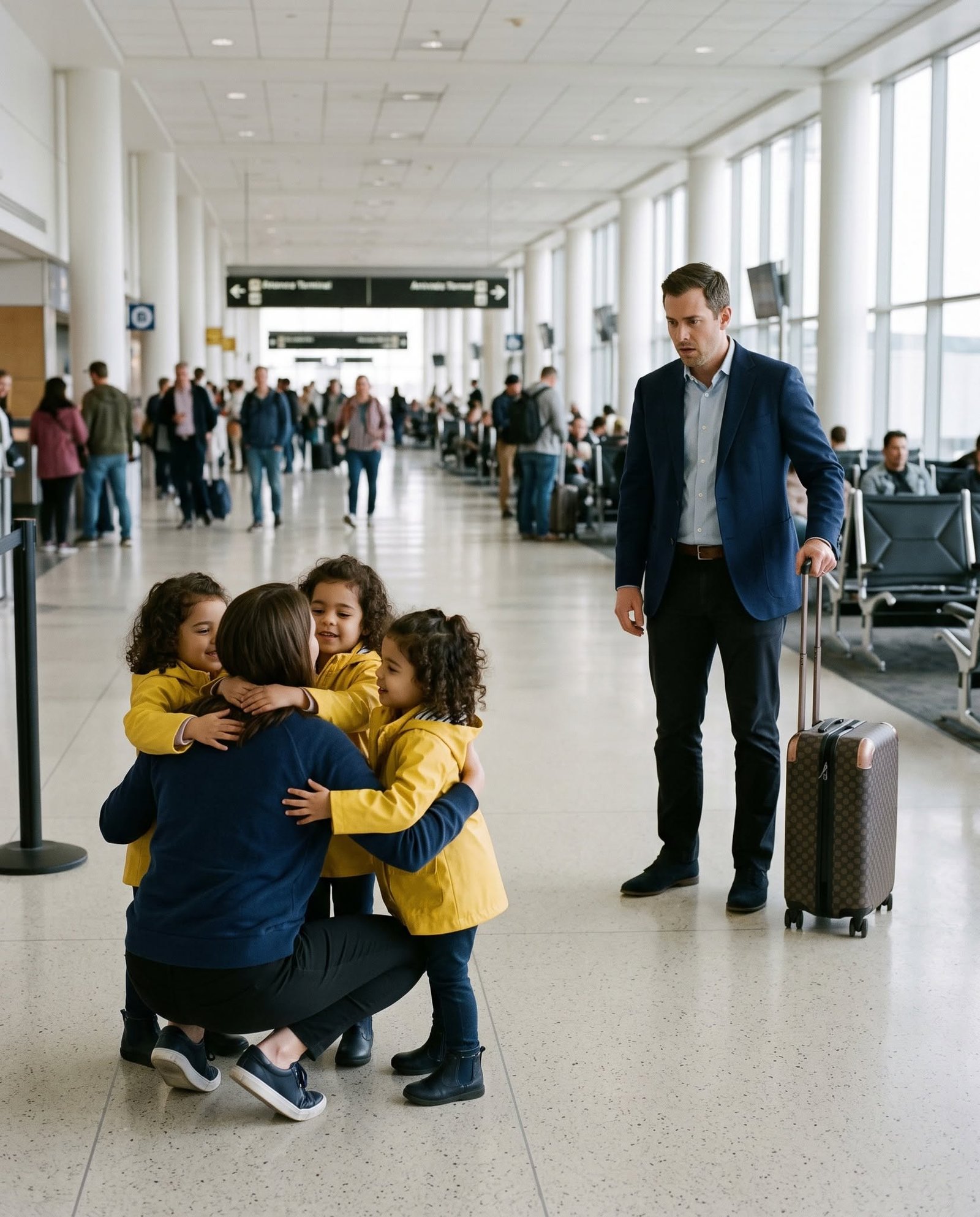
Nathaniel was adjusting the cuffs of his blazer when three voices rang across the terminal.
“Mommy!”
I turned.
Chloe, Nora, and Grace came racing toward me in matching yellow raincoats, chestnut curls bouncing behind them.
Their nanny, Sarah, hurried after them.
“Girls! Slow down!”
Too late.
All three hit me at once.
I dropped to my knees laughing as six little arms wrapped around my neck.
“We made you a card!”
“I found a beetle!”
“Sarah promised smoothies!”
“One emergency at a time,” I laughed, kissing each forehead.
Then I stood.
And saw Nathaniel.
He had gone completely still.
His designer suitcase stood forgotten beside him.
His eyes moved from Chloe to Nora to Grace.
Same curls.
Same high eyebrows.
And all three had bright hazel eyes with a faint amber ring around the pupils.
A Whitcomb trait so distinctive that Nathaniel’s mother used to mention it as though the family had personally invented hazel.
“Emily…”
His voice cracked.
I said nothing.
“Who are they?”
“My daughters.”
His face drained.
“How old?”
“They turned four last month.”
I watched him calculate.
Five years since our divorce.
Four-year-old children.
Nine months.
He looked at me.
Then at the girls.
“No.”
I remained silent.
“Emily, are they mine?”
Grace stepped behind my leg.
I lowered my voice.
“This is not the place.”
Nathaniel barely heard me.
“You were pregnant when you left?”
“I didn’t know yet.”
His face twisted.
“You hid my daughters from me for four years?”
“No.”
“I didn’t even know they existed!”
“I know.”
“Then how is that not hiding them?”
I handed Sarah my car keys.
“Take the girls to the car, please.”
Sarah immediately understood.
Once they were out of earshot, I faced Nathaniel.
“Three weeks after our divorce was finalized, I collapsed at work. I thought it was exhaustion.”
He stared at me.
“It wasn’t.”
I took out my phone.
“There were three heartbeats.”
Nathaniel sank onto the nearest bench.
“But the clinic said—”
“I know what the clinic said.”
During the final year of our marriage, we had spent thousands on fertility testing.
Nathaniel’s mother, Victoria, insisted we use a private specialist she trusted.
After weeks of appointments, she sat beside me while the doctor explained that I was unlikely ever to conceive naturally.
Victoria called me defective afterward.
Nathaniel said nothing.
A month later, he asked for a divorce.
He told me the Whitcomb family expected children.
I had packed two suitcases and walked away believing my body had failed my marriage.
Nathaniel stared at me now.
“The tests…”
“Were altered.”
His head snapped up.
“What?”
“I spent four years trying to get the original records.”
I opened an email.
“The physician who treated us finally agreed to provide a sworn statement after his former practice came under review.”
Nathaniel’s face changed.
I continued.
“The infertility diagnosis wasn’t mine.”
He whispered:
“No.”
“It was yours.”
He stared at me.
“The specialist found severe oligospermia. Natural conception was unlikely. Not impossible. Unlikely.”
Nathaniel looked toward the doors where our daughters had disappeared.
Then back at me.
“No.”
“Your mother paid to have the report rewritten.”
He stopped breathing.
“She couldn’t accept that her son might be the one with the fertility problem.”
I showed him the documents.
Financial records.
The original lab summary.
Correspondence between Victoria and the clinic.
The retired physician’s statement.
Nathaniel scrolled through the pages with shaking fingers.
Then he reached one email.
His mother had written:
Emily can carry the burden better than Nathaniel. He must not think there is something wrong with him.
Nathaniel sat down again.
For the first time since I had known him, he looked completely stripped of certainty.
Then he whispered:
“My mother destroyed our marriage.”
I looked at him.
“No.”
He raised his eyes.
“She helped.”
I swallowed.
“But you were there too.”
━━━━━━━━━━━━━━━━━━━━
Part Two — The Letter He Never Saw
Nathaniel flinched.
I had spent years imagining what I would say if this moment ever happened.
In those fantasies, I humiliated him.
He begged.
I walked away triumphant.
Reality felt different.
Because three children were sitting in a car outside.
And whatever Nathaniel had done to me, the truth about their father belonged to them too.
“I tried to tell you,” I said.
He frowned.
“What?”
“When I found out I was pregnant, my attorney sent a certified notice to the address your family lawyer had provided during the divorce.”
“I never got anything.”
“I know that now.”
His face went pale again.
“What do you mean?”
“Your family’s attorney replied.”
I opened another document.
The response said Nathaniel denied responsibility for any pregnancy discovered after the divorce and requested that further communications go through counsel.
I had believed Nathaniel approved it.
He stared at the signature block.
“I never authorized this.”
“I spent four years believing you had.”
He looked physically sick.
Then I said:
“Two months ago, your family attorney retired. His former assistant contacted me after seeing my name in archived files.”
Nathaniel looked up.
“She remembered the letter.”
“And?”
“She remembered who told them not to forward it to you.”
Nathaniel didn’t need me to say the name.
But I did.
“Your mother.”
He closed his eyes.
The terminal noise seemed to disappear around us.
“She knew?”
“She knew about the pregnancy.”
“All this time?”
“Yes.”
“And she never told me?”
“No.”
He pressed both hands over his face.
For the first time, I felt something I had not expected.
Pity.
Not enough to erase the past.
But enough to remind me that Nathaniel had been manipulated too.
Then he looked toward the parking garage.
“Can I meet them?”
I shook my head.
“Not like this.”
His expression hardened instinctively.
“They’re my daughters.”
“Biologically, that is likely. Legally, it still has to be established.”
He looked stunned.
“You’re going to make me take a paternity test?”
“I’m going to make sure three four-year-old children are not thrown into the middle of an adult disaster because you discovered them twenty minutes ago.”
That silenced him.
I continued.
“If you want a relationship with them, do it properly.”
He looked at me.
“Are you trying to punish me?”
“No.”
And I meant it.
“Punishing you would be easier.”
━━━━━━━━━━━━━━━━━━━━
Part Three — What Legacy Actually Means
The paternity test confirmed what we already suspected.
Nathaniel was their biological father.
That did not make him their father overnight.
There were lawyers.
Counselors.
Gradual introductions.
Questions about how the original notification had been handled.
A separate dispute involving the falsified medical records.
Victoria denied everything at first.
Then claimed she had only been protecting her son.
Nathaniel asked her one question.
“Protecting me from what?”
She said nothing.
“From knowing I wasn’t perfect?”
Still nothing.
Nathaniel finally understood the family rule he had spent his entire life obeying.
Appearance first.
Truth second.
Sometimes truth not at all.
The Whitcomb name had to look successful.
Healthy.
Controlled.
Anything that threatened that image became somebody else’s shame to carry.
For years, I had carried it.
Then Nathaniel had carried the consequences without even knowing why.
And eventually three little girls nearly inherited the same silence.
Nathaniel stopped speaking to his mother for almost a year.
I did not tell him to.
I also did not celebrate it.
That was his relationship to decide.
My concern was the girls.
The first time he met them properly, we used a family therapist’s office.
Nathaniel arrived without presents.
That had been my request.
I did not want him buying his way into their lives.
Chloe asked first:
“Are you Mommy’s friend?”
Nathaniel looked at me.
Then back at her.
“Not exactly.”
Nora asked:
“Do you know us?”
“I’m trying to.”
Grace stared at him for a long time.
Then she said:
“You have my eyes.”
Nathaniel had to look away.
That was the first time I saw him cry.
Not airport tears.
Not shock.
Quiet tears.
He wiped them quickly.
“Yes,” he said. “I think you have mine.”
Grace considered that.
Then went back to coloring.
Children can make adults’ greatest tragedies look surprisingly small.
Not because the tragedies are small.
Because children are interested in what happens next.
And that became the real question.
What happened next?
Nathaniel showed up.
At first for one-hour visits.
Then afternoons.
Then school events.
He learned Chloe hated peas.
Nora woke early.
Grace needed every stuffed animal arranged in a specific order before she could sleep.
He missed things too.
Once he forgot a preschool performance.
Grace cried.
Nathaniel did not send a giant gift to compensate.
He came over the next morning and apologized.
“I said I would be there, and I wasn’t.”
No excuse.
That mattered more than any toy could have.
Our relationship changed too.
Not romantically.
There was too much history for that.
And honestly, I no longer wanted the woman I had become to disappear back inside the marriage I had left.
But we learned to co-parent.
Slowly.
Sometimes awkwardly.
Nathaniel also learned something about my “little business.”
It was no spare-bedroom hobby.
I had built a design firm employing twenty-seven people.
The first time he visited the office, he looked around and said:
“You did all this?”
I smiled.
“Yes.”
He nodded.
No patronizing joke.
No surprise disguised as praise.
Just:
“I underestimated you.”
“Yes.”
He almost smiled.
“I did that a lot.”
“Yes.”
That was enough.
Victoria eventually asked to meet the girls.
I refused at first.
Not forever.
Just until there was real accountability.
Her first letter said:
Everything I did was because I loved Nathaniel.
I returned it unanswered.
Her second was better.
I loved my son in a way that made me believe protecting his image mattered more than telling him the truth. I made Emily carry shame that belonged to nobody. Then I kept three children secret because admitting what I had done would have exposed me.
That was finally honest.
Years later, the girls met her.
Carefully.
With boundaries.
No one called what she had done a misunderstanding.
No one demanded that forgiveness erase memory.
She became part of their lives only where her behavior made room for it.
When Chloe, Nora, and Grace turned twelve, they asked why their father had not known about them when they were babies.
Nathaniel and I had always agreed that one day we would tell them the truth.
Not every ugly detail at once.
But enough.
We sat at my kitchen table.
The same table where they had done homework and spilled milk and argued over markers.
Nathaniel spoke first.
“When your mom and I were married, some adults lied about medical information because they were afraid of what the truth would mean.”
Grace frowned.
“Grandma Victoria?”
Nathaniel nodded.
“Yes.”
“And you believed her?”
“Yes.”
Nora looked at me.
“Then why didn’t Dad know we were born?”
I answered.
“I tried to send word. Someone kept it from him.”
Chloe looked at Nathaniel.
“Did you want us?”
The room went very still.
Nathaniel’s eyes filled.
“I didn’t know you existed.”
“That’s not what I asked.”
I looked at Chloe.
Twelve years old.
Already unwilling to accept an answer to a question she hadn’t asked.
Nathaniel took a breath.
“If I had known?”
“Yes.”
He looked at all three girls.
“I wish I could tell you exactly what man I would have been then.”
He paused.
“But I was still too controlled by what my family thought. I might have disappointed you.”
The girls watched him.
Nathaniel continued.
“What I can tell you is that once I knew you existed, I wanted the chance to know you. And every day since then, I’ve tried to deserve that chance.”
There was no grand hug.
No music.
Grace simply said:
“Okay.”
Then Nora asked if she could have ice cream.
That night, after they went upstairs, Nathaniel stood beside the old family photograph hanging in my hallway.
The girls at four.
Matching yellow raincoats.
Me kneeling in the middle.
He had taken the photograph from a distance that first day at the airport.
I didn’t know until years later.
“Do you remember what I said when I saw them?” he asked.
“You said they had to be yours.”
He nodded.
“I was thinking about blood.”
I looked at him.
“I thought seeing my face in theirs meant I had some automatic claim.”
He was quiet.
“Now?”
He smiled faintly.
“Now I know resemblance is the least important thing I’ve given them.”
That was true.
Nathaniel had grown up in a family obsessed with legacy.
The Whitcomb eyes.
The Whitcomb name.
The Whitcomb company.
The Whitcomb reputation.
Everything had been about what was passed down.
But our daughters taught both of us something better.
Legacy is not the shape of someone’s eyes.
It is not money.
Not a surname.
Not bloodline.
Legacy is what the people who come after you have to carry because of the choices you made.
Victoria gave us secrecy.
Nathaniel once gave me silence.
For years, I carried shame that was never mine.
But that did not have to be what our daughters inherited.
So we gave them something else.
Truth.
Apologies that named the harm.
Boundaries that meant something.
And the freedom to love family members without pretending those family members had never failed them.
Sometimes I still think about the airport.
Three little girls in yellow raincoats running toward me.
Nathaniel standing frozen beside his expensive luggage.
Doing the arithmetic.
For years, I thought that was the moment he discovered his daughters.
It wasn’t.
That happened slowly afterward.
At preschool performances.
Doctor appointments.
Saturday pancakes.
Forgotten promises followed by real apologies.
Thousands of ordinary moments in which biology stopped being the most interesting thing about their relationship.
Blood told Nathaniel who those girls were connected to.
Showing up taught him who they were.
And in the end, that was the only legacy any of us could choose.