He had spent forty years building something she didn’t know existed. He spent his last three weeks making sure she would find it after he was gone. What the brass key opened changed everything — and three months later, a notice arrived at the house on Maple Avenue that answered every question her son and daughter-in-law had forgotten to ask.
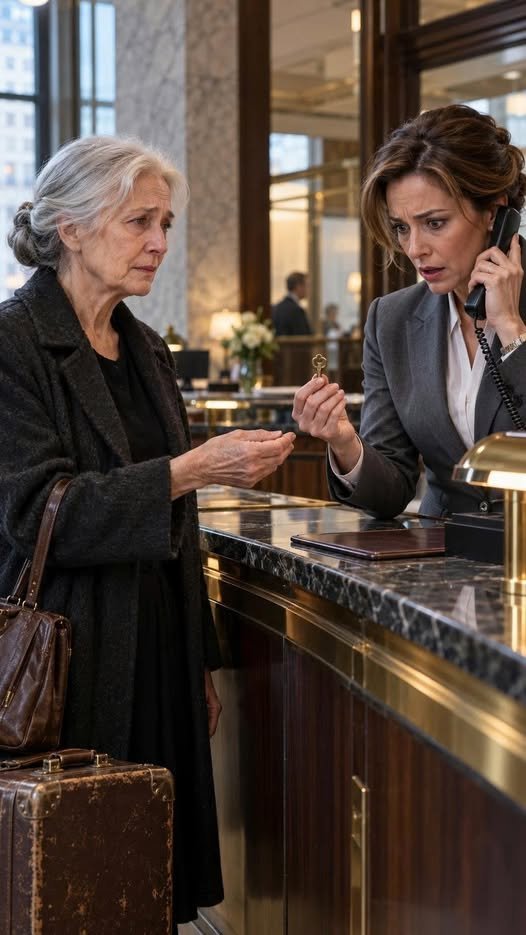
The woman in the gray suit put down the phone.
She stood up from her desk — something that had not happened when I first walked in, when I was simply a seventy-one-year-old woman in a black coat carrying a suitcase and a purse and a brass key that I did not yet fully understand. She stood up and said: “Mrs. Hargrove, my name is Claire Whitfield. I am the senior vault manager for this institution. I want to make sure you are comfortable before we proceed.”
She offered me water.
She offered me coffee.
She asked if I had eaten.
I had not eaten since the vending machine I had not been able to touch the night before.
She sent someone for a sandwich.
I ate it at the desk while Claire Whitfield made two more phone calls — short ones, in a voice too low for me to hear — and while I ate I thought about my husband James, who had pressed a brass key into my palm in a hospital room three weeks before he died and told me to keep it safe and not tell anyone and whom I had dismissed as confused from the medication because he had always been the practical one and I had not imagined that the practical one had been quietly building something for forty years that he had never mentioned.
I had been wrong about the medication.
I had been wrong about a great many things.
James Hargrove had worked in commercial real estate for forty-one years.
I knew this the way you know the broad facts of a life you have shared — I knew he went to the office, I knew he managed properties, I knew he attended meetings and flew to cities and came home tired and ate dinner and read the paper and went to bed and got up and did it again. I knew the surface of it with the comfortable familiarity of someone who has shared forty years with a person and has never needed to examine the specific mechanics because the surface was warm and reliable and sufficient.
What I had not known was the depth beneath the surface.
What Claire Whitfield walked me through across the next three hours — with the patient thoroughness of a woman who has delivered information of this magnitude before and understands that it must be delivered slowly and completely and with sufficient pauses for the recipient to breathe — was this:
James had been, across his forty-one years in commercial real estate, considerably more successful than he had ever communicated to me or to our son or to anyone in our family circle.
The properties he managed had, beginning in the mid-1980s and accelerating through the 1990s and 2000s, generated returns that he had consistently reinvested, structured, and diversified through a series of holding companies and investment accounts that he had established with the guidance of two attorneys and a financial advisor whose names I was now being given for the first time.
The vault I had opened with the brass key contained documentation of assets.
Cash accounts across three institutions: combined balance of $11.4 million.
Investment portfolio — equities, bonds, and real estate investment trusts — managed through a fiduciary firm on Lexington Avenue: current value of $12.8 million.
A deed.
The deed was the thing that stopped me mid-sandwich.
A penthouse apartment on the Upper East Side of Manhattan. Purchased in 2009. Owned outright. No mortgage. Paid in full from one of the holding company accounts. Assessed value in the current market: $4.1 million.
James had bought a penthouse apartment in Manhattan in 2009 and had not mentioned it.
Total: $28.3 million in documented assets, not including the penthouse, which was a property and valued separately.
Claire Whitfield set the final document on the desk and looked at me.
“Your husband,” she said, “established a revocable trust in 1997. The trust names you as the sole primary beneficiary. Upon his death, all assets held within the trust transfer directly to you. There is no probate process. There is no contest period. The transfer is legally complete and was completed at the time of his death.”
I looked at the documents on the desk.
I looked at the brass key.
“Why didn’t he tell me?” I said.
Claire was quiet for a moment.
“There is a letter,” she said. “In the vault. He left specific instructions that it was to be given to you when you presented the key.”
She gave me the letter.
I will not share all of it here — it is mine and it belongs to me and to James and to forty years of a marriage that contained more than I had known. But I will share the part that explains the question I had asked.
He had written: “I didn’t tell you because I knew you, my darling. I knew that if you had known about this you would have stopped working. You would have said we didn’t need it. You would have been right that we didn’t need it and wrong about what it was for. It was not for us to spend. It was for you to have when I was gone. I have watched you give yourself away your entire life — to the hospital, to Marcus, to everyone who needed something. This is yours. Only yours. Do not give it away.”
Marcus was my son.
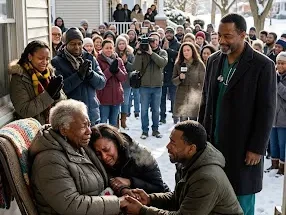
The one who had stood behind his wife in the living room in his father’s house five days after his father’s funeral and said nothing while she told me to go live on the streets.
Do not give it away.
James had known.
He had known what Marcus had become and had said nothing to me about it because saying something would have required me to act and I was not ready to act and he had understood this better than I had. He had built instead. He had built and structured and organized and signed and placed a brass key into my palm in a hospital room and said keep this safe and don’t tell anyone because he had known that the moment after his death would arrive the way it arrived and that I would need what he had built.
I sat at the desk in the bank on 47th Street and held my husband’s letter and understood that the practical one had been, across forty years of dinner and newspapers and early mornings and tired evenings, loving me in a language I had not known he was speaking.
I moved into the penthouse that afternoon.
It was not what I expected and I am still not sure I have the right vocabulary for what it was.
It was clean and large and had windows that faced east toward the river and west toward the park and it had been furnished — James had furnished it, quietly, at some point across the years, with the specific taste of a man who had grown up with very little and had developed, slowly and privately, an understanding of what quality looked like.
There was a photograph on the kitchen counter.
Us. From 1987. The year Marcus was born. James and I in the backyard of the house on Maple Avenue, before the double shifts became necessary and before Marcus became the person who stood silent while his wife removed the wedding photo from the mantel.
James had put it there.
He had wanted me to see it when I walked in.
I put my suitcase down.
I put my purse on the counter.
I stood at the east window and looked at the river and told James what I thought of what he had done, which was that it was the most extraordinary thing anyone had ever done for me and that I wished he were there to tell me himself and that I missed him with the specific weight of someone who has just discovered that the person they lost was larger than they had known.
Three months later, a notice was delivered to the house on Maple Avenue.
It was not from me directly — I had retained an attorney, a woman named Sandra Park who had been recommended by the estate team at the bank and who had, upon reviewing the full picture of the signed papers I had left on the kitchen table before walking out with my suitcase, identified several significant issues.
The papers I had signed were a voluntary transfer.
Sandra’s review established that the voluntary transfer had been presented to a widow five days after her husband’s funeral while she was still in mourning dress, without independent legal counsel, without the required disclosure of the full estate picture, and with a time pressure that the circumstances of my departure — the explicit instruction to leave — had created.
The transfer was challengeable.
Sandra challenged it.
The notice delivered to the house on Maple Avenue informed Marcus and his wife that the voluntary transfer of the Maple Avenue property was being contested on grounds of undue influence, failure of disclosure, and procedural impropriety, and that they were required to respond through legal representation within thirty days.
Marcus called me.
I did not answer the first call.
Or the second.
On the third call I answered.
He said: “Mom.”
I said: “Marcus.”
He said: “I didn’t know—”
I said: “Marcus.”
He stopped.
“Your father built something for forty years,” I said. “He built it for me. He did it because he understood, better than I did, what I was going to need. And while he was dying in that hospital and while I was standing at his grave and while I was sitting in a motel off Route 119 with a vending machine dinner I couldn’t eat, you were putting sticky notes on my furniture and your wife was telling me to go live on the streets.”
He was quiet.
“I don’t need the house,” I said. “I have a home. Your father made sure of it. But I am contesting that transfer because I signed it without counsel while I was in mourning black and that is not a transfer I will allow to stand simply because it is uncomfortable to undo.”
“Mom—”
“I am not finished,” I said.
He was quiet.
“Your father’s letter said not to give it away,” I said. “I have thought about that every day for three months. I don’t know yet what is possible between us. I don’t know if you are capable of becoming someone different from the man who stood behind his wife and said nothing. I don’t know if I have the capacity to find out. What I know is that I am seventy-one years old and I am standing in a kitchen in Manhattan with a river out the window and a photograph of your father and me from 1987 on the counter, and I am going to find out who I am without managing everyone else first.”
I ended the call.
I stood at the kitchen counter.
The river was doing what rivers do in the morning — moving, unconcerned, completely itself.
The legal proceedings resolved in my favor six months later.
The Maple Avenue property was returned to the estate and subsequently sold. My attorney was thorough and the documentation of the circumstances was clear and Marcus’s attorney, having reviewed the full picture, had advised him that contesting further was inadvisable.
Marcus and I have had three conversations since.
They are not warm conversations. They are honest ones, which is the beginning of something and may or may not become something more over time. I have decided not to make the decision about what is possible until I have more information than three conversations provide.
His wife has not called.
I have not expected her to.
I am still in the penthouse.
I will be seventy-two in the spring.
I have a view of the river. I have James’s letter in the bedside drawer where I can find it. I have our photograph from 1987 on the kitchen counter where I see it every morning when I make the coffee.
I have the brass key on a chain around my neck.
Not because it opens anything anymore — the vault has been emptied and documented and managed by the estate team and the key’s practical function has been completed. I wear it because it is the last thing James put in my hand and because wearing it is a way of carrying the conversation I did not know we were having for forty years.
He had spoken in buildings and trusts and carefully structured accounts and a furnished penthouse with east and west windows and a photograph on the counter.
I had been listening, without knowing it, every day.
I know now.
I hear you, James.
I hear you completely.
— As told by the woman who said okay, picked up her suitcase, and discovered that the most important conversation of her marriage had been happening in a language she had not known she was fluent in until the morning she handed a brass key to a woman in a gray suit and everything about the room changed.