I opened the hotel curtains, and the morning light poured over my bare scalp and the note in my hand.
I had spent three years being underestimated. Now I knew exactly what to do with it.
“Margaret,” I said into the phone, “change of plans. Bring the documents, but I need you to bring someone else too. A criminal attorney, and anyone you trust at the district attorney’s office.”
“Rachel. What did he do?”
“He drugged me and shaved my head. His family knew.”
The silence on the line was brief and cold. “I’ll be there in forty minutes. Don’t speak to him. Don’t touch anything.”
I didn’t cry. I treated it like a case, because my grandfather, who built a construction company from one truck, always told me that feelings are for after, and evidence is for now.
I called my maid of honor, Tessa, and told her only, “Come to my room. Alone. Bring your phone.” When she saw me, she gasped, then pressed both hands over her mouth and began to shake with fury.
“I’m going to kill him.”
“You’re going to help me document him,” I said. “Photograph everything. The note, my scalp, the pillow, the hair on the floor. Then drive me to the hospital.”
At the emergency room, I told a nurse exactly what I suspected. A doctor ordered a toxicology screen and photographed the nicks along my scalp. A forensic nurse took my statement and gave me a copy of the report. The test would show a sedative in my system, and it did.
By ten-thirty I was back at the Bellmont with a signed medical report, a folder of screenshots, and a hat I did not intend to wear.
Margaret was waiting in the lobby with a briefcase and two people beside her. One was a tall woman named Ellen Ortiz, a prosecutor in the DA’s special victims unit. The other was a plainclothes detective, who looked at my scalp, then at the note, and said quietly, “Ms. Calloway, I’m very sorry. You did everything right.”
“Is it enough?”
“Drugging someone to cause bodily alteration without consent is a serious crime,” Ortiz said. “With the medical report and those messages, we can act today. But I want to be careful. Do you want him arrested before the ceremony or after?”
I thought about it. In a room upstairs, Carter was putting on a tuxedo and a smirk. Two hundred guests were taking their seats under white flowers and crystal lights. The wedding planner had pushed the ceremony back to eleven-thirty, citing “a hair and makeup emergency,” which was the most accurate lie anyone had told all morning.
“After he says what he came to say,” I told her. “I want him to say it in front of everyone.”
At eleven-thirty, the music began.
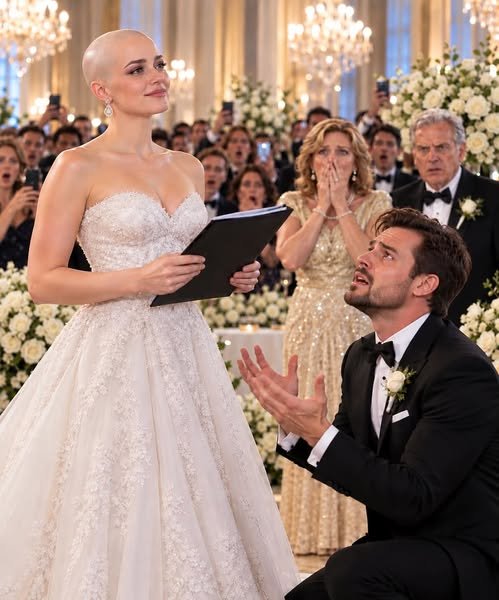
Carter stood at the altar in a navy tuxedo, with Diane in the front row in pale pink and Vanessa beside her, already smiling. When the doors opened and I walked in, the room made a sound I will never forget.
It was two hundred people inhaling at once.
I wore the white gown I’d chosen. I wore no veil, no wig, no hat. Just my own head, pale and bare and lifted. Tessa walked behind me, tears running down her face. A few guests began to stand, not out of respect for tradition but because they couldn’t stay seated.
Carter’s smile cracked. He had expected a wig, a flood of tears, and a bride too humiliated to speak. Instead he saw me walking down that aisle like I owned the building.
I stopped in front of him. The officiant looked frightened.
“Carter,” I said, loud enough for the back row, “I’d like to say something before we begin.”
“Rachel, not now,” he hissed. “Put something on your head.”
“I think I’ll keep it exactly as you left it.”
Margaret rose from the second row with her briefcase. “Mr. Whitmore, I’m the executor of the Calloway family trust. Rachel asked me to bring the documents she planned to sign today. May I read them?”
Carter’s eyes flicked to Diane. Greed beat fear. “Of course.”
Margaret opened the folder. “Fifteen million dollars was to be transferred into a joint investment account in both your names, immediately after the ceremony.”
A murmur ran through the room. Diane’s hand flew to her chest. Carter’s mouth twitched into something like triumph.
“Rachel has decided,” Margaret continued, “that she will not be signing this transfer. Instead, the full sum has been irrevocably committed to the Hartley Calloway Foundation, which funds scholarships and legal aid for survivors of domestic and intimate abuse. The transfer was completed at ten-fifteen this morning.”
Nobody moved.
“She also hasn’t signed the prenuptial amendment your attorney sent yesterday,” Margaret added. “Which, I’ll note, would have given you sweeping control of marital property within thirty days of the wedding.”
The tuxedo seemed to shrink around Carter.
“You’re out of your mind,” he said. “You can’t do this.”
“I just did.”
Then I took out my phone and handed it to Tessa, who plugged it into the hotel’s projector, as arranged with the manager.
The screen above the altar filled with three things in order.
First, Carter’s note: Now you look as ridiculous as you really are.
Second, Vanessa’s message: Mom said you deserved it after refusing to let Carter control your inheritance. Honestly, just apologize and enjoy your wedding.
Third, a page of the toxicology report, with the name of the sedative highlighted in yellow.
Diane stood up so quickly her chair toppled. Vanessa turned the color of paper. Around them, guests began to look at one another, at the screen, at the Whitmores. A man in the third row, I later learned, was Carter’s own boss.
“Is that true?” someone asked.
I looked at Carter. “You tell them.”
He opened his mouth. For once, charm failed him.
“It was a joke,” he said. “It was a prank. Everyone does pranks before weddings.”
“You drugged my champagne,” I said. “You shaved my head while I was unconscious, and you wrote me a note about it. That’s not a prank. It’s assault.”
The side doors opened. Detective Ruiz and two uniformed officers stepped through, as quietly as they could, which wasn’t very.
The arrest took less than two minutes. Carter didn’t fight. He seemed to understand, finally, that he was standing in front of two hundred witnesses with no script. The detective read him his rights beneath the flowers meant for our vows, and the room was so silent I could hear the cuffs click.
Diane tried to speak, to explain, to demand. Ortiz stepped up to her, spoke softly, and handed her a card. “Mrs. Whitmore, we’ll need to talk to you and your daughter. Please bring an attorney.”
Carter pleaded guilty four months later to assault and administering a substance without consent. The judge, who read the note aloud in court, called it “an act of contempt dressed up as humor.” He received eighteen months in custody, followed by probation, a protective order, and mandatory counseling. Diane and Vanessa were charged with conspiracy to commit assault, based on their texts. They accepted plea deals and community service. Carter’s firm let him go before sentencing.
The Hartley Calloway Foundation opened its offices that autumn. In its first year it funded legal representation for forty-one women and eleven men. I sat on the board, wearing a fuzzy half inch of dark hair, and signed every check myself.
My hair grew back slowly. By spring it was a soft, short crop, and I liked it more than I expected. By the following winter, it brushed my shoulders.
One evening, Tessa found me on the balcony of my new apartment, brushing it out in the lamplight.
“Do you ever regret it?” she asked. “The fifteen million?”
I thought about my grandfather and his one truck. About a man who thought love could be bought, and a family that believed humiliation was a form of control.
“No,” I said. “It was never a gift for him. It was a gift for everyone who’s ever woken up on the worst morning of their life and thought they had no one.”
I set down the brush.
“And besides,” I said, smiling, “he was right about one thing. I did pick the perfect day.”