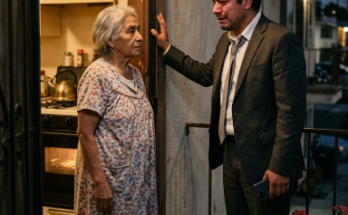
Florence Whitaker’s story begins with something deceptively ordinary: six moving cartons lined neatly along her hallway wall. What unsettled her was not their presence but the handwriting on them. Each box was labeled with precision — Kitchen, Linens, Winter Coats, Nightstand. The word Nightstand froze her in place. That piece of furniture had stood beside her bed since 1978, surviving decades of family life, hardship, and love. It was more than wood and drawers; it was memory itself.
Florence had left her home at 2:29 p.m. to buy groceries — milk, cheddar, bread, bananas, and cinnamon rolls for her grandson. She returned at 3:22 p.m., only fifty‑three minutes later, to find her life dismantled. Upstairs, she heard furniture scraping against hardwood floors, followed by voices. Her son Theodore’s calm instructions: “Push a little more to the left.” Then her daughter‑in‑law Marguerite’s casual reply: “Did you grab the curtain rods from the truck? We should finish before dinner.”
The words struck Florence like a betrayal. Truck. Curtain rods. Finish before dinner. This was not a misunderstanding. It was a plan. Her belongings were being packed away, her bedroom stripped, her home rearranged as though she were already gone.
The cartons themselves symbolized more than relocation. They represented erasure. Florence was not consulted, not asked, not even warned. Her daughter‑in‑law had taken possession of her private space, reducing decades of living into labeled boxes. The handwriting was neat, deliberate, almost clinical — as if Florence’s existence could be catalogued and filed away.
The house, once familiar, now felt foreign. The maple tree outside glowed with October fire, reminding her of autumns past with Vincent, her late husband. He had been gone eleven years, yet his presence lingered in every corner. The nightstand, the bed, the clock, the kitchen mug — all bore witness to a shared life. And now, in less than an hour, that continuity was being severed.
Florence’s shock was compounded by memory. Vincent had once warned her, in the quiet years after his illness, that family could sometimes wound more deeply than strangers. He had urged her to guard her independence, to keep her home secure, to never surrender her dignity. His words returned now with painful clarity.
The betrayal was not loud or violent. It was domestic, routine, almost polite. That made it worse. Her son’s voice carried no malice, only assumption — the assumption that he belonged, that he had the right to rearrange his mother’s life. Marguerite’s tone was brisk, efficient, focused on logistics. Together, they treated Florence’s home as a project to be completed before dinner.
Florence stood frozen, groceries still in hand, the door half open behind her. The cinnamon rolls she had bought for her grandson now seemed symbolic — sweetness intended for family, contrasted with the bitterness of being displaced by that same family.
The summary of her experience is not merely about boxes or furniture. It is about identity, memory, and the fragile boundary between belonging and exclusion. Florence’s daughter‑in‑law did not simply clear a bedroom; she attempted to rewrite Florence’s place in her own home. The act was both practical and symbolic: a quiet coup against the widow’s authority, a reshaping of domestic space that declared, without words, You no longer matter here.
Florence’s realization was immediate and devastating. Fifty‑three minutes had been enough to expose the truth: her son and daughter‑in‑law were not waiting for her consent. They were moving forward, confident in their entitlement, indifferent to her grief.
The cartons stood as silent witnesses. Each label was a verdict. Kitchen — as though her meals no longer belonged to her. Linens — as though her comfort could be folded away. Winter Coats — as though her seasons were finished. Nightstand — as though her memories could be boxed and forgotten.
The betrayal was not only logistical but emotional. Florence understood that her daughter‑in‑law’s efficiency masked a deeper intent: to claim ownership, to establish dominance, to erase the widow’s authority. Theodore’s compliance revealed another truth — that blood ties did not guarantee loyalty.
Florence’s story is a lesson in vigilance, memory, and resilience. It reminds us that family conflict often unfolds not in dramatic confrontations but in quiet, calculated acts. It shows how grief can be exploited, how widowhood can be treated as weakness, and how the sanctity of home can be violated in less than an hour.
Her husband’s final warning now echoed with prophetic weight. Vincent had known that love could be fragile, that loyalty could fracture, that independence must be defended. Florence realized that his words were not abstract advice but a shield she had failed to raise in time.
The cartons remained in the hallway, their labels stark against cardboard. Florence’s groceries sat heavy in her arms. Upstairs, furniture scraped again. Voices continued. The house was no longer hers alone.
This is the essence of Florence Whitaker’s ordeal: a widow’s discovery that her daughter‑in‑law had cleared out her bedroom while she was away shopping, and the painful recognition that her husband’s final warning had been right all along.