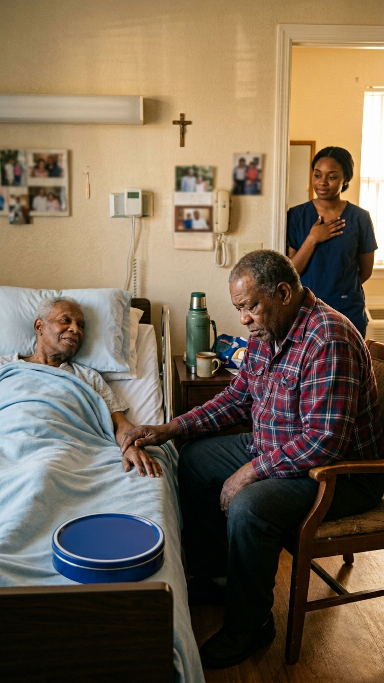
His name was Gerald.
Seventy-four years old. Bad hip. Lived three houses down from James on Livernois for twenty-two years before the neighborhood changed and Gerald moved to an apartment off Michigan Avenue.
He heard about James through a woman at their old church. Drove over on a Wednesday in June with a thermos of black coffee and a bag of butter cookies — the kind James had always kept in a jar on his kitchen counter.
The nurse at the desk looked at him. “Are you family?”
Gerald didn’t hesitate. “Yes,” he said.
He visited every day for eleven days.
He didn’t talk much. Mostly he sat. Sometimes he read the box scores out loud from his phone. Sometimes he just let the room be quiet in the way that two men who’ve known each other a long time can let silence be enough.
On the tenth day, James looked at Gerald clearly — clearer than he had in weeks — and said, “You came.”
“Course I came,” Gerald said.
James died the following morning at 6:14 a.m. Gerald was in the chair beside him. A nurse named Adaeze held his other hand.
The children arrived that afternoon, luggage still in the car, grief arriving several months too late to do any good.
The funeral was held the following Saturday. All four children sat in the front pew and wept loudly.
Gerald sat in the back.
Afterward, a young nurse from the facility approached him in the parking lot. She had worked Room 114 for the final two weeks.
She looked at him a long moment and said simply: “He knew you were there. Every single day. He knew.”
Gerald drove home. Made coffee. Sat in his kitchen.
And wept — not from grief alone, but from the particular weight of having done the right thing when no one else would.