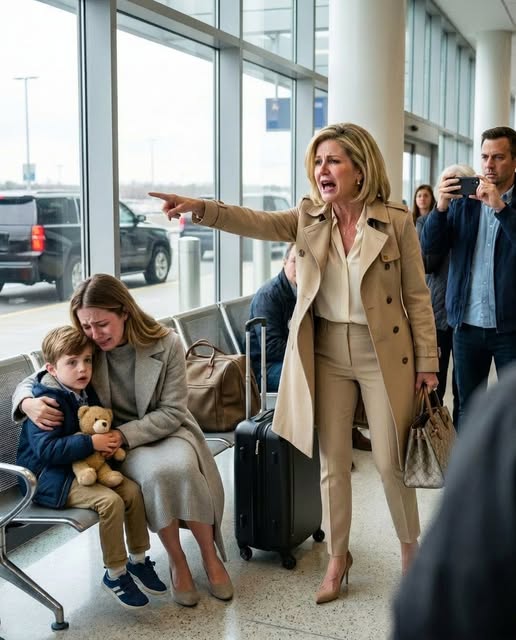
The sterile hum of JFK International Airport had always been a place of order for Raymond Whitaker. After three weeks in London, immersed in economic negotiations, he expected the familiar rhythm: chauffeur waiting, luggage handled, estate awaiting his return. Instead, the terminal became a stage for betrayal. A faded denim jacket caught his eye. On a cold bench sat Elena, his widowed daughter‑in‑law, clutching her son Leo and three battered suitcases.
Raymond’s heart seized. Elena was supposed to be safe at the Long Island estate. Ever since Liam’s death in a military training accident, Raymond had vowed to protect her and Leo. Yet here she was, abandoned in the chaos of arrivals.
Chapter 2 – The Exile
Elena’s tears revealed the cruelty behind her presence. Beatrice, Raymond’s sister, had stormed the guest house with guards, packed Elena’s belongings, and handed her a one‑way ticket to Ohio. Her words were venomous: “You don’t fit this family. You’re a burden dragging us down.”
This was not merely an insult—it was an attempted erasure. Beatrice sought to rewrite the family’s legacy, exploiting Liam’s death to exile his widow and child. Her obsession with reputation had crossed into tyranny.
Chapter 3 – The Clash of Worlds
Raymond knelt before Elena, touching Leo’s hair, listening to her trembling voice. The textbook analysis of this moment reveals three forces colliding:
- Class prejudice: Beatrice’s elitism versus Elena’s modest upbringing.
- Grief and vulnerability: Elena’s desperation, Leo’s innocence, Raymond’s shock.
- Power vacuum: With Liam gone, Beatrice believed she could seize control.
The airport became more than a transit hub—it was the battlefield where compassion confronted cruelty.
Chapter 4 – The Command
Raymond rose, his face a mask of resolve. He lifted Elena’s luggage, looked her in the eye, and spoke with quiet steel: “Get in the car.”
This line, simple yet decisive, marked the turning point. It was not just an invitation—it was a declaration of war. Raymond reclaimed authority, signaling that Beatrice’s reign of manipulation was over.
Chapter 5 – Legacy and Power
The textbook‑style expansion explores Raymond’s broader reflections:
- Family Legacy: His son’s sacrifice, his duty to protect Leo as the heir.
- Power Structures: Beatrice’s attempt to weaponize class and reputation.
- Moral Authority: Raymond’s belief that true power lies not in wealth but in loyalty and protection.
By analyzing these themes, the narrative becomes both emotional and instructive—a case study in how families fracture under grief and ambition.
Chapter 6 – Elena’s Dignity
Elena’s role is not passive. Though broken, she embodies resilience. Her refusal to abandon Leo, her willingness to endure humiliation, and her tears at JFK reveal the strength of a mother’s dignity. In textbook terms, she represents the “outsider” who challenges entrenched hierarchies, forcing Raymond to confront the moral decay within his own bloodline.
Chapter 7 – The Reckoning Ahead
The story closes with anticipation. Raymond’s command—“Get in the car”—is both protection and confrontation. The reader knows what comes next: Beatrice will face the full weight of Raymond’s authority. The textbook analysis frames this as the inevitable clash between compassion and cruelty, between legacy and ambition.