The moment my mother said, “But we forgive you, sweetheart,” something inside me finally clicked.
Not broke.
Not shattered.
Cleared.
Like fog lifting from a harbor.
Because after three years, I finally understood something that had taken me most of my life to learn:
My family never wanted reconciliation.
They wanted access.
Access to my time.
My money.
My guilt.
My obedience.
And tonight was simply another collection attempt.
I looked around the table.
Seventeen people.
Seventeen adults.
Not one had asked about my life.
Not one had asked if I was happy.
Not one had apologized for what happened after Grandma died.
Every conversation had revolved around the same theme:
What I owed them.
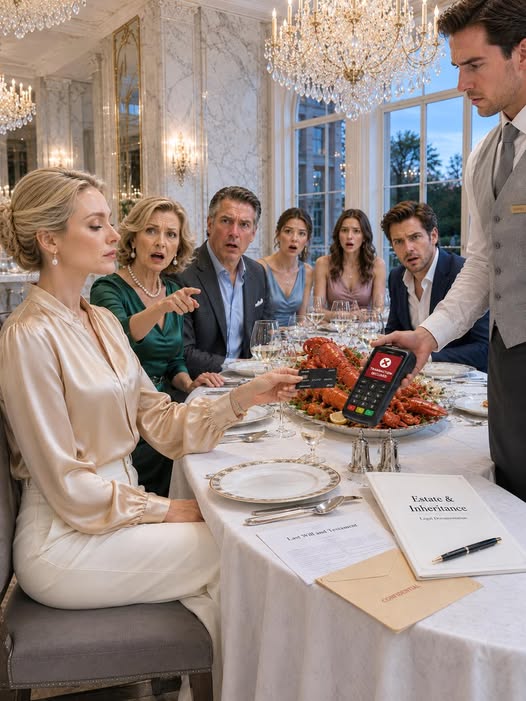
The waiter appeared beside my father.
“Whenever you’re ready, sir.”
My father smiled confidently.
Then he pushed the check folder toward me.
“You’re covering this, right, Emily?”
Silence settled over the table.
Everyone watched.
Waiting.
Expecting.
Assuming.
The old Emily would have panicked.
The old Emily would have paid.
The old Emily would have spent weeks justifying it to herself.
But that woman had disappeared three years ago.
Slowly, I opened the folder.
The total sat at the bottom.
$7,842.63.
I almost laughed.
Nearly eight thousand dollars.
For a dinner I didn’t organize.
A dinner I hadn’t wanted.
A dinner specifically designed to trap me.
I closed the folder.
Then slid it back.
“No.”
The word landed like a bomb.
Jason blinked.
“What?”
“No.”
My father frowned.
“Emily, don’t start.”
“Start what?”
“This attitude.”
The table shifted uncomfortably.
I remained calm.
“I didn’t invite seventeen people to an expensive restaurant.”
My mother forced a smile.
“We’re family.”
“Exactly.”
The smile vanished.
“If we’re family, why am I the only one expected to pay?”
Nobody answered.
Because there was no answer.
Only entitlement.
Jason leaned forward.
“You have money.”
There it was.
The truth.
Not love.
Not reconciliation.
Money.
I looked directly at him.
“And?”
“You inherited Grandma’s investments.”
I nodded.
“I did.”
My father’s jaw tightened.
“Which should have been shared.”
The room grew quiet.
Finally.
The real conversation.
Three years late.
I folded my hands on the table.
“Grandma made her decision.”
My aunt Denise sighed dramatically.
“She was manipulated.”
I laughed.
Actually laughed.
The sound startled everyone.
“Manipulated?”
Denise crossed her arms.
“She wasn’t thinking clearly.”
That did it.
I reached into my purse.
Then I removed a sealed envelope.
Their expressions changed instantly.
Confusion.
Curiosity.
Concern.
I placed the envelope in the center of the table.
My father stared at it.
“What is that?”
“Something Grandma left for me.”
Nobody moved.
Slowly, I opened the envelope.
Inside was a letter.
A handwritten letter.
One I had never shown anyone.
Not even my attorney.
Not because it was legally important.
Because it was personal.
Painfully personal.
I unfolded the pages.
Then I began reading.
“My dearest Emily.
If you’re reading this, I’m gone.
And if I know this family, there will already be arguments about my estate.”
The table went silent.
I continued.
“I want you to know something.
The cottage and investments are yours because you were the only person who visited when there was nothing to gain.”
Nobody moved.
Nobody spoke.
“You were the only grandchild who called after Grandpa died.”
Jason stared at the table.
“You were the only one who sat beside my hospital bed.”
My mother’s face reddened.
“You were the only person who asked how I felt instead of asking what was in my will.”
Silence.
Absolute silence.
Then came the final paragraph.
“The others will tell themselves stories.
They will say I was confused.
Manipulated.
Unfair.
But I was neither confused nor unfair.
I simply paid attention.
And I gave my legacy to the person who treated me like family.”
My voice shook slightly as I finished.
“The rest had years to earn what they now feel entitled to.”
I lowered the letter.
No one spoke.
Because there was nothing left to argue.
Grandma had answered every accusation before they made it.
Years before.
My father’s face turned crimson.
“That doesn’t change anything.”
I stared at him.
It changed everything.
Jason stood abruptly.
“You’re humiliating everyone.”
I almost couldn’t believe it.
They had tried to ambush me with an $8,000 bill.
And somehow I was humiliating them.
I looked around the table.
At every face.
Every person who had spent three years convincing themselves they were victims.
Then I stood.
And I decided to say what nobody else ever would.
“You know what’s funny?”
Nobody answered.
“I spent years thinking I lost my family.”
The room remained silent.
“But sitting here tonight, I realize I lost you a long time before Grandma died.”
My mother’s eyes filled with tears.
Real or strategic, I couldn’t tell.
“Emily…”
“No.”
I raised a hand.
“You don’t get to cry now.”
Her face fell.
I continued.
“When Grandma was sick, you were too busy.”
“When she was lonely, you were unavailable.”
“When she needed help, you disappeared.”
The room froze.
“And now you’re angry because she noticed.”
Nobody could meet my eyes.
Not one person.
The truth had finally entered the room.
And nobody liked it.
My father stood.
“This is ridiculous.”
“No.”
I pointed toward the bill.
“That is ridiculous.”
Then I did something unexpected.
I pulled out my phone.
Opened my banking app.
And transferred exactly $37.50.
The cost of the iced tea and salad I had ordered.
Nothing else.
The confirmation appeared instantly.
I set the phone down.
“There.”
Jason stared.
“What is that?”
“My portion.”
The waiter, who had been hovering nervously nearby, looked relieved.
I handed him the receipt.
Then picked up my purse.
My mother rose quickly.
“You’re really leaving?”
I looked at her.
For the first time in years, I saw her clearly.
Not as the mother I wished she had been.
As the person she actually was.
And those are very different things.
“Yes.”
Tears slipped down her cheeks.
“After everything we’ve been through?”
I nodded.
“Exactly.”
Then I walked away.
No shouting.
No dramatic scene.
No revenge speech.
Just consequences.
The most powerful thing in the world.
As I crossed the restaurant, I heard raised voices behind me.
Jason blaming my father.
My father blaming Denise.
Denise blaming everyone.
The bill had become their problem.
Exactly where it belonged.
Outside, cold Boston air hit my face.
The harbor lights reflected across the dark water.
For a moment, I simply stood there.
Breathing.
Feeling lighter than I had in years.
A week later, I learned what happened after I left.
Apparently nobody wanted to pay.
The argument lasted nearly forty minutes.
Several relatives attempted to leave.
Management became involved.
The restaurant threatened to call police.
Eventually everyone contributed.
Nobody was happy.
The irony was beautiful.
For years they had expected one person to carry everyone else’s burden.
For one night, they were forced to share it.
Three months later, I received a letter.
Not from my parents.
Not from Jason.
From Aunt Denise.
Inside was a short note.
Three sentences.
You were right.
We were wrong.
Grandma would be ashamed of us.
I read it twice.
Then put it away.
No celebration.
No victory dance.
Just closure.
Because the truth is that some endings aren’t about revenge.
They’re about freedom.
That summer, I spent several weeks at Grandma’s lake cottage in Maine.
The mornings smelled like pine trees and lake water.
The evenings were quiet.
Peaceful.
The kind of peace that exists when nobody is demanding anything from you.
One afternoon, I sat on the porch with Grandma’s letter.
The same letter that had ended the argument.
The same letter that had protected me even after she was gone.
As sunlight reflected across the lake, I finally understood the greatest gift she left behind.
It wasn’t the cottage.
It wasn’t the investment account.
It wasn’t the money.
It was permission.
Permission to stop proving my worth to people determined not to see it.
Permission to walk away.
Permission to choose peace.
And for the first time in my life, I did.
The family dinner they thought I would pay for became the last favor they ever expected from me.
And the best investment I ever inherited wasn’t money.
It was learning the difference between family and obligation.