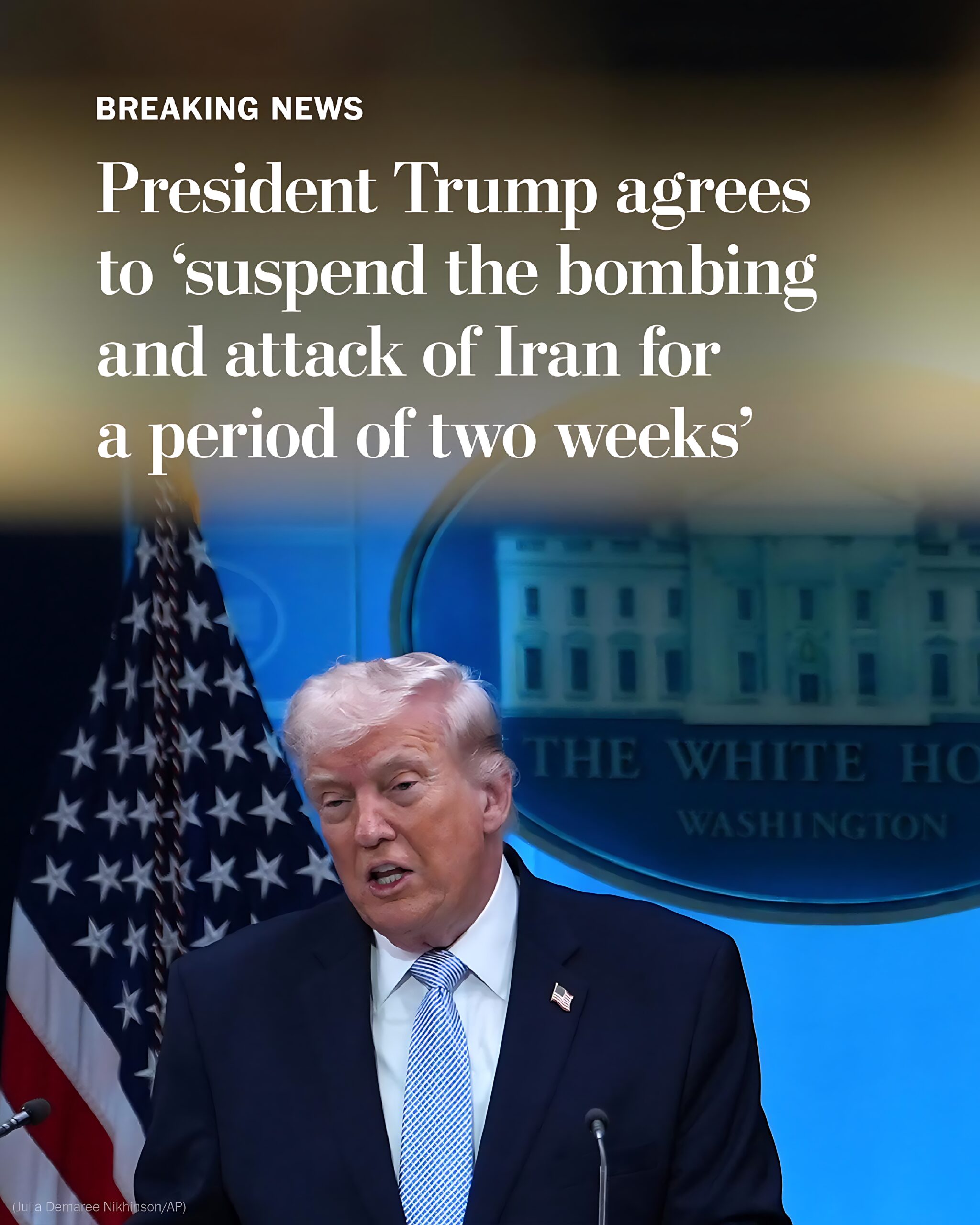
WASHINGTON — President Donald Trump announced Wednesday that the United States will suspend all bombing and offensive military operations against Iran for a period of two weeks, marking the first formal pause in hostilities since the conflict escalated earlier this year.
Speaking briefly to reporters outside the Oval Office, Trump said the temporary halt was agreed to after “productive communication” through European and Gulf intermediaries. The pause, he said, is intended to give negotiators “a real chance” to make progress toward a broader de‑escalation agreement.
“We’re giving diplomacy a window,” Trump said. “For two weeks, no strikes, no attacks — but Iran has to show good faith.”
A Shift in Tone After Weeks of Escalation
The announcement comes after days of heightened rhetoric, including repeated warnings from the administration that the U.S. was prepared to target Iranian bridges, power plants, and military infrastructure if Tehran did not reopen the Strait of Hormuz.
The two‑week suspension does not lift the U.S. deadline for Iran to ease restrictions on tanker traffic, but officials say it creates space for negotiators to work without the immediate threat of new strikes.
Senior administration officials described the pause as “conditional,” noting that any attack on U.S. forces or allies would immediately void the agreement.
Iran’s Initial Response
Iranian state media acknowledged the suspension but said Tehran would not accept any agreement “under threat or coercion.” Officials in Tehran said they welcomed a reduction in hostilities but insisted that the U.S. must also ease economic pressure if it expects meaningful progress.
Diplomats familiar with the talks say Iran has signaled interest in a phased de‑escalation plan but remains firm on issues of sovereignty and control over the Strait of Hormuz.
International Reaction
Global leaders reacted cautiously to the announcement:
- European Union officials praised the pause as “a necessary step toward preventing a wider regional conflict.”
- Gulf states expressed guarded optimism, noting that the suspension could stabilize energy markets.
- China and India, major importers of Gulf oil, urged both sides to use the two‑week window to reach a durable agreement.
Oil prices dipped slightly following the announcement, reflecting hopes for reduced military risk in the region.
What Comes Next
U.S. officials say the next two weeks will be critical. Negotiators are expected to focus on reopening the Strait of Hormuz, establishing communication channels to prevent miscalculation, and exploring a framework for longer‑term de‑escalation.
The White House emphasized that the suspension is not a permanent cease‑fire but a “test of Iran’s intentions.”
For now, the pause marks the most significant diplomatic opening since the conflict began — and a moment of cautious relief for a region on edge.