Marcus tried.
God knows he tried.
He enrolled in every VA program available — physical therapy, vocational rehabilitation, mental health counseling. He showed up to every appointment on his prosthetic leg, jaw set, refusing to let pain read as weakness. He applied for housing assistance and was placed on a fourteen-month waiting list. He applied for accelerated disability benefits and received a letter of acknowledgment and nothing else for six months.
Meanwhile, the bills didn’t wait.
Dominique had stopped working her second job shortly after he came home. When he asked why, she said she needed to be present for him. He believed her. He was grateful. He doubled down on his own recovery, pushing harder so he could return to work faster, so she wouldn’t carry the financial weight alone.
He noticed things. Small things he catalogued and then quietly excused.
A second phone she kept face-down.
Perfume on a Tuesday afternoon when she hadn’t left the house — or said she hadn’t.
The way she startled when he came down the hallway, like his presence in his own home had become an interruption.
He told himself he was paranoid. That trauma does this — makes ordinary things feel threatening. His counselor had warned him about hypervigilance.
He worked on trusting her harder.
Three months after coming home, Marcus had a VA appointment that ended forty minutes early. The buses were running slow. He decided to walk — he always walked when the weather was decent, building strength and stamina in the prosthetic.
He came through the back door because the front porch step was still broken and he’d been asking the landlord to fix it for weeks.
The house wasn’t empty.
He stood in the hallway for ten full seconds before his brain fully processed what his eyes had already seen.
The man scrambled. Dominique didn’t even cry immediately — she just stared at Marcus with an expression he would carry for years. Not guilt, exactly. Something closer to exhaustion. Like she had been waiting for this moment to arrive and was almost relieved it finally had.
The man was someone Marcus recognized. A neighborhood face. Nobody significant.
That made it worse, somehow.
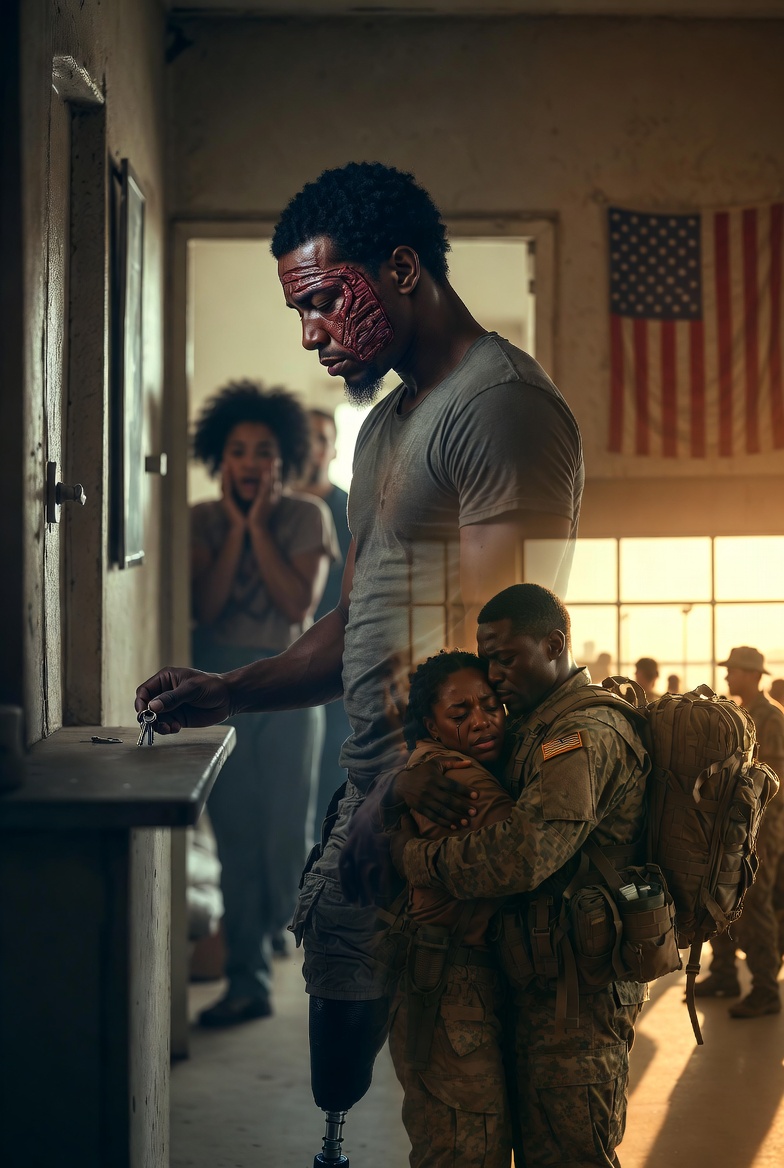
Marcus didn’t raise his voice. That surprised him later — he had expected rage. Instead, he felt something colder and more final settle through his entire body. He set his keys on the counter with extraordinary care. He looked at Dominique one long moment.
Then he walked back out the door he’d come in through.
He slept at his unit brother Darnell’s apartment that night. Then the next night. Then the next.
He never went back for anything but his discharge papers and his grandmother’s Bible.
The divorce was finalized four months later. Dominique didn’t contest it.
Marcus Webb rebuilt slowly. A veterans’ nonprofit connected him with real legal advocacy — the kind the VA pamphlet never mentioned. His benefits were eventually corrected. He found work in security consultation. He moved into a small apartment with a fixed front step and a window that caught morning light.
He still walks with intention. Still carries the scars. Still flinches sometimes at loud sounds in parking lots.
But he also laughs again — that chest-deep laugh that fills rooms.
It took time.
But no one who truly knows Marcus Webb was ever surprised that he made it.
Some men are just built, at their core, to keep standing.
He Gave Everything For His Country. His Country Gave Him Nothing Back.