It was Miguel who posted the photo.
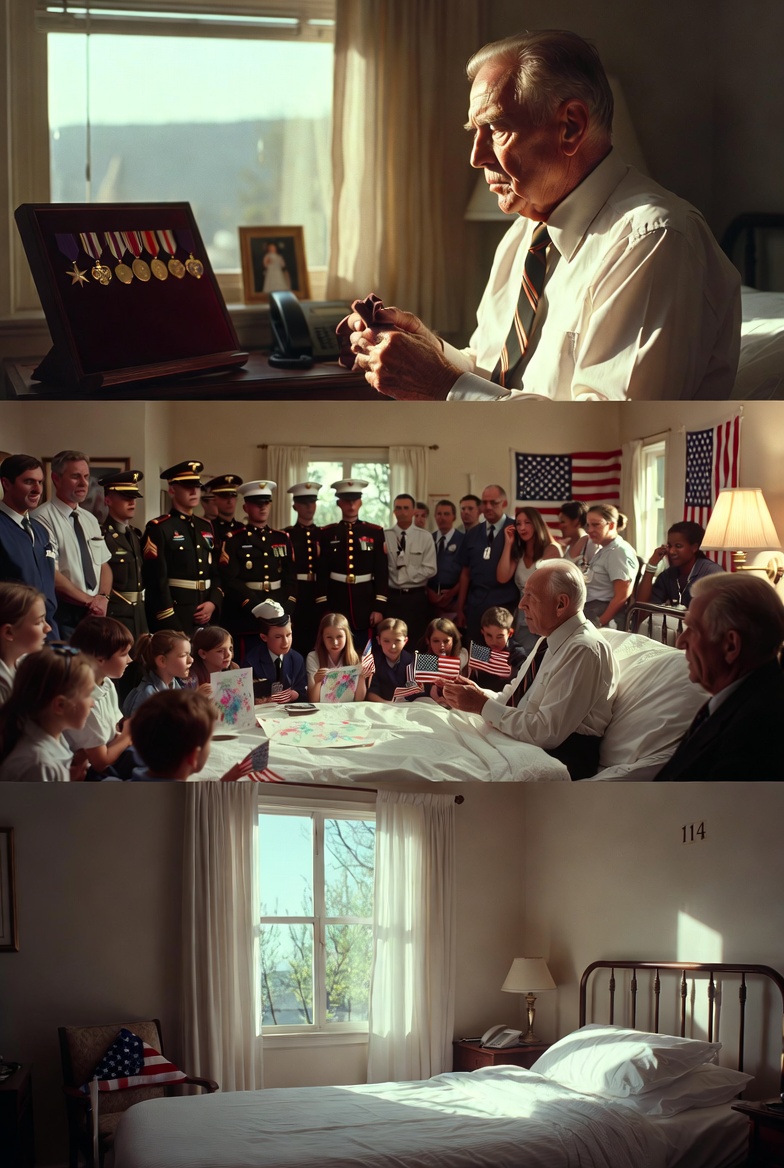
He hadn’t planned it as anything significant. Just a quiet act of witnessed injustice that he couldn’t carry alone anymore. He took the picture one morning — Harold sitting straight-backed in his chair by the window, medals polished and displayed beside him, dressed in his pressed shirt and Army tie, hands folded in his lap, eyes on the door — and he wrote four sentences underneath it.
He wrote that this man was ninety-four years old. That he was a Korean War veteran with a Silver Star and three Purple Hearts. That his family had not visited in three years. That he polished his medals every single morning anyway.
Miguel posted it on a Thursday night from the Pinecrest parking lot after his shift.
He went home and went to sleep.
He woke up to eleven thousand notifications.
The post had been shared overnight across veteran communities, military family networks, and eventually into the general current of the internet where certain true things move at a speed that algorithms cannot fully explain. By Friday afternoon it had been shared forty thousand times. By Saturday morning, news outlets in three states had picked it up.
The calls to Pinecrest began Friday morning.
Could they visit Harold? Could they send cards? Could they bring anything? A veteran’s organization in Greensboro chartered a van. A Marine Corps League chapter four hours away organized a formal visitation with dress uniforms. A group of active duty soldiers from Fort Liberty called the facility and requested permission to pay their respects to a Silver Star recipient.
Pinecrest’s administrator — a practical woman named Carol who had run care facilities for twenty-two years and believed she had seen everything — sat at her desk Friday afternoon and processed request after request with an expression that kept threatening to become something other than professional.
She approved every single one.
They came on a Sunday.
Harold was told only that he had visitors. He dressed in his best — the same pressed shirt, the Army tie, the dress pants — and sat in his chair at 9 AM and waited with the stillness of a man who has spent a lifetime being ready.
The first car arrived at 9:30.
By noon, the Pinecrest parking lot was full.
Sixty-three people came that day. Veterans in uniform. Military families. A ninety-one-year-old Korean War veteran who had driven two hours with his son specifically to shake Harold’s hand and say “I was there too.” Schoolchildren from a local fourth grade class who had made cards by hand — crayon drawings of medals and flags and the words THANK YOU in large careful letters. A woman who said only that her grandfather had served in Korea and she had never gotten to thank him and she hoped this would count for something.
Harold received every single person.
For six hours he sat in the Pinecrest common room — which the staff had decorated with American flags and a banner the night nurses had made at midnight — and he shook hands and accepted embraces and listened to stories and told some of his own, his voice steady and his posture unbroken and his eyes the most alive Nurse Deborah had ever seen them.
At one point a young soldier in dress uniform — twenty-two years old, just back from his first overseas deployment — sat beside Harold and asked him what it felt like to serve.
Harold looked at him for a moment.
“It felt like the most important thing I ever did,” he said. “And I’d do every day of it again.”
The young soldier nodded slowly.
“Thank you, sir,” he said. “For real.”
Harold placed one hand briefly on the young man’s arm.
“Thank you for coming, son.”
Richard and Patricia — Harold’s children — saw the post on Saturday. Both called Pinecrest that weekend. Both spoke with their father briefly on the phone.
Harold was gracious. He was always gracious.
But the room that had been full of strangers who chose to come said something that a phone call from people who had been reminded to call could not unsay.
Harold died four months later on a Tuesday morning in March. Peacefully. In room 114. Nurse Deborah was with him.
His medals were polished.
His window was open to the spring morning.
The Pinecrest staff placed a single folded American flag on his empty chair.
Miguel posted one more photo that day.
Just the chair. The flag. The medals.
Four words underneath.
“Rest easy, Sergeant Briggs.”
It was shared two hundred thousand times.
He polished his medals every morning for a family that stopped coming. Strangers drove hours to give him what his own blood wouldn’t. Share this for every veteran sitting alone in a room somewhere waiting for a knock on the door that never comes. 🎖️🇺🇸 Tag someone who needs to read this today. 👇