His neighbor was a sixty-two-year-old retired schoolteacher named Evelyn Cross.
She lived directly across the hall in apartment 4B and had learned, over eight months of proximity, the precise rhythms of Daniel’s comings and goings the way perceptive people learn the patterns of those around them without meaning to.
She knew he left at 5:45 AM for early shifts. She knew he returned between 6 and 7 PM most evenings. She knew he cooked — she could smell it, something real and careful, not the microwave indifference of someone who had stopped trying. She knew he had a son’s photo on the wall visible once when she passed his open door. She knew he nodded in the hallway with the particular nod of someone who has been courteous his whole life but has forgotten how to begin a real conversation.
She had knocked on his door exactly once — a casserole when he moved in, standard neighborly gesture. He had thanked her with genuine warmth and returned the dish two days later washed and dried. That had been the extent of it.
On the evening of his forty-fourth birthday she heard something she hadn’t heard before through their shared wall.
Not crying, exactly. Not distress in any way she could name clinically.
Just a silence that was different from other silences. The kind a person who has spent forty years paying close attention to human beings learns to recognize as something other than ordinary quiet.
She stood in her hallway for a moment.
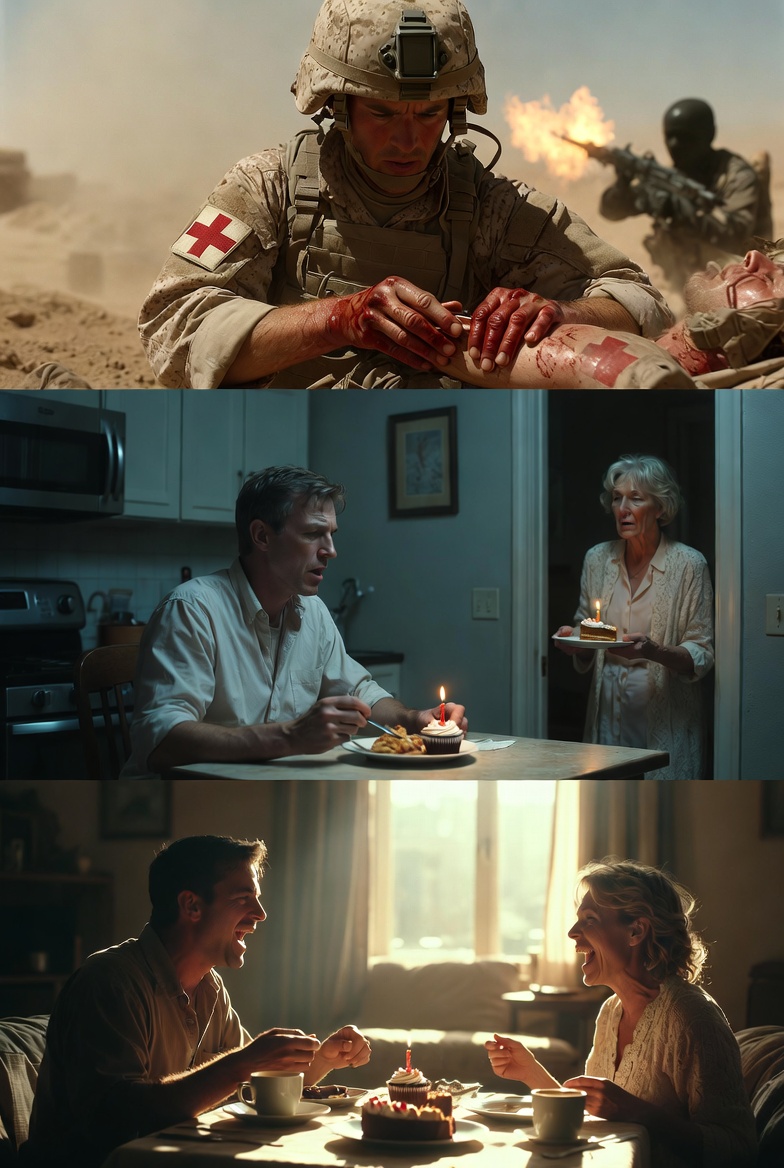
Then she picked up the spare piece of birthday cake she had made that afternoon — her own birthday, she made herself a small one every year, a habit from living alone — and she crossed the hall and knocked.
Daniel opened the door in the same clothes he had arrived home in. The meal he had cooked was visible on the counter behind him, partially eaten. His face was the specific face of a man managing something large with great discipline.
Evelyn held up the plate.
“I made too much cake,” she said. “It’s my birthday too, as it happens. I don’t see any reason two people should eat birthday cake alone when they live six feet apart.”
Daniel looked at her for a moment.
Something crossed his face that wasn’t quite expressible.
“Come in,” he said.
They sat at his kitchen table for three hours. Evelyn did not ask probing questions. She talked about her own life — her teaching years, her late husband, the grandson she video-called every Sunday who was learning to walk. She was funny in the dry specific way of people who have processed enough of life to find its absurdity genuinely amusing.
Daniel laughed twice. Real laughs. The kind that surprise you by arriving.
At some point — naturally, without architecture — he began to talk.
Not everything. Not all at once. But enough. The loneliness. The sons. The particular impossible weight of being the person who saves everyone and having no framework for being the person who needs saving.
Evelyn listened the way teachers listen — fully, without preparing her response while he was still speaking, without minimizing or redirecting.
When he finished she was quiet for a moment.
“You know,” she said carefully, “the bravest thing a man like you can do now is exactly what you just did. Say it out loud to another human being.”
Daniel looked at his hands — the hands that had held fourteen lives together in the dirt of foreign countries.
“I don’t know how to ask for help,” he said. Honest. Direct. The first completely undefended thing he had said in years.
“I know,” Evelyn said. “But you just did. Just now. That counts.”
She connected him the following week with a veterans’ peer support group run by a former Marine named Torres who had been through his own version of the same tunnel and had found the other side. Not a pamphlet group. Not a checklist group. A room of men who understood the specific language of what it means to carry others so long you forget you have weight of your own.
Daniel went once because Evelyn asked him to.
He went back the following week because he wanted to.
His older son Marcus called three months later — unprompted, a real call, forty minutes. They talked about baseball. They talked about nothing. They talked about everything that mattered disguised as nothing the way men do when they are slowly finding their way back to each other.
Daniel still works as an EMT.
He still runs toward the emergency without hesitation.
But now, on Tuesday evenings, he crosses the hall and has dinner with Evelyn who makes too much food deliberately and asks about his week with the full attention of someone who has decided he is worth showing up for.
He is learning — slowly, imperfectly, with significant resistance from a lifetime of conditioning — that being saved does not require a battlefield.
Sometimes it requires one neighbor.
One piece of birthday cake.
One knock on the right door at exactly the right moment.
He carried wounded soldiers through gunfire for sixteen years. He came home and couldn’t find one person to carry him. Share this for every veteran fighting invisible battles alone in quiet apartments. 🎖️💙 If you know someone struggling in silence — knock on the door. Don’t wait. Tag someone who needs to read this today. 👇