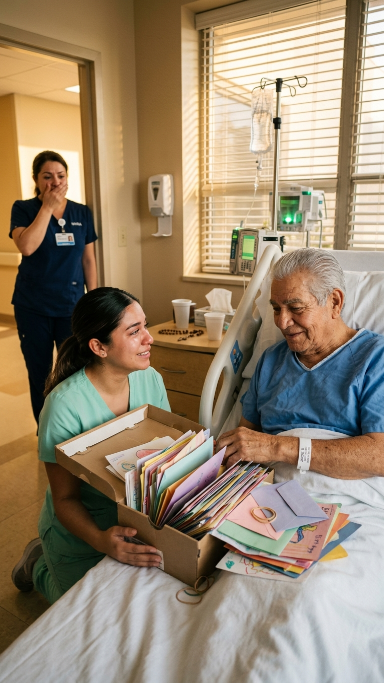
Rosa brought the box to the charge nurse, Maria, who recognized the weight of what she was holding before she’d even opened the first envelope. They stayed late that night, reading with permission Eduardo had quietly given when he woke and found them sitting beside his bed, neither of them pretending they hadn’t been crying.
The cards spanned forty years. His children — four of them, three sons and a daughter — had written to him faithfully every birthday from the time they could hold a crayon until sometime in their late twenties. The last card in the stack was dated eleven years ago.
Nobody knew what happened. Eduardo didn’t volunteer it, and the nurses didn’t push. What they could see was that he had kept every single one. Not stored — kept. Carried, clearly, from home to home. The box had been taped and re-taped at the corners. Some cards had water stains. A few were brittle at the folds from being opened too many times.
Maria made a decision that wasn’t in any protocol manual. She found the names. It took two days of careful work through public records and a hospital social worker who understood what was being asked without needing it explained.
She left a simple voicemail for each of the four children: “Your father is in the hospital. He keeps your cards under his bed. I think you should know.”
Two didn’t call back.
One called and spoke to Eduardo for forty minutes, weeping the entire time.
And one — his daughter, Carmen, who lived four hours away in San Antonio — arrived on a Friday morning with her own children in tow, a woman in her fifties with her father’s eyes, walking fast down the hall of Room 114 like she was afraid if she slowed down she might lose her nerve.
Eduardo was sitting up when she walked in.
He didn’t look surprised. He looked like a man who had been waiting a very long time, and had quietly decided to keep waiting, because the alternative was giving up.
The nurses gave them the room. They stood in the hallway and didn’t say much to each other. There wasn’t anything to say that the moment wasn’t already saying better.
Rosa still thinks about that shoebox. About what it means to love people who have stopped showing up — and to keep the proof of better days right where you can reach them, even from a hospital bed.
Especially then.