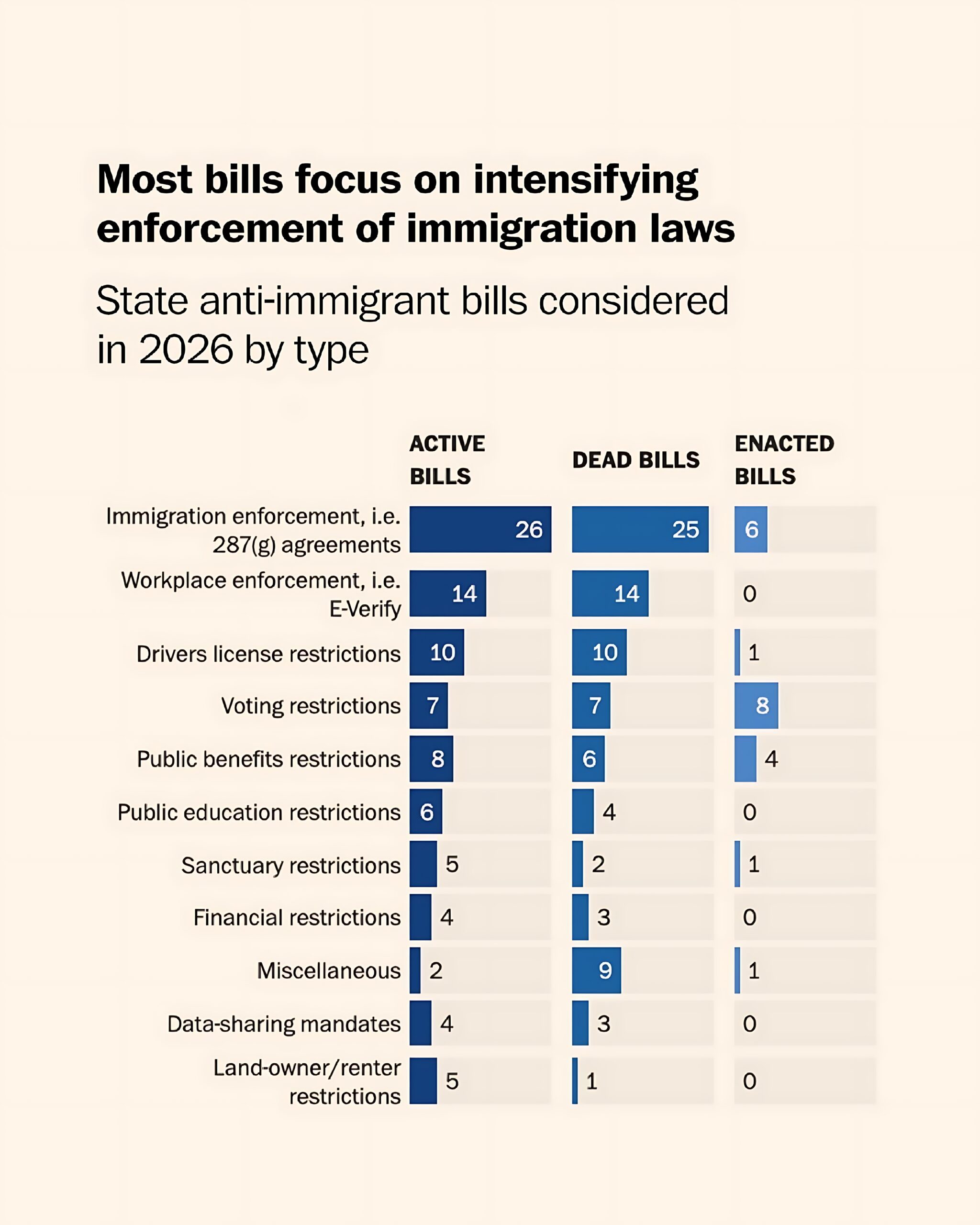
WASHINGTON — With Congress paralyzed by partisan divisions, Republican-led states are increasingly moving to implement elements of the Trump administration’s anti‑immigration agenda on their own, introducing hundreds of bills aimed at tightening enforcement and restricting benefits for undocumented migrants.
According to legislative tracking groups, nearly 200 immigration‑related bills have been filed across more than a dozen states since January. Most have stalled amid opposition from business coalitions and faith‑based organizations, but analysts say the surge reflects a growing effort by state governments to fill the policy vacuum left by Washington’s gridlock.
“States are acting because Congress isn’t,” said a policy researcher at the Migration Policy Institute. “Republican legislatures are trying to replicate Trump‑era enforcement priorities — even if many of these proposals never make it into law.”
A Patchwork of State-Level Initiatives
The bills vary widely in scope. Some seek to expand local law‑enforcement authority to detain migrants, while others propose restrictions on public benefits or penalties for employers who hire undocumented workers. Texas, Florida, and Tennessee have led the charge, introducing measures that mirror federal policies once championed by the Trump administration.
In Florida, lawmakers advanced a bill requiring hospitals to report patients’ immigration status to the state. In Texas, legislators proposed expanding state police powers near the border. Several Midwestern states have debated resolutions urging Congress to resume construction of the border wall.
Business and Faith Groups Push Back
Despite the flurry of proposals, most of the roughly 200 bills have stalled, largely due to resistance from business associations and Christian advocacy groups that warn of economic and moral consequences. Agricultural and construction industries have argued that stricter enforcement could worsen labor shortages, while church leaders have urged compassion and due process for migrants.
“Our faith calls us to welcome the stranger,” said a spokesperson for the National Association of Evangelicals. “Punitive laws do not reflect the values we hold as Americans or as Christians.”
Congressional Paralysis Fuels State Action
The state‑level momentum comes as Congress remains deadlocked over comprehensive immigration reform. Efforts to pass bipartisan border legislation collapsed earlier this year, leaving states to navigate enforcement and humanitarian challenges on their own.
Legal experts say the trend could deepen the divide between states that align with Trump‑era policies and those pursuing more inclusive approaches, such as California and New York.
A Fragmented National Landscape
Immigration advocates warn that the patchwork of state laws could create confusion and unequal treatment for migrants depending on where they live. Federal courts have previously struck down state measures that conflict with national immigration authority, but analysts expect more legal battles ahead.
“We’re seeing a de facto decentralization of immigration policy,” said a constitutional law professor at Georgetown University. “It’s a reflection of political polarization — and of Congress’s inability to act.”
What Comes Next
Several Republican governors are expected to revisit stalled bills later this year, hoping to capitalize on voter frustration over border security. Meanwhile, business and faith groups plan to intensify lobbying efforts to block measures they view as harmful or unconstitutional.