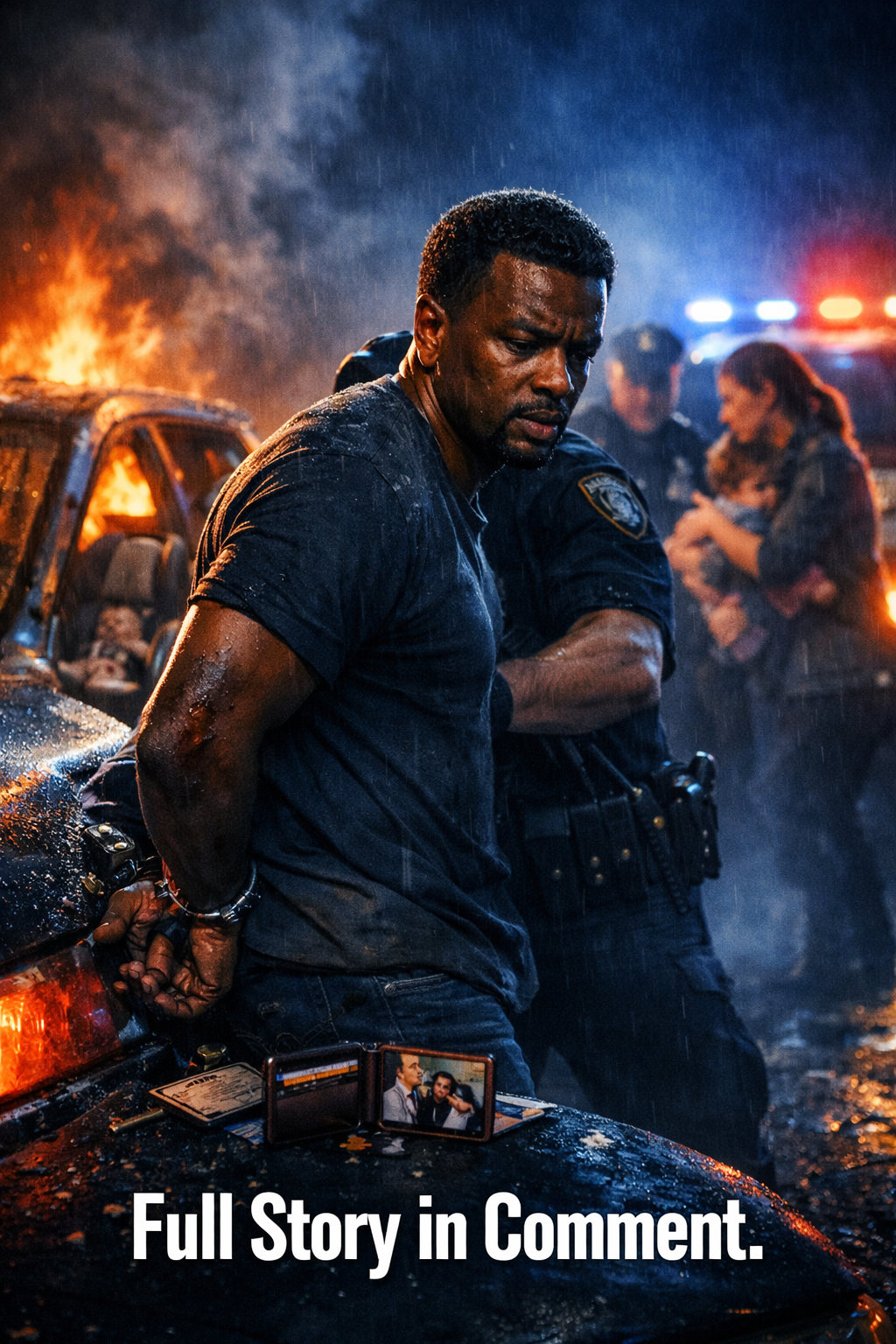
He was walking home from work when he saw it — smoke rising from a parked car, faint at first, then thick and gray. Inside, a baby was crying.
He didn’t think. He ran. He smashed the window with his elbow, ignoring the pain. He reached in, unbuckled the baby, and pulled her out just as the flames began to crawl across the dashboard.
The baby was crying, but alive. He held her close, whispering, “You’re okay. You’re safe.”
Then the mother arrived. She saw him — a Black man holding her child — and screamed.
Within minutes, sirens filled the air. Police cars. Ambulance. Crowd. Phones recording.
He tried to explain, but the words drowned under the noise. “She was inside!” he shouted. “I saved her!”
But all they saw was his skin. All they heard was her scream.
“Put the child down!” “Step away from the vehicle!” “Hands where we can see them!”
He obeyed. He always obeyed.
The baby reached for him, tiny fingers grasping the air. But they pulled him back, cuffed him, and pushed him against the burning car.
The mother sobbed, clutching her child. The officer asked, “Is this the man?” She nodded, still shaking. “He broke the window. He was holding her.”
No one asked why. No one asked how.
The fire truck arrived too late. The car was gone. The truth was gone with it.
Hours later, at the station, they reviewed the footage. A bystander’s video showed everything — the smoke, the rescue, the moment he pulled the baby out. The officer sighed. “You’re free to go.”
He didn’t move. He just stared at his hands — scraped, burned, trembling. The same hands that saved a life now felt like evidence of guilt.
He whispered, “I did the right thing.” The officer didn’t look up. “Sometimes that’s not enough.”
He walked home alone, the smell of smoke still clinging to his clothes. Every step heavier than the last. Every breath reminding him that heroism has a color — and his wasn’t the right one.