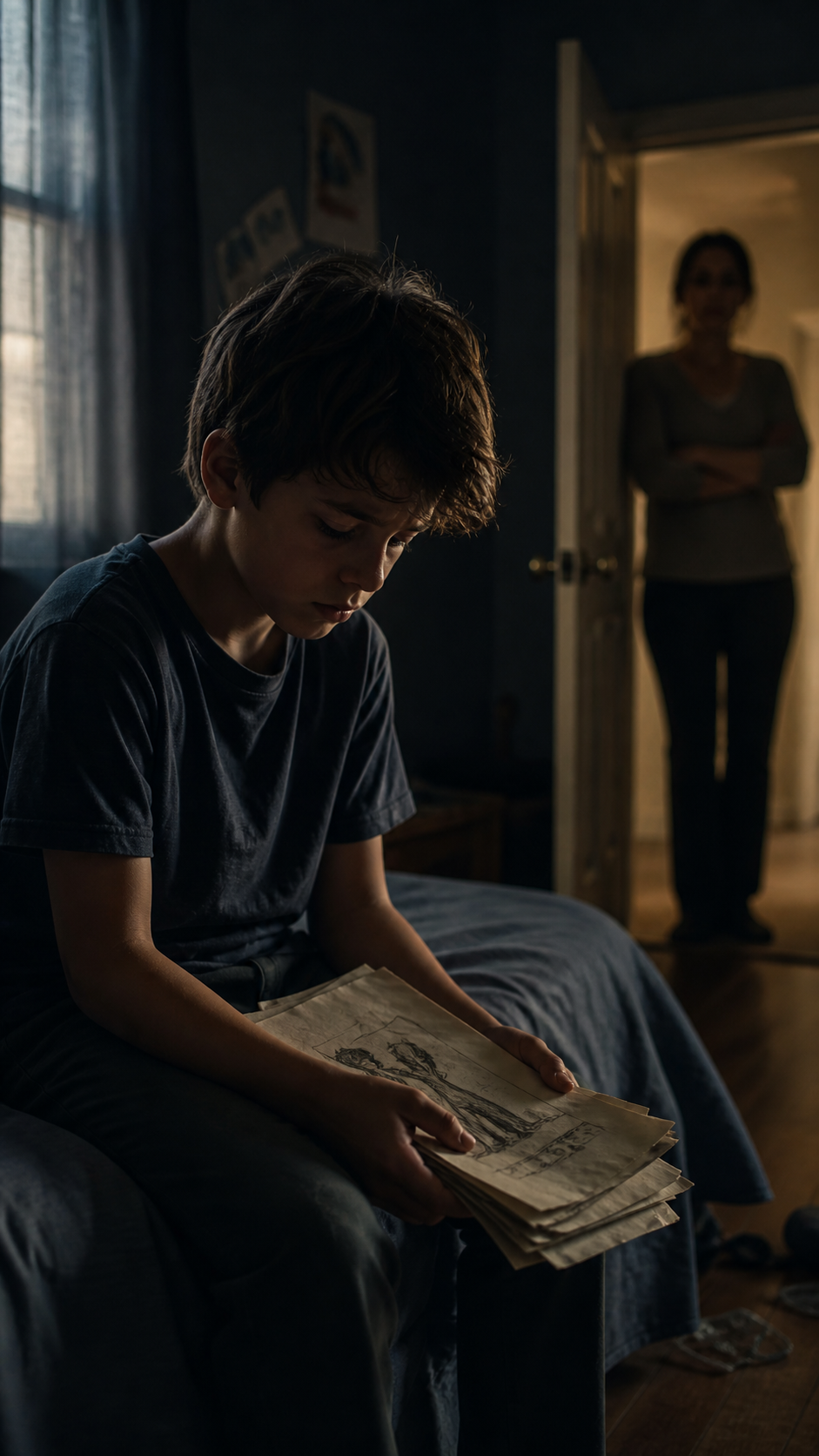
Amir was twelve when his world changed. His mother’s laughter — the sound that used to fill their small home — was gone. His father remarried quickly, saying the boy needed “a woman’s care.” But care was not what Amir received.
His stepmother, Layla, was beautiful and poised, but her kindness had edges. She smiled when others were watching, but when the door closed, her voice turned sharp.
Her own children had new clothes, warm meals, and bedtime stories. Amir had hand‑me‑downs and silence. He learned to eat fast, to stay quiet, to disappear before she found something to scold him for.
His father noticed, sometimes. He’d glance at Amir’s empty plate or the bruised look in his eyes, but he said nothing. He was afraid — afraid of losing another marriage, afraid of confrontation, afraid of admitting he’d failed his son.
One evening, Amir overheard Layla whisper, “He’s just a reminder of your past.” The words burned deeper than any punishment.
That night, Amir packed his drawings — the ones his mother used to praise — and hid them under his bed. He stopped drawing after that. He stopped asking for hugs. He stopped believing that love was something he deserved.
Years later, when he left home for college, his father hugged him awkwardly and said, “Make us proud.” Layla stood behind him, smiling for the photo.
Amir smiled too — but only for the camera.
Inside, he carried the quiet ache of a boy who had learned that sometimes, family isn’t the peo