I knew the wedding would hurt long before I stepped into the Fairmont ballroom. My sister Allison had always been the daughter my parents displayed like a trophy—polished, admired, and endlessly praised. I, on the other hand, was the practical one, the afterthought, the daughter mentioned only when convenient. So when I arrived alone and discovered I’d been placed at table nineteen beside the kitchen doors, I told myself to survive the evening quietly and leave without creating problems.
The ballroom looked like wealth brought to life. Crystal chandeliers glowed above polished marble floors. White orchids spilled from silver vases. Women in designer gowns floated through the room like curated illusions. Men in tuxedos shook hands as if business deals were being finalized between courses. In the center of it all stood Allison, glowing in diamonds and lace beside her new husband, Bradford Wellington IV—heir to one of Boston’s most powerful banking families.
Meanwhile, I sat near the kitchen entrance where servers brushed past my chair every few seconds. My mother, Patricia Campbell, found me before dinner and immediately criticized my dress color before reminding me not to “draw attention” away from Allison. I assured her I would remain invisible, though by then I had already stopped caring about pleasing any of them.
Dinner passed in carefully staged perfection. Toasts celebrated Allison as the family’s “golden child,” while my father glowed with pride beside the wealthy Wellington family. Not once did anyone look toward table nineteen.
Under the table, I checked my phone.
Nathan: Landed. Traffic bad. Coming straight to you. ETA 45. Me: Surviving. Nathan: Not for long.
Later, I slipped outside toward the terrace for air. That was when my father tapped his champagne glass for attention and began addressing the entire ballroom. For one foolish second, I thought maybe he intended to speak about both daughters. But he only praised Allison, describing her marriage as the proudest accomplishment of his life.
Then he noticed me trying to leave.
“Leaving already, Meredith?” he called through the microphone.
Every head turned toward me.
What followed wasn’t a speech. It was public humiliation disguised as humor. My father mocked me for arriving alone, emphasized my age, joked about my lack of a relationship, and compared me openly against Allison’s “success.” Guests laughed nervously at first, then more openly as he continued.
I looked at him and quietly said, “You have no idea who I am.”
The microphone caught every word.
His face hardened instantly.
“I know exactly who you are,” he snapped.
Then he shoved me.
Hard.
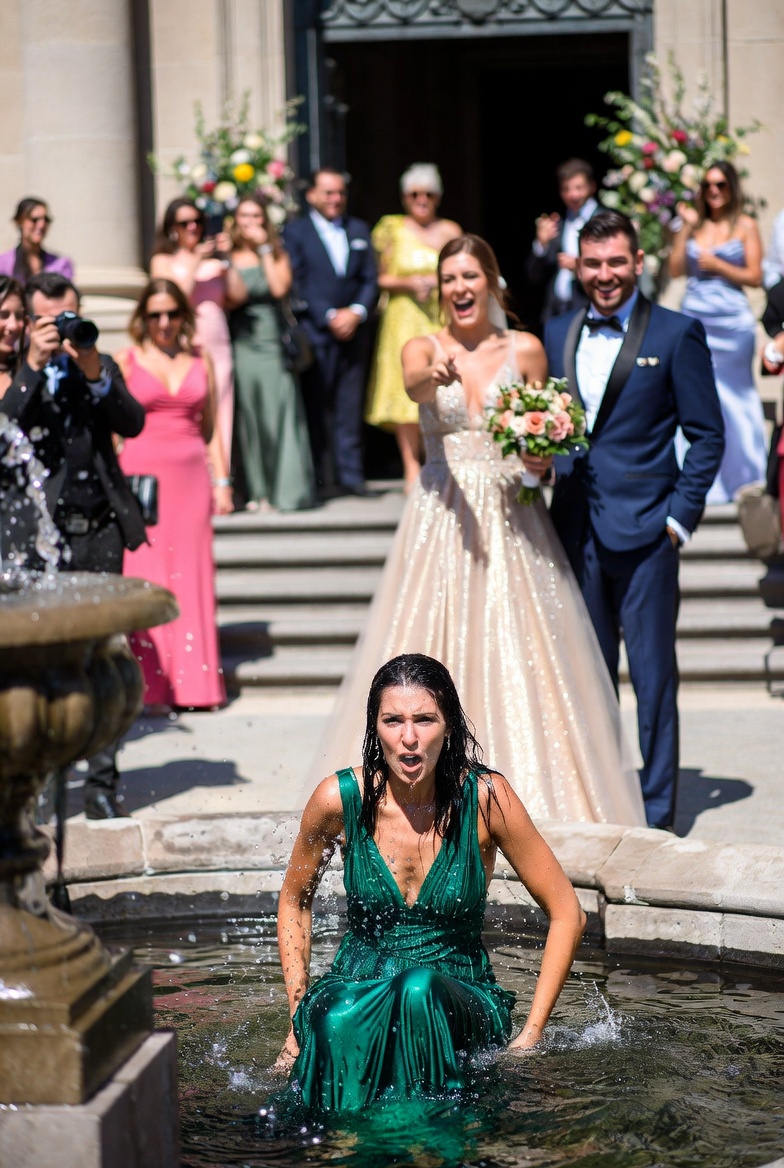
My heels slipped across the polished floor, and suddenly I was falling backward into the courtyard fountain while two hundred guests watched. Ice‑cold water swallowed me whole. My emerald silk dress clung to my body, my hair collapsed from its pins, and pain shot through my hip as I hit the stone edge beneath the water.
Then came the laughter.
Layer after layer of it.
People clapped. Someone whistled. My mother hid a smile behind her hand while Allison openly laughed beside the head table.
But standing there soaked in the fountain, something inside me changed completely.
I climbed upright and looked directly at them.
“Remember this moment,” I said calmly. “Remember exactly how you treated me. Remember who laughed. Remember who applauded. Remember what you chose when you had the chance to act differently.”
The ballroom fell silent.
I walked away dripping wet while nobody offered help, apologies, or even a towel. And strangely enough, by the time I reached the restroom mirror, I realized I wasn’t embarrassed anymore.
I was done.
Then my phone buzzed again.
Nathan: I’m 20 out. Nathan: Talk to me. Me: Dad shoved me into the fountain in front of everyone. Nathan: I’m coming. 10 minutes. Security is already inside.
Of course they were.
Nathan Reed never simply arrived somewhere. He prepared for it.
I changed into the emergency black dress I kept in my car, fixed my makeup, and returned to the ballroom just as my mother was telling her friends, “Some children simply refuse to thrive.”
“Are they?” I asked quietly.
Before she could answer, the atmosphere in the room shifted.
The ballroom doors opened.
Two men in dark suits entered first, scanning the crowd with professional precision.
Then Nathan walked in behind them.
And suddenly every conversation in the ballroom died.