The letter arrived on a cold Thursday morning, slipped halfway under Carter Reynolds’ apartment door while he slept restlessly on the couch. At first, he assumed it was another bill or advertisement. But the moment he saw the return address — St. Mary’s Medical Center, Chicago — a sharp, involuntary tension gripped his chest. He hadn’t heard from his ex‑wife, Emily, in months. Their divorce had been finalized only three months earlier, ending a marriage that had slowly dissolved into silence.
Inside the envelope was a short, handwritten message informing him that Emily had listed him as her emergency contact and had been asking for him repeatedly since her admission the previous evening. The words felt unreal. They had walked out of the courthouse in opposite directions, both exhausted, both convinced that the quiet collapse of their marriage was final. Yet now, she was calling for him from a hospital bed.
The drive downtown felt like moving through a fog. Chicago’s winter sky hung low and gray, and traffic crawled along the icy streets. As he drove, memories he had tried to bury resurfaced with painful clarity: Emily laughing uncontrollably on their first date, the country songs she sang while cooking pancakes, the way she stole fries from his plate even after insisting she wasn’t hungry. And then the silence — the heavy, suffocating silence that had swallowed their marriage whole.
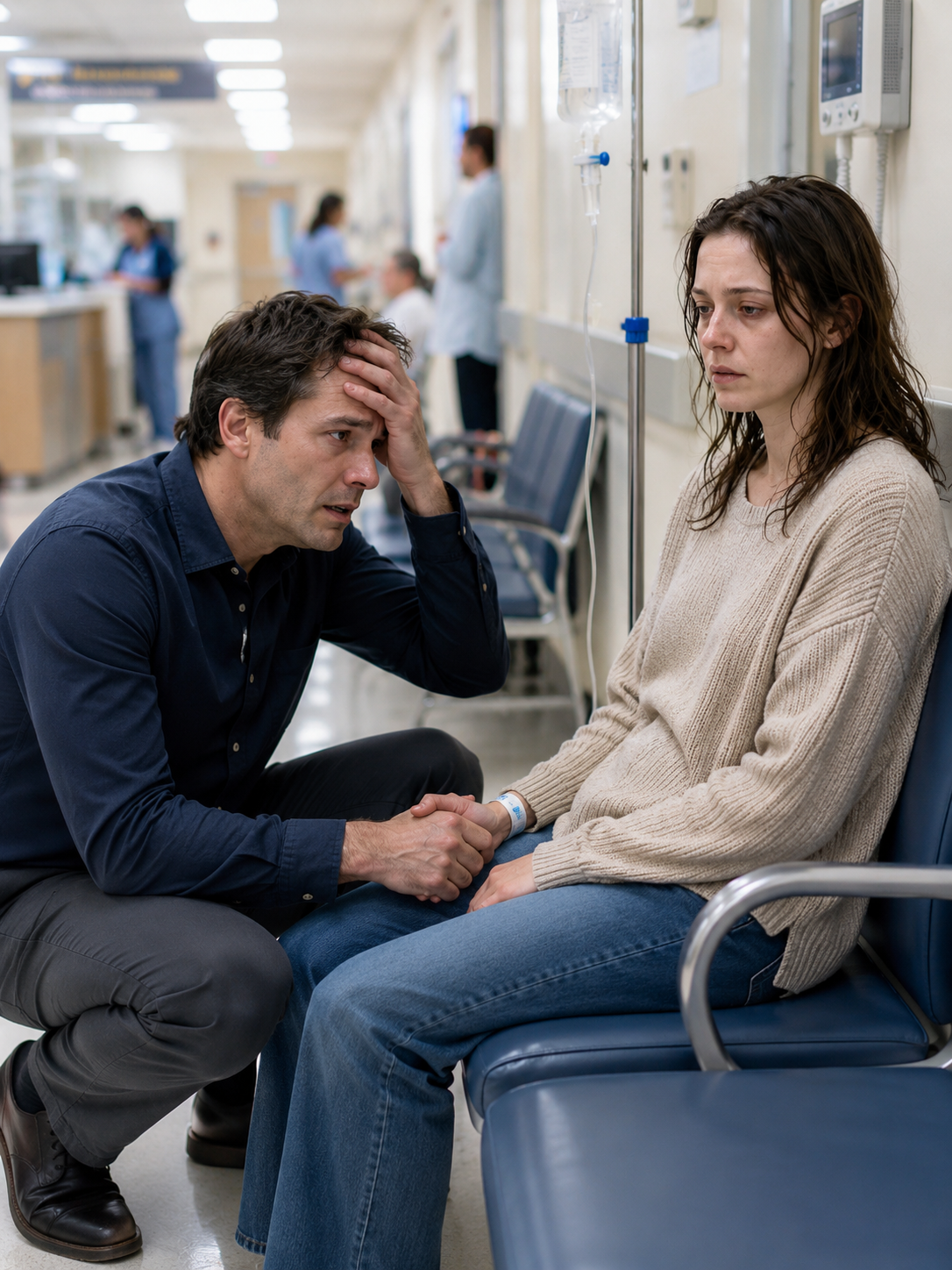
When Carter reached the cardiac floor of the hospital, he almost didn’t recognize her. Emily sat near the window, small and fragile in a pale hospital gown. Her once‑polished appearance was gone; her hair hung loosely, her posture slumped, her expression exhausted. She looked older, worn down by something far heavier than time.
“You actually came,” she whispered when she saw him.
He hesitated at the doorway, unsure whether he belonged there anymore. They were no longer husband and wife. They were barely acquaintances now. But she explained quietly that she had no one else — her father was gone, her mother had moved away, her sister barely spoke to her. “Some habits survive longer than marriages do,” she said with a sad smile.
When Carter finally asked what had happened, Emily stared out the window for a long moment before answering. “My heart stopped,” she said softly. She had collapsed at work two days earlier. Doctors told her it was a cardiac episode linked to prescription medication.
“What prescriptions?” he asked.
Her fingers tightened around the blanket. “Several. Too many.”
What followed was an hour of confessions that shattered everything Carter thought he knew about their marriage. Emily revealed years of anxiety attacks she had hidden from him — sleepless nights, panic episodes in office bathrooms, mornings spent crying in the shower before work. She described the medications she had been prescribed over the years, how they initially quieted the fear inside her, and how she eventually became dependent on them.
She had been drowning silently while he mistook her suffering for emotional distance.
The overdose that nearly killed her wasn’t intentional. It was the result of desperation — a frantic attempt to calm the panic that had consumed her for years.
Then came the confession that broke him.
“The morning I collapsed,” she whispered, “I kept thinking about the divorce. I kept thinking about how badly I ruined everything between us.”
Her voice was calm, but the pain beneath it was unmistakable. Carter realized that the woman he believed had fallen out of love with him had actually been fighting a private war he never recognized. He remembered the days she refused to get out of bed, the canceled plans, the emotional withdrawal. He had interpreted all of it as disinterest, coldness, or resentment. Now he understood it had been fear, exhaustion, and untreated anxiety.
When he asked why she never told him, Emily finally looked directly at him. Her eyes were vulnerable in a way he hadn’t seen in years.
“Because I was terrified you’d leave me,” she said. “And then eventually… I became terrified you’d stay only because you pitied me.”
The words hit him harder than any argument they ever had. She had been hiding her suffering not because she didn’t trust him, but because she feared losing him — or worse, becoming a burden he felt obligated to carry.
As she spoke, Carter felt the foundation of their failed marriage shifting beneath him. The signs had been there, but he had been too consumed by his own frustrations to see them. Emily had become skilled at hiding her pain, and he had become skilled at assuming the worst.
Sitting beside her hospital bed, he realized something devastating: their marriage may not have ended because Emily stopped loving him. It may have ended because she was slowly dying inside, and he never noticed until it was almost too late.
The silence that had destroyed them wasn’t emptiness — it was unspoken suffering.
And now, in a hospital room filled with the steady hum of medical machines, Carter finally understood the truth he had missed for years.