The house smelled faintly of coffee and bleach. Morning light spilled through the kitchen window, touching the edges of the counter where my mother’s hands trembled. I had come home early from deployment, still wearing my uniform, boots heavy with dust from a place that had taught me how fragile peace could be. I wanted one quiet minute before the noise started — before the hugs, the tears, the questions.
Instead, I heard gagging.
Not coughing. Not choking on food. Gagging — the kind that comes from humiliation, not sickness.
I dropped my duffel in the hallway and moved fast.
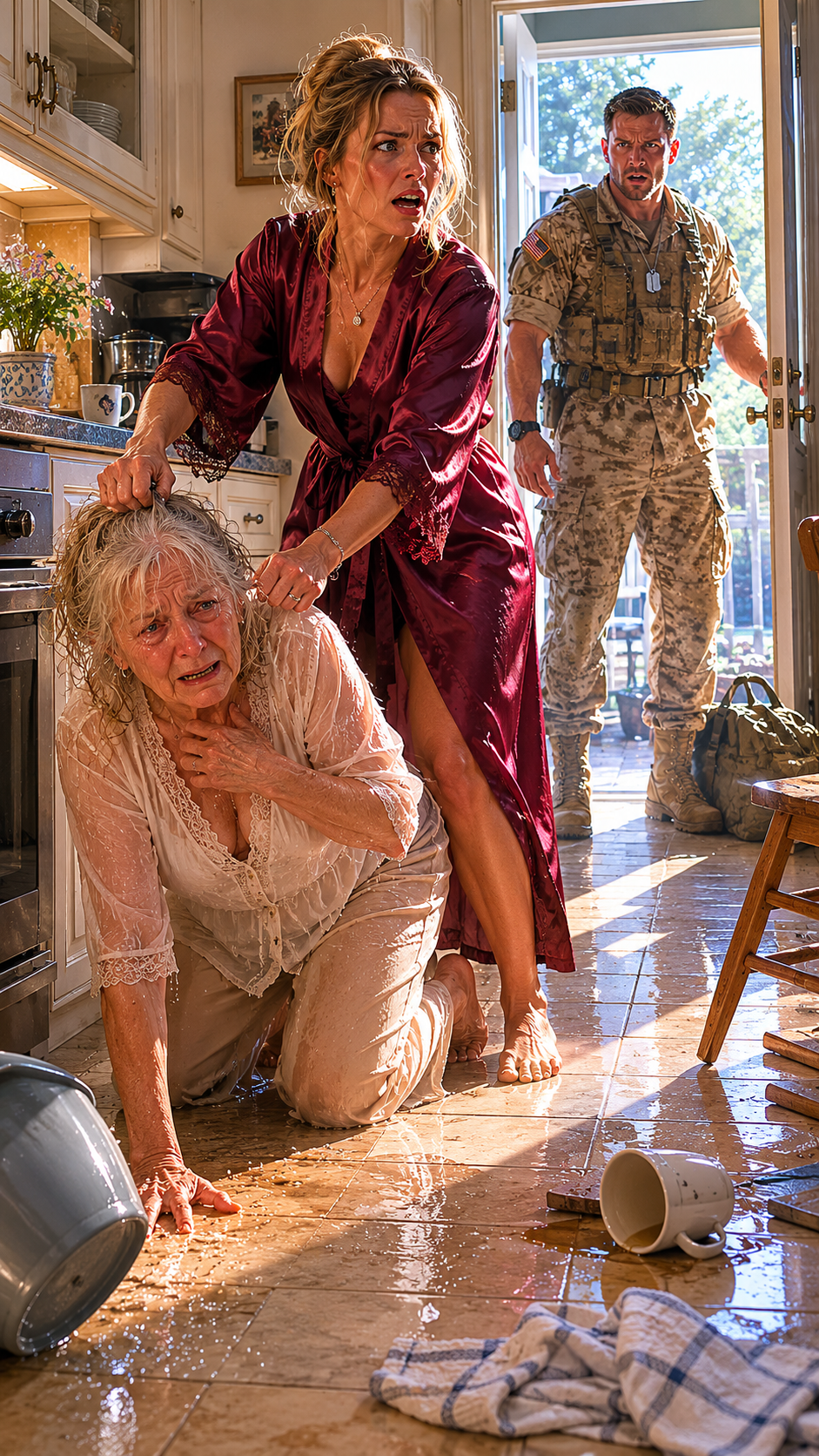
My mother was on her knees on the tile, seventy‑eight years old, shaking, soaked down the front of her blouse. One hand braced against the floor. Beside her stood Sloane — my wife — wearing a silk robe, holding a gray plastic basin near my mother’s mouth.
“Drink it,” Sloane snapped. “If you want to stay in my house, you earn it.”
My mother saw me first. Her eyes widened, but she didn’t speak.
Sloane kept talking. “Your son signed everything over before he left. You’re done here.”
Then she turned.
She saw me — combat boots, uniform, face — and all the color drained from her at once.
For a moment, no one moved. The air felt thick, heavy, electric. My mother’s breathing came in shallow bursts. Sloane’s hand loosened in her hair.
I stepped forward. “Let her go.”
Sloane froze. My brother‑in‑law, Evan, appeared behind her, still laughing from whatever cruelty had just unfolded. My sister‑in‑law, Mara, leaned against the counter, arms crossed, eyes sharp with satisfaction.
“She’s exaggerating,” Sloane said quickly. “She—”
I didn’t let her finish. I lifted my mother gently from the floor, her body light, fragile, trembling. She whispered, “I didn’t want you to see this.”
I looked at Sloane. “What did you make her drink?”
Sloane’s lips parted, but no sound came. Evan smirked. “You should’ve told your wife to keep her mother out of your house.”
My voice stayed calm. “This is my mother’s house.”
The silence that followed was the kind that rearranges everything.
Sloane’s face twisted. “You signed the deed over before you left. You said it was easier for taxes.”
I nodded slowly. “I did. But I also kept the original title.”
I reached into my duffel and pulled out a folder — the one I had carried through checkpoints, sandstorms, and nights when I wasn’t sure I’d make it home. Inside were the papers proving what she had tried to erase.
Sloane’s voice cracked. “You can’t just—”
“I can,” I said. “Because I never filed the transfer.”
Evan’s smirk vanished. Mara’s arms dropped. My mother’s eyes filled with tears she had been holding back for months.
I had suspected something was wrong during my last rotation. The calls had grown shorter. The tone colder. Sloane had stopped mentioning my mother altogether. When I asked about her, Sloane said she was “fine” — that she was “resting.”
But the letters my mother sent told a different story. They arrived late, sometimes torn, sometimes rewritten in handwriting that wasn’t hers. I kept them all. I read them under desert stars, trying to believe the silence was distance, not cruelty.
Now, standing in my own kitchen, I understood everything.
Sloane had moved my mother into the guest room, stripped her of access to her bank account, and told neighbors she was “confused.” She had convinced my in‑laws that my mother was a burden, a relic, someone to be mocked.
And they had believed her.
I turned to Sloane. “You told her she had to earn her place here?”
She swallowed hard. “You don’t understand—”
“I understand perfectly.”
I looked at Evan and Mara. “You laughed while she humiliated my mother?”
Evan shrugged. “She’s old. She doesn’t even know what’s going on.”
I stepped closer. “She knows enough to remember kindness. Something you’ll never understand.”
The room went silent. Sloane’s robe shimmered under the light, her face pale, her hands trembling. My mother stood beside me, small but steady.
I said quietly, “Pack your things.”
Sloane blinked. “You can’t—”
“I can,” I said again. “Because this house isn’t yours. Because cruelty has consequences. Because I came home.”
By noon, the house was quiet again. Sloane’s car was gone. Evan and Mara left without a word. My mother sat at the kitchen table, hands wrapped around a cup of tea. The sunlight touched her hair, silver and soft.
“I thought you’d never come back,” she whispered.
“I almost didn’t,” I said. “But something told me to.”
She looked at me, eyes wet. “You saved me.”
I shook my head. “You saved yourself. I just walked in at the right time.”
Outside, the wind moved through the trees. The house felt different — lighter, cleaner, alive again.
I realized then that war doesn’t always happen overseas. Sometimes it lives quietly inside the walls we call home.
And sometimes, coming home means fighting a battle you never expected.