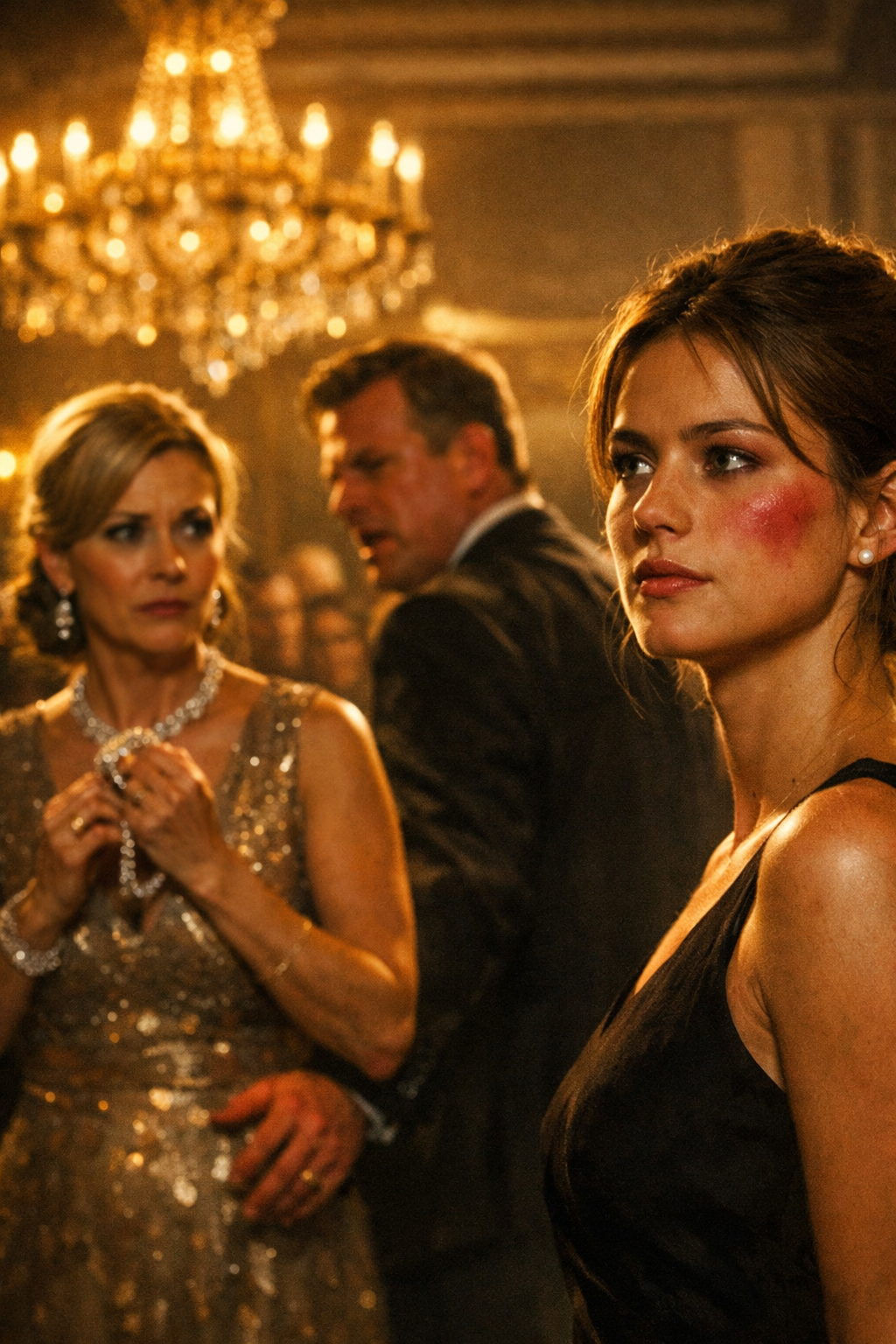
The ballroom never recovered from that silence. Even after the band resumed, the laughter sounded forced, brittle — like glass about to crack. I walked through the crowd, my heels clicking against marble, every step echoing louder than the music. No one met my eyes. They looked at the chandeliers, the wine, the floor — anywhere but the girl who had just been slapped in front of two hundred witnesses.
Outside, the night air hit my face like mercy. I touched my cheek; it was swollen, hot, pulsing. Somewhere inside, humiliation burned, but beneath it was something colder — clarity.
I had spent years trying to belong to that family. Tonight proved I never would.
I drove home in silence, the bracelet’s image burned into my mind. The cameras had caught everything — the accusation, the slap, the moment Uncle Raymond held up the proof. I didn’t need revenge. I needed truth.
At dawn, I called my grandmother’s attorney. “Release the footage,” I said. He hesitated. “Are you sure?” “Yes,” I whispered. “Let them see themselves.”
By noon, the video was everywhere — shared, reposted, dissected. My father’s hand, Celeste’s trembling accusation, the crowd’s cowardly silence. The internet didn’t forgive what the family refused to admit.
That evening, reporters gathered outside the mansion gates. The company’s stock plummeted. Investors demanded statements. My father’s empire, built on reputation, began to crumble under the weight of one slap.
Celeste tried to call me. I didn’t answer.
Two days later, I drove past the mansion. Police cars lined the driveway. The estate was being seized — unpaid taxes, hidden debts, falsified accounts. My father’s voice carried from the porch, furious, desperate. Celeste stood beside him, her diamonds gone, her face pale.
I parked across the street and watched. For the first time, I felt nothing.
The man who had raised his hand against me now raised it against the officers, shouting about respect, legacy, betrayal. But the cameras didn’t blink. They recorded everything again — this time for the world to see.
I turned the key and drove away.
That night, I found a letter waiting on my doorstep — my grandmother’s handwriting, faded but steady.
“My dear, When truth is buried under pride, it waits for courage to dig it out. You were always that courage. The estate, the shares, the vineyards — they are yours. But remember: ownership means nothing without peace.”
I sat on the porch, the letter trembling in my hands. Peace. It sounded impossible. But maybe it was the only thing left worth chasing.
A week later, my father came to my apartment. No suit. No arrogance. Just exhaustion.
He stood in the doorway, eyes hollow. “You destroyed us.”
I met his gaze. “No. You did.”
He looked down. “I was angry.”
“You were cruel.”
He swallowed hard. “I thought I was protecting the family.”
“By hitting your daughter?” I asked quietly.
He didn’t answer. The silence stretched until it hurt.
Finally, he said, “I don’t expect forgiveness.”
“Good,” I said. “Because I’m not offering it.”
He nodded slowly. “But I am sorry.”
For the first time, his voice cracked. And for the first time, I believed him.
Months passed. The scandal faded, replaced by newer headlines. The mansion was sold. The vineyards reopened under new management — mine. I kept the cameras, the footage, the truth. Not to humiliate them again, but to remind myself what silence costs.
At the annual shareholders’ meeting, I stood where my father once had — same podium, same lights, different heart.
“I was accused of theft,” I said. “But what was stolen wasn’t jewelry. It was dignity. Tonight, I reclaim it.”
Applause filled the hall — not polite, but real.
Afterward, I walked outside. The air smelled of grapes and rain. The sky was clear, the stars sharp. I touched the faint scar on my cheek, the only trace left of that night.
It didn’t burn anymore.
Six months later, I visited my grandmother’s grave. I placed the bracelet — cleaned, repaired — beside her headstone.
“Thank you,” I whispered. “For believing in me when no one else did.”
The wind moved through the trees, soft and forgiving. I closed my eyes.
Behind me, the world that had once mocked me was gone — replaced by something quieter, stronger. I had lost a family, but found myself.
And that was enough.