Boyd set the phone down on the workbench very gently, the way you put down something that might go off.
“Fifteen thousand,” he said. “The truck.”
“Yes, sir.”
“Zayn told me the dealer wanted cash up front. He said the price jumped. He came back twice for more.” Boyd wiped his hands on a rag for a long time. “I never asked to see the truck. That’s on me.”
I didn’t say anything. I’d learned from Bee that silence lets people finish their own sentences.
“Gage, why bring this to me and not just pay it? You could have made the problem disappear.”
“Because it isn’t my problem,” I said. “And because Kylie is marrying into a family that’s lying to her. I didn’t think that was fair to her, or to you.”
He studied me with eyes the same pale gray as his daughter’s.
“One question,” he said quietly. “Have you told anyone else what you just showed me?”
“No. I wanted you to hear it from me first, not find out at the wedding.”
He nodded slowly. “Then let me ask you the thing I should have asked a year ago, at the lake. Who’s been looking after you?”
My throat closed. Nobody had asked me that. Not once.
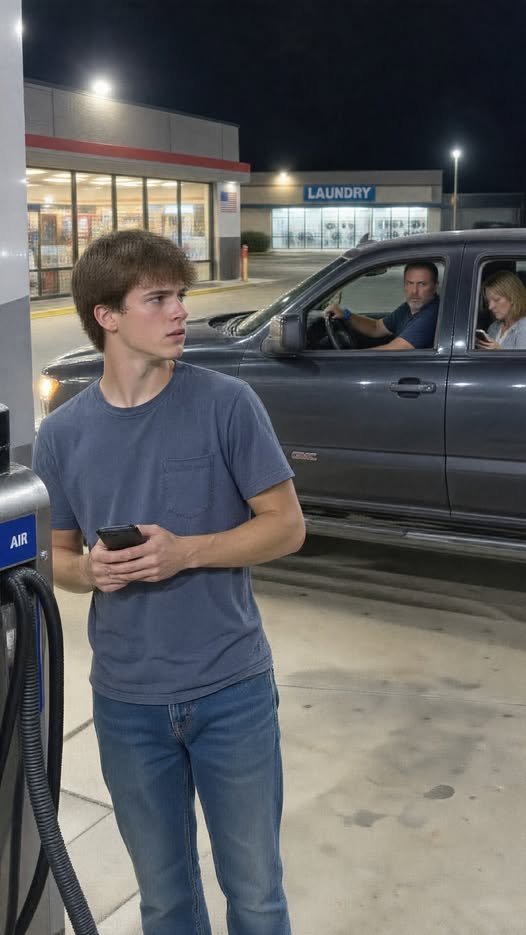
I told him everything while he made coffee in a dented percolator: the gas station, the wallet in the console, the laundromat, Bee and the room upstairs. He listened standing, arms crossed, jaw working.
“Ninety miles,” he said when I finished. “At eighteen.”
“Yes, sir.”
“And they still wanted the money.”
“Every message.”
He set his cup down hard. “Stay for lunch. I’m calling Kylie.”
“Mr. Boyd, I don’t want to wreck her wedding.”
“You didn’t wreck anything,” he said. “Zayn built it. You just turned on the lights.”
Kylie arrived within the hour, still in her work scrubs, car door left open. She read Mom’s March message at the workbench, then the yellow note. Her hand went to her mouth.
“He told me you’d chosen to leave,” she whispered. “He said you were estranged because you were stubborn.”
“I know.”
“And the truck. He showed me photos of a truck.”
“Probably a dealer’s listing,” Boyd said grimly.
She sat on an overturned bucket, shaking. “Gage, I sent you that Christmas message. I told you we were proud of you. You must have thought I was…”
“I thought you were kind,” I said. “You were the only one who was.”
She cried quietly for a minute. Then she wiped her face and stood up, and I watched something settle in her, the way steel firms as it cools.
“I’m going to talk to Zayn,” she said. “Not tonight. I need a plan, not a fight.”
The plan was Boyd’s, and it was fair. He gave Zayn one week to come clean to Kylie, in his own words. If he did, the wedding could be postponed while he repaid the loan from a real job, with Boyd holding the paperwork. If he didn’t, Boyd would tell her himself, and the engagement would end on its own.
Zayn came to the shop alone that Friday. I wasn’t there, but Kylie told me afterward.
“He sat in my father’s office for an hour,” she said. “He kept saying he’d planned to pay it back. Dad asked him one question: ‘Where is the truck, son?’ And Zayn put his head down on the desk.”
He had no truck, no business, and no savings. The engagement party, the deposit on a honeymoon, and a string of small loans had swallowed the rest. Kylie did not leave him that night. She did something harder. She told him the wedding was off until he had worked a full year at a steady job and paid back every dollar of her father’s money, and that she would decide afterward whether she still wanted to marry him.
“Do you think he’ll do it?” I asked.
“I don’t know,” she said. “But for the first time, he heard ‘no’ from someone who wasn’t going to move the money.”
My parents called me the next week. Both of them, on speaker, from the kitchen where I’d grown up.
“You humiliated your brother,” Mom said. “In front of Boyd. After everything we’ve done for you.”
“Mom, what exactly did you do for me?”
Silence.
“I’m asking honestly,” I said. “I’d like to know.”
Dad cleared his throat. “We gave you a home.”
“Until you left me at a gas station ninety miles away without my wallet.”
“You were being dramatic,” Dad said, but his voice had lost its edge.
“I slept in a laundromat chair, Dad. A stranger fed me. I’m not angry anymore. I’m just telling you what happened, because I don’t think either of you has ever said it out loud.”
Neither of them answered. I could hear the refrigerator humming in the background, that same low note from every childhood evening.
Then Mom said, very small, “I didn’t think you’d really have to walk.”
“I know. That’s the part I can’t forget.”
I ended the call gently. I didn’t hang up in anger. I just stopped.
Zayn wrote me a letter in June, three pages, in his terrible handwriting. He’d taken a job at a landscaping company, minimum wage, six days a week. He was paying Boyd two hundred dollars every Friday.
I told myself you were selfish because it was easier than admitting I was taking from you. I’m sorry about the $400, and the printers, and all of it. I don’t expect anything. I just wanted it written down somewhere.
I wrote back one line. Written down counts. Keep going.
Kylie and Zayn did not marry that fall. In spring, a year to the week after the gas station, he stood in Bee’s laundromat holding a small envelope. Inside was a money order for four hundred dollars.
“It’s not the whole thing,” he said. “It’s the first thing I owed you.”
I took it. We didn’t hug. We just stood among the humming dryers, two brothers who had never talked, until he said, “Can I see the printers?”
I showed him the room upstairs. He watched a part come off the bed, warm and smooth, and said, “You made that from nothing.”
“From a drawing,” I said. “Anyone can learn it.”
He looked at it for a long time. “Could I?”
I handed him the calipers.
Today, Bee’s laundromat has a small shop sign out front: Gage’s Parts, Fixes & Replacement Knobs. I employ two people. Boyd sends me three or four orders a month for old farm radios, and he insists on paying double. Kylie comes by on Saturdays and brings sandwiches.
I haven’t spoken to my parents often. We talk at holidays, politely, and Mom has started asking questions about my work. Last week she said, “Your father wonders if you’d show him the printers someday.” I said I would.
On the shelf above my desk sits the first knob I ever made, a cracked white dryer dial I kept from Mom’s old machine. Beside it is the yellow note, folded flat.
Bee found me staring at it once.
“You gonna throw that out?” she asked.
“No. I’m keeping it so I remember.”
“Remember what, honey?”
I thought about the gas station and the laundromat, and all the ninety miles in between.
“That the day they asked me for everything,” I said, “was the day I found out how much I had.”