“What’s in there?” Dad asked again.
I looked at the folder. Then I looked at the total at the bottom of the last page. Two hundred and sixty-one thousand, four hundred dollars, spread across fourteen years.
“Before I answer,” I said, “I want to understand this.” I tapped the page. “Where did it go, Ranata?”
She didn’t speak. Desmond studied the faucet.
“Ranata,” Mom said, in a voice I had never heard her use. “Answer your sister.”
It came out slowly, the way water comes through a cracked foundation.
Fifteen years earlier, Ranata and Desmond had bought a house they couldn’t afford. When the payments got tight, Ranata mentioned to Mom, almost in passing, that Fay was struggling with the farm and too proud to ask. Mom sent a check “for Fay” and told Ranata to deliver it quietly. Ranata deposited it into her own account.
It worked. So she did it again.
“It started small,” she said, staring at the island. “A few hundred. Then there was the boat loan. Then Desmond’s business failed. Every time, it was easier to say you needed it than to say we did.” Her voice cracked. “And then you couldn’t tell them the truth, because you didn’t know. And I couldn’t stop, because they believed it.”
“You told them I was drowning,” I said. “For fifteen years.”
“I told myself you’d never find out. You never asked about family money. You never asked for anything.”
“Because I never needed anything from you.”
Dad had gone very still. “How could you let us think she was failing?”
“Because if you thought she was fine, the money would stop,” Ranata whispered. “And I was already so far in.”
Mom began to cry, quietly, with her hand over her mouth. “I called you every month to ask how your sister was doing. And every month you told me she was behind.”
I should say what I felt, because it wasn’t what I expected.
I wasn’t triumphant. I had carried a secret fortune into that house, half hoping to watch it land. Instead I sat there seeing something sadder. For fifteen years my parents had believed they were helping me. They had sent money they could have used themselves, and my father’s car, I now noticed, was nine years old. They had loved a daughter who didn’t exist, and I had let them, because it hadn’t occurred to me to ask what stories were being told.
I picked up the folder and set it on the table.
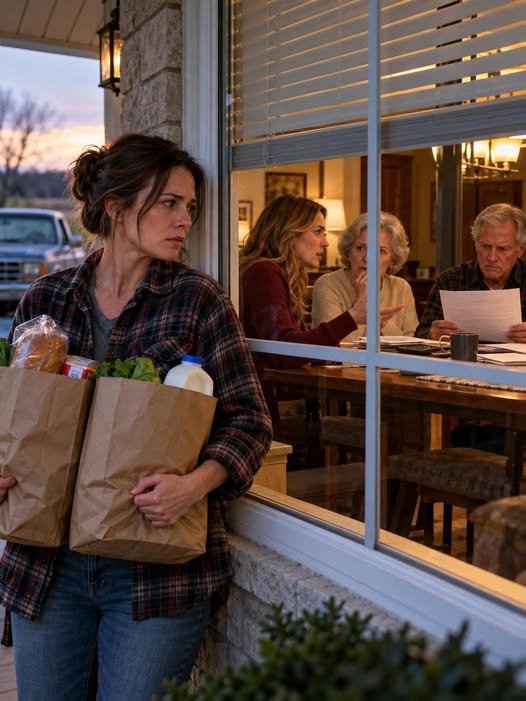
“I came over today with groceries,” I said. “I heard part of this through the door. I didn’t knock, because I wanted to understand what I’d heard before I said anything.”
Dad looked at me. “You were on the porch?”
“For about five minutes.” I opened the folder. “I also have something to tell you. I was going to wait for a better moment, but I don’t think there’ll be one.”
I laid out the closing statement, then the purchase agreement.
Mom read the number first. She read it twice, and then she looked up at me.
“Thirty-nine million,” she said slowly. “Fay, what is this?”
“I sold the farm,” I said. “Three days ago. A company wanted the land for an expansion. I’ve been negotiating for two years and I told nobody. I wanted to see who I was to you when I had nothing to show.”
Ranata made a small, wounded sound.
“I’m not saying that to punish anyone,” I said. “I’m saying it because it’s true, and because I think we’ve had enough stories in this family.”
Nobody spoke for a long time. The refrigerator hummed. Somewhere outside, a dog barked twice.
Dad took off his glasses and pressed his fingers against his eyes. When he put them back on, he looked ten years older and strangely lighter.
“All these years,” he said, “I thought I was failing you. I thought I should have done more. I looked at that truck and I thought, my daughter is struggling and I can’t fix it.”
“You were wrong about the struggling,” I said gently. “You were right about the truck. It’s awful. I love it.”
He laughed, a wet, startled sound. Mom laughed too, through her tears. Even Desmond’s shoulders eased.
Only Ranata stayed rigid, hands flat on the table, waiting for the sentence.
“I’m going to tell you what I’ve decided,” I said. “I thought about it on the drive over.”
She looked up.
“I’m not pressing charges. You took money from our parents under false pretenses, and legally that could matter. I don’t want to take it there. But I have conditions.”
“Anything,” Ranata whispered.
“First, you tell Mom and Dad everything. Every transfer, every account. Not the version you can live with. The whole ledger.”
“Yes.”
“Second, you repay them, on a schedule, however long it takes. I won’t pay it for you, and I won’t be involved. That’s between you and the people you took it from.”
“Yes.”
“Third.” I paused. “You don’t get to be my sister in the old way. Not for a while. You’ll have to earn that back. I’m not angry enough to cut you off, Ranata. But I’m tired enough to want it done honestly.”
Her face crumpled. “Fay. I’m sorry. I was ashamed of how much I had and how little I’d earned, and I made you the one who was lacking so I’d feel less lacking myself.”
I believed her. That was the hard part.
“I know,” I said. “That doesn’t make it right. But it makes it understandable.”
Then I turned to my parents.
“The money you sent,” I said. “I want to give it back.”
Dad shook his head hard. “Absolutely not.”
“It was meant for me. It never reached me, so it’s mine to return.” I wrote a figure on a napkin and slid it across: two hundred and sixty-one thousand, four hundred, plus interest at a fair rate. “I’ll wire it tomorrow. And I’m setting aside a separate gift, because you spent fifteen years worrying about me, and nobody should have to carry that for nothing.”
Mom was sobbing now. “Fay, we don’t want your money.”
“I know,” I said. “That’s why I want to give it.”
It took Ranata three years to repay what she owed. She sold the boat and the lake house, took a full-time job, and moved to a smaller place near our parents. Desmond found work in sales and, to his credit, never once defended her.
At the first Thanksgiving after the sale, I brought two bags of groceries. This time I knocked.
Mom opened the door and hugged me for a long time. In the kitchen, Dad stood at the stove, holding a spoon like he’d never seen one.
“Thought I’d learn to make your mother’s gravy,” he said.
“Don’t,” Mom said. “It’s a disaster.”
It was. We ate it anyway.
Ranata arrived last, carrying a pie and her chin low. She stood in the doorway, uncertain. I stepped forward and took the pie from her hands.
“You’re late,” I said.
“I know.”
“Come in. There’s room.”
She sat beside me. Halfway through dinner, under the table, her hand found mine and squeezed once. I squeezed back.
In the spring, I bought forty acres of my own, not for profit, only for the work. I kept the old truck. Dad looked at it in the driveway and shook his head, the same way he always had.
“Still driving that thing?”
“It still runs,” I said.
This time he smiled, and so did I.
The money sat in the bank, doing what money does. But the best thing I took from that year wasn’t a number. It was five minutes on a porch with grocery bags in my hands, hearing the truth about my family, and choosing to open the door anyway.