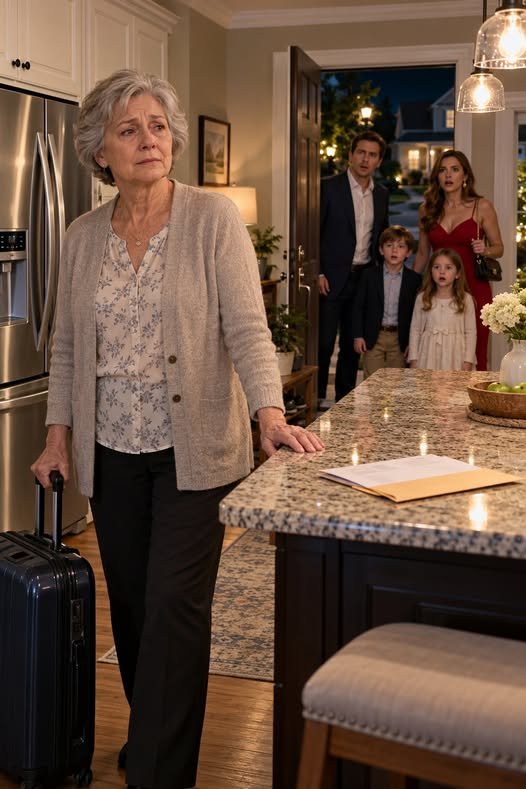
Daniel picked it up with shaking hands. It was a manila envelope, and on top of it, held down by the brass house key I had carried for eleven years, lay a single sheet of lined paper in my handwriting.
Emily snatched it from him and read aloud, her voice climbing with every line.
Daniel and Emily,
I have taken my things and gone. Please don’t worry about me. I am safe, and I know exactly where I’m going.
Inside this envelope are three documents. Read them tonight, together.
Dinner leftovers are in the fridge. Please don’t waste them.
Betty
Emily’s face flushed. “Is she being sarcastic? She’s actually being sarcastic?”
“Emily,” Daniel said quietly. “Open it.”
The first document was a notice from the county. Daniel read it twice, and the color drained from his face.
“Mom owns the house,” he whispered.
“Don’t be ridiculous. We own the house. We’ve paid the mortgage for nine years.”
“We paid her.” His voice cracked. “Emily, when Dad died, his life insurance paid off the old mortgage. Mom bought the house outright and let us move in. She told me we could pay her whatever we could afford each month. She said we’d sort the deed out later. I never followed up.”
Emily stared at him. “You never put it in our names?”
“I kept meaning to. She never pushed. She never asked for a thing.”
The second document was a copy of the title, with Betty J. Hartman listed as sole owner. The third was a letter from an attorney, dated three months earlier, confirming that I had consulted him and understood my rights. Clipped to it was a thirty-day notice of lease termination, signed and dated that very morning.
Emily’s scream, I’m told, shook the windows.
I wasn’t there. I was sitting in a quiet guest room at my sister Ruth’s house in Dayton, drinking chamomile tea and watching the clock.
Ruth had picked me up at the end of the street at ten-fifteen. She hadn’t asked a single question. She’d simply taken my suitcase, put it in the trunk, and squeezed my hand across the seat.
“Are you sure?” she asked once.
“No,” I said. “But I’m sure about the part where I stop pretending.”
At eleven-thirty, my phone began to light up. Daniel. Emily. Daniel again. I watched it ring and did not answer.
Finally, at midnight, I picked up. It was Daniel.
“Mom,” he said. He was crying. “Where are you?”
“I’m safe, sweetheart.”
“Please come home. We can talk about this.”
“We can talk,” I said. “But not tonight, and not at that house.”
There was a long silence.
“Mom,” he said, very small, “I didn’t know you felt like this.”
“I know you didn’t,” I said gently. “That’s the part that hurt most.”
Here is what I did not put in the letter, because it wasn’t a weapon. It was simply true.
I had not planned to take their home. I had planned, months earlier, to speak to them. I had made lists. I had rehearsed. I wanted to say, I would love to be included. I would love to be thanked. I am not your housekeeper. But every time I opened my mouth, I swallowed it, because I was terrified they’d say, Then maybe you should find somewhere else to live.
So I went to a lawyer first. Not to punish them, but to know my footing. He told me I held every right a homeowner has. He also told me something I hadn’t expected.
“Betty, nobody’s making you leave your own house. But if you want to go, there are better ways than a notice. Are you sure you want it this way?”
“I want them to understand I’m not powerless,” I said. “And I want them to understand I’m not cruel.”
So I wrote the notice, signed it, and set it in a drawer. I told myself I would use it only if there was no other way for them to hear me.
At nine-thirty on the night of Emily’s promotion, I found out there was no other way.
Daniel came to Ruth’s door the following Saturday. He came alone.
He looked as if he hadn’t slept. He stood on the porch with his hands in his pockets, thinner than I remembered, and said, “Can I come in?”
Ruth looked at me. I nodded.
We sat in her small kitchen, and he didn’t start with an apology. He started with a list.
“I wrote down everything you did this year,” he said, pulling a crumpled paper from his pocket. “Every school lunch. Every doctor’s appointment you drove the kids to. Every night you covered when we both worked late. I stopped at two hundred and eleven items.” He looked up. “Mom, I didn’t count even half of it.”
“Danny…”
“I watched Emily give you orders for years,” he said. “And I said nothing, because it was easier. Because you never complained. And the whole time, I told myself you were happy.”
“I told myself that too,” I said softly.
He covered his eyes with one hand. His shoulders shook.
“I’m so ashamed,” he said. “You made dinner for us every night, and we left you at home with a paper bowl.”
I reached across the table and put my hand over his. For a moment, he was seven years old again.
“I’m not angry that you went to dinner,” I said. “I’m hurt that nobody noticed I wasn’t there.”
Emily did not come that Saturday. Or the next.
She came on the third weekend, alone, in a plain gray sweater. She stood in Ruth’s doorway holding a small box of lemon cookies from a bakery in Columbus. I recognized the label. They were my favorites. I had told her once, six years earlier, and I hadn’t thought she had been listening.
“Betty,” she said. Her voice shook. “I don’t expect you to forgive me.”
“Come in.”
She sat across from me, her hands clasped so tightly her knuckles were white. For several seconds she couldn’t speak.
“I’ve been thinking about the word ‘everybody,'” she finally said. “I said it to my mother on the phone that day. ‘Everybody’s coming.’ And I didn’t think about you at all. Not once. That’s the part I can’t get past. I didn’t exclude you out of malice, Betty. It was worse. I didn’t think of you as someone to exclude.”
She wiped her eyes. “I treated you the way I’d treat a very good appliance.”
“That’s honest,” I said.
“It’s awful.” She laughed, and it turned to a sob. “I don’t deserve another chance. But I’d like to earn one.”
We did not move back in that month, or the next.
I did return to the house eventually, but under new terms, written at Ruth’s kitchen table, with a mediator and a pot of tea. Daniel and Emily would pay a fair rent. They would hire a cleaner twice a week. I would no longer cook every meal, scrub every counter, or be summoned like a bell. My name would sit beside theirs at every family event, and Emily put that in writing herself.
Then, to my surprise, she added a line I hadn’t asked for. Betty will be consulted in all family decisions, large and small.
I cried when I read it.
On the first Sunday after I came home, I woke at sunrise out of habit and lay in bed, listening for a list of things to do.
Instead, there was a knock. Daniel opened the door with a breakfast tray: toast, eggs, a cup of tea, a small vase with one yellow tulip. Behind him, my grandchildren crowded in, in pajamas, holding a hand-drawn card.
TO GRANDMA. YOU ARE THE PEOPLE WHO MEAN EVERYTHING TO US.
Emily stood in the doorway, looking at me the way you look at someone you hope will say yes.
“Come in,” I said. “There’s room on the bed.”
She sat at the foot. Daniel took the other side. The children piled in between us, spilling crumbs across the quilt.
Downstairs, the refrigerator hummed. There were fingerprints on the door, small and sticky, and nobody rushed to wipe them away.
I looked at my family, crowded and warm and imperfect, and for the first time in years, I was not holding my breath.
“Leftovers?” I asked, smiling.
Emily laughed through her tears. “Don’t waste them,” she said.
And for the first time, it was a joke we all shared.