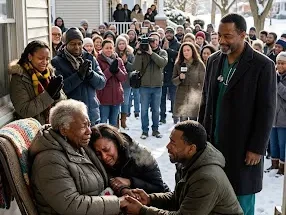
Daniel did not leave the hospital that night.
He sat beside Frank’s bed until dawn, with Marcus asleep in the chair, and the two men talked quietly in the blue light. Frank told him about the cold. About the ditch. About a young soldier named Harold who had written his girlfriend’s name on the inside of his helmet and made Frank promise to mail the letter if he didn’t make it.
“I kept that promise,” Frank said. “Or I tried. But the address was wrong. The letter came back.” He gave a small, rueful smile. “I carried it in my pocket for thirty years.”
“Do you still have it?”
“It’s in the drawer by my bed. Under the pocket watch.”
Daniel pressed his lips together. “Her name was Dorothy. She was my mother.”
Frank closed his eyes. The monitor beeped on, and the old man, who had been alone for eleven years, let himself weep.
On Christmas morning, a nurse brought in a package.
It had been delivered to the hospital at seven, wrapped in plain brown paper, with a note in a shaky hand clipped to the front. Daniel recognized the handwriting at once and had to sit down.
The note read: To the man who carried me. If you ever read this, I never stopped looking. Thank you, with every year of life you gave me. Harold.
Inside was a small wooden box. Daniel had found it in his father’s desk three months earlier, with a label that said For the soldier, if I find him, and had put it in his car to figure out later. He’d had it with him in the glove compartment all along.
Frank opened the lid with trembling hands.
Inside lay a framed photograph. The same one Daniel remembered: a squad of bundled soldiers on a snowy hillside. On the back, in his father’s neat penmanship, were names. Frank Dalton was written third from the left.
Below the frame was a folded paper. It was a deed.
Daniel cleared his throat. “My father bought a small cabin in Vermont in 1985. He told us it was for ‘a friend he hadn’t found yet.’ He kept paying the taxes every year. It’s yours, Mr. Dalton, if you want it. No strings.”
Frank stared at the paper. “I can’t take a man’s cabin.”
“You carried him four hundred yards,” Daniel said. “He’d say you’ve earned it a thousand times.”
The old soldier covered his face with his hand.
By the time Frank was discharged two days later, the story had traveled.
Daniel had told the fire department. The fire department told the local paper. A young reporter named Priya Nair drove to Maple Court Apartments, found the little tree still standing beside the door, tin star swaying in the wind, and wrote a short article titled The Man Behind the Tree. Within a day, it had been shared four thousand times.
The neighbors saw it.
The man in the second-floor apartment who had mocked the “Christmas Soldier” read it standing at his kitchen counter. He put down his coffee. The woman in 4B, who had complained about the eyesore, read it twice and went very quiet. The teenagers on the stairwell passed a phone around in silence.
When Frank came home in the back seat of Daniel’s truck, Marcus helping him out, he stopped at the building entrance and blinked.
The strip of grass was covered in people.
Forty or fifty of them. Neighbors, kids, an old couple from the corner, the mail carrier with his bag still on his shoulder. Somebody had strung a second set of lights along the railing, and these ones worked on both sides. A table of casseroles stood against the wall. A hand-painted sign, in uneven letters, hung above the tree.
WELCOME HOME, SERGEANT DALTON.
The man from the second floor stepped forward, hat in hand. His face was red.
“Mr. Dalton,” he said. “I owe you an apology. A big one. I’ve been a fool for years, and I’d like to start over, if you’ll let me.”
Frank looked at him for a long moment. “Name’s Frank,” he said. “I never held it against anybody.”
“I’m Gerald.”
“Pleased to meet you, Gerald.”
They shook hands. Behind Gerald, the woman from 4B was crying openly. A girl of about seven pushed through the crowd and held up a small paper star she had colored herself.
“For the tree,” she said.
Frank crouched stiffly and hung it on a branch, right next to the wooden soldier.
That afternoon, Frank sat at the head of a long folding table in the building’s community room, with a plate of ham and sweet potatoes and more people around him than he had seen in a decade.
Marcus sat on his right. Daniel sat on his left. Down the table, neighbors who had never spoken to one another traded recipes and stories. Someone had brought a guitar. Someone else found a harmonica. A little before three, a woman Frank had never met stood up with a glass of cider.
“I just want to say something,” she said. “I’ve lived in this building for six years, and I never knew your name. I’m sorry for that. I think we all are.” She raised her glass. “To Sergeant Frank Dalton, who put up a tree for people who didn’t deserve it, and taught us how.”
The room echoed with the clink of glasses.
Frank sat very still. His jacket, mended now by a neighbor with a sewing kit, hung over his chair. The medal gleamed on the lapel, where anyone could see it.
“I’ve been alone a long time,” he said, and the whole room quieted. “I told myself it was fine. A man gets used to it.” He looked down the table at the faces, young and old. “But I don’t think a man is meant to get used to it. I think he’s meant to be found.”
Marcus put a hand on his shoulder.
In the spring, Frank went to Vermont.
Daniel and Marcus drove him up the winding road to a small wooden cabin beside a quiet pond. A flag stood on the porch, left by Harold’s hand years before. Inside, on the mantel, someone had placed a photograph of two young men, one with a bandaged leg, one with a scar above his eyebrow, both laughing in the snow.
Frank stood in the doorway for a long time.
“He kept it ready,” he said. “All those years.”
“He never stopped waiting,” Daniel said.
Frank nodded slowly. Then he stepped inside, took off his cap, and set it on the table, the way a man does when he has finally come to rest.
Every December afterward, he spent two weeks in Vermont, and the rest of the winter at Maple Court. Every first of the month, Marcus carried the little tree down the stairs and set it up by the door. By the third year, forty other households had decorated their own, and the whole street glowed.
Nobody called him the Christmas Soldier anymore.
They called him Frank, and when he walked by, they said, “Merry Christmas,” and he answered, every time, with the warmest voice on the block.