I went back the next morning, alone, before my mother’s car could possibly make it across town.
Grandma opened the door in her robe, as though she had been standing behind it since dawn. She locked it behind me and led me to the kitchen table, where a pot of coffee and a worn brown envelope were already waiting.
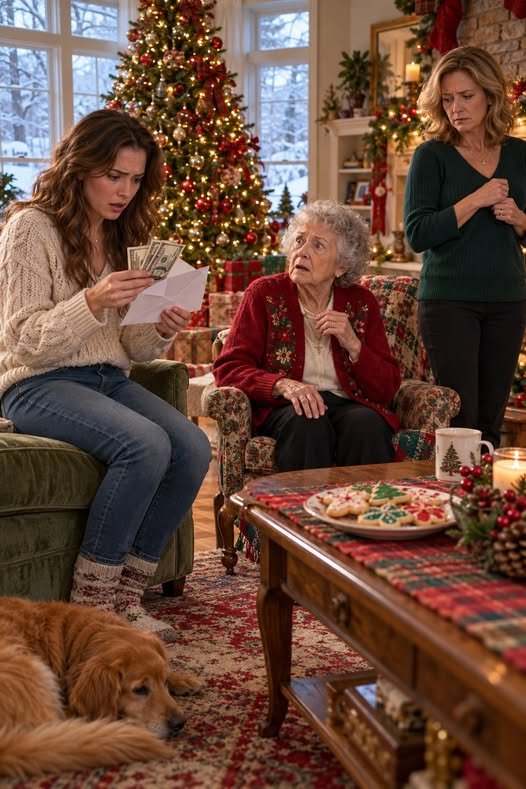
“Your mother,” she said, “took out what I wrote you. And she replaced it with money.”
“Why would she do that?”
“Because she read it.” Grandma’s hands trembled around her cup. “And she knew I had finally decided to tell you.”
She slid the envelope toward me. “I made a copy, sweetheart. I’m old, not foolish. I made one at the library the day I wrote it.”
Inside was a single page in her slanting handwriting. I read it at her table, with the radiator ticking and a cardinal pecking at the feeder outside the window.
Dear Nola,
Twenty-four years of letters, and this is the one I should have written first. Your father did not die in a motorcycle accident. His name is Thomas Keating, and he is alive. He lives in Rochester, forty minutes from my house.
When you were three, your mother was in debt and afraid. Thomas had been struggling with drinking, and he’d made mistakes, but he was getting sober. He fought to keep you. Your mother, newly engaged to Frank, told a lawyer a story that was only half true, and a judge terminated Thomas’s visitation. She then told everyone he had died, because it was easier than explaining.
Thomas wrote to you every birthday for twenty-four years. I have kept the unopened letters in a box in my closet, because your mother returned them and I could not bear to throw them away.
He is eleven years sober. He has never stopped looking for you.
I was a coward for a long time. I’m done being one.
Love, Grandma
My hands went cold. “There are letters?”
She stood, with effort, and went to the hall closet. She came back carrying a shoebox, tied with kitchen string, much like the one I kept in my own closet. Inside were twenty-four envelopes, each addressed in a careful hand to Nola Claire Keating. None of them had been opened.
I did not cry then. I held the box in my lap for a long time.
“Why didn’t you tell me before?”
“I promised your mother.” Grandma’s eyes were wet. “After the court, she begged me. She said you’d be safer, happier, that Frank would be a real father. And Frank was good to you. I believed that was true, so I kept quiet. But every year, I watched you ask about him, and I watched her lie, and it grew heavier.”
“And this year?”
“My doctor found something.” She said it plainly. “My heart. He thinks I may not have many more Christmases. I decided I wouldn’t take this to the grave.”
I came around the table and held her, her small shoulders shaking under my arms.
My mother arrived at ten, as I’d expected. She stood in the kitchen doorway in her good wool coat and took in the scene: the box, the letter, my face.
“Nola,” she said. “Please. Let me explain.”
“You took the letter out of my envelope.”
“Yes.”
“You lied to me my entire life.”
“Yes.” Her voice cracked. “I was twenty-five, drowning in debt. Thomas had relapsed, and I was scared for you. I told a lawyer things that were exaggerated. I thought it was temporary, that I would fix it, and then the years passed, and I had built a whole story, and I couldn’t take it apart without everything falling down.”
“Everything did not fall down for him,” I said. “He lost a daughter.”
She had no answer. For the first time in my life, my mother, always polished, always composed, looked small and old and ashamed.
Frank had followed her in. He stood behind her, gray-faced. He had not known, I realized. Not all of it.
“Elaine,” he said quietly. “What did you do?”
I did not make a decision that morning. I want to be honest about that. I drove home with the shoebox on the passenger seat and spent three days not opening it.
On the fourth day, I opened the earliest envelope.
Dear Nola, it began, in uneven pencil, nearly shaky. Today you are four. I am not allowed to see you, but I wanted you to know that somebody thinks about you every single day…
There were twenty-four of them. I read them over a weekend, one by one, at my kitchen table, crying until my ribs ached. He told me about learning to build furniture. About getting sober, one day at a time. About a dog named Biscuit. About how he drove past my elementary school once and sat in the parking lot for an hour, then left, because he’d promised himself he wouldn’t intrude.
In the last letter, written the previous spring, he said: If you ever want to find me, I’m at the same address. I will not stop being your father. Whenever you’re ready, I’ll be here.
I drove to Rochester on a bright, cold Saturday in January.
The house was small, with a neat porch and a wreath still on the door. I sat in the truck for twenty minutes with my hands on the wheel.
Then I walked up and knocked.
The man who opened the door was tall and gray, with my eyes, my chin, and the same crooked eyebrow. He stood very still. His hand tightened on the frame.
“Nola?” he whispered.
“Hi,” I said. “I got your letters.”
His face collapsed. He did not reach for me. He just stood there, tears sliding down his cheeks, saying “I’m sorry, I’m sorry, I’m so sorry,” while I stepped inside and put my arms around a stranger who smelled like cedar and coffee.
It was not a movie ending. We were awkward. We sat at his kitchen table, and he showed me a photo album he’d kept, with pictures of the toddler I had been, and a framed union card he’d sent a congratulations for when I finished my apprenticeship, never knowing if I received it. A dog, a gray old Biscuit descendant named Pepper, leaned against my leg.
“I don’t expect you to call me Dad,” he said. “I haven’t earned it.”
“We’ll start with Thomas,” I said, “and see.”
He laughed, wet and startled. “That’s more than I hoped.”
Frank came to my apartment a week later. He sat on my couch twisting his cap.
“I’m not leaving you,” he said. “Whatever you learn, whoever you find. I’m your dad too, if you’ll have me.”
“I know, Frank.” I sat beside him. “You were there every day. That counts for more than blood.”
He nodded and rubbed his eyes. “I told your mother she has to tell you everything. Properly. And that she should go to counseling.” He paused. “We’re not sure about us, Nola. But we’re sure about you.”
My mother and I did not speak for months. When she finally wrote, it was a long letter, three pages, the first honest thing she’d ever put on paper for me. She did not ask for forgiveness. She asked for the chance to apologize in person.
We met at a diner halfway between our homes. She cried before the coffee arrived.
“I thought I was protecting you,” she said. “I was protecting myself.”
“I know.”
“Can I try to earn some of it back?”
I looked at her for a long time. “Slowly,” I said. “And honestly.”
She nodded, and for once she did not smile.
Grandma lived through that spring and, to everyone’s surprise, through the summer. In October, she sat at the head of her table with Frank, my mother, and Thomas, all together for the first time, passing dishes with careful politeness. It was uncomfortable and tender and real.
The following Christmas, Grandma handed me a small envelope.
I opened it at the table. Inside was a twenty-dollar bill, and a letter.
Dear Nola, Twenty-five years, and I’m proud of you still. This year I’m proud of you for having the courage to open a door that others kept shut. Love always, Grandma.
I read it twice. Then I looked up at the table: my grandmother, my mother, Frank, and Thomas, all watching me with the same hopeful, anxious faces.
“Thank you,” I said. “It’s the best present I’ve ever gotten.”
And I meant it, because it was never the money. It was the person who finally told me the truth.