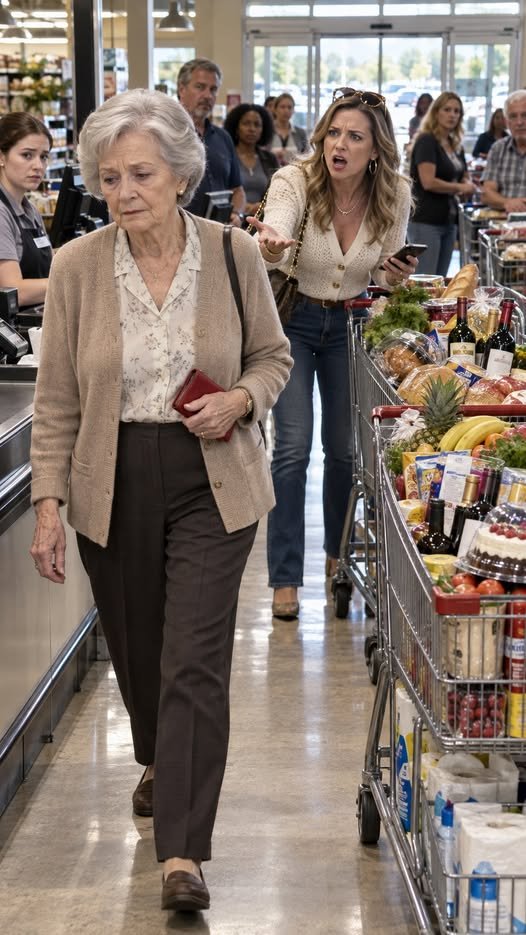
I did not go back to that house that night.
I walked eleven blocks in the Savannah heat with my purse hugged against my chest, and then I did something I had not done in four years. I called my own friend, Rosalind, whom I had known since we were girls in the church choir. She answered on the second ring.
“Margaret? Where are you?”
“Outside a pharmacy. Rosalind, I don’t have anywhere to go tonight.”
“Stay right there,” she said. “I’m bringing the car.”
Rosalind lived in a small brick house near Forsyth Park, widowed like me, with a guest room she kept made up out of habit. She put a plate of cold chicken in front of me and a cup of chamomile tea beside it, and she did not say a word until I finished eating.
Then she said, “Tell me everything.”
So I did. The house I sold. The money I transferred. The bedroom turned into a storage room. The bills. The groceries. The “temporary” requests that never ended.
“Margaret,” she said carefully, “do you have any paper showing what you gave them?”
I almost laughed. “I have everything. I never trusted my own memory with numbers after Donald died. I kept every bank receipt in a shoebox.”
“And where is that shoebox?”
My stomach dropped. “In the room Stephanie calls storage.”
Here is the part I did not tell Stephanie in the supermarket, or at any point in four years.
When I sold the house, I did not give them almost all of it. I gave them what they asked for. But the sale had been larger than I let on. The house, bought in 1981 for little, had been worth far more than anyone knew, and part of the proceeds went into a savings account that only Donald and I knew about. Donald had set it up years earlier. After he died, I could not bring myself to touch it. It felt like spending him.
That account held a little over two hundred thousand dollars.
And there was something else. Every month for four years, I had been paying Stephanie’s electric bill, her internet, and part of the groceries. I had paid it from my pension and from that account, without telling her, because I was afraid that if I stopped, I would be told to leave.
That night, in Rosalind’s guest room, I opened my banking app and looked at the list of automatic payments, one by one. The electric company. The internet provider. The grocery card. The house insurance, which I had quietly taken over the previous winter when Clinton “forgot.”
Then I understood what I had told myself at the supermarket door. I would stop paying for something far more important than groceries.
I pressed cancel on every one.
It took forty minutes. My hands shook the entire time. When the last confirmation appeared, I put the phone face down on the nightstand and slept more deeply than I had in years.
At 7:12 the next morning, it began to ring.
Stephanie. Then Clinton. Then Stephanie again. Then a number I did not recognize, which turned out to be the electric company, politely informing me that the account had been closed at my request and service would end in seventy-two hours unless a new account holder was registered.
I let them all ring.
At nine, Rosalind knocked and handed me a mug. “Your daughter is on my porch.”
Stephanie stood on the front step with her hair unbrushed and her sunglasses pushed up on her head. Behind her, Clinton waited by the car. They both looked like people who had not slept.
“Mom,” she said. “Please. Come home.”
“Is that an invitation,” I asked, “or an instruction?”
She flinched. “The dinner was a disaster. Clinton’s boss was there. We had to order pizza. And this morning the internet’s out, and the electric company says…”
“I know what they said. I canceled it.”
“You canceled it?” Her voice cracked. “Mom, those were our bills.”
“They were mine,” I said. “I’ve been paying them since the day you moved me into that wet corner. You just never asked who was doing it.”
She stared at me. Clinton had stepped closer, and for the first time in four years he looked uncertain.
“Margaret,” he said. “We didn’t know.”
“You didn’t ask.”
I invited them in, because I wanted to say it sitting down.
At Rosalind’s kitchen table, with the morning sun on the tablecloth, I laid out what I had printed at the library the evening before. Four years of bank statements. The wire transfer for the house. The monthly payments, circled in blue.
The total was a little over one hundred and eighty-three thousand dollars, including the money from the sale and everything I had paid since.
Stephanie read the last page twice. Her lips moved. She looked up at me, and for the first time since Donald’s funeral, I saw my little girl, the one who used to fall asleep on my lap.
“I didn’t know it was that much,” she whispered.
“You never wanted to.”
“I thought…” She swallowed. “I thought it was just there. Like you were. Like it didn’t cost anything.”
“It cost me my house, my husband’s memory, and my place at your table.”
She put her hand over her mouth.
“Here is what happens now,” I said.
Clinton opened his mouth, and Stephanie touched his arm. “Let her.”
“First, I’m not coming back to that house. Not as it was. I’ve spoken to a lawyer, Mr. Hargrove. He tells me the money I put into your home can be treated as a loan or as a share of ownership, and either way, I’m entitled to a written agreement. He drew one up this morning.”
I slid it across the table.
“It says that I hold a twenty-five percent stake in the property. Or you may buy me out, over time, at a fair price. The choice is yours.”
Clinton went white. “That’s a lot of money.”
“It’s less than what I put in.”
Stephanie was crying openly now. “Mom, I don’t want to fight you.”
“Neither do I. That’s why there’s a second thing.” I folded my hands. “I’m moving into a small apartment near Rosalind. I found it yesterday. I will pay my own rent from my pension and from what Donald left me. I’ll cover my medications. I’ll buy my own tea.”
Stephanie let out a small, startled laugh through her tears.
“And Mason?” she whispered. “He asked for you at breakfast. He said, ‘Where’s Grandma?'”
My throat closed. “I want to see him. Every Saturday. As his grandmother. Not as his cook.”
“Yes,” she said instantly. “Yes. Of course.”
It did not heal quickly.
Clinton resisted the agreement for two months. Then his boss quietly learned about the situation, and Clinton, who cared a great deal about appearances, signed. Stephanie took a second job. They sold the boat, a purchase I had known nothing about. Slowly, month by month, they bought back my share. I used every payment to travel, something Donald and I had always promised ourselves.
I moved into my little apartment on a sunny Tuesday. It had a window box, a reading chair, and a bedroom that was entirely mine. When Rosalind helped me hang the last picture, a framed photograph of Donald and me on the day we bought our first house, I stood back and had to hold the doorway.
“It’s quiet,” I said.
“Good quiet?”
“The best kind.”
On Saturdays, Mason arrived with a backpack and a bag of cookies his mother had made. We baked, or we walked, or we sat on the floor with a puzzle. He told me about school. I told him about Grandpa.
One Saturday in November, Stephanie came to pick him up and lingered at the door.
“Mom,” she said. “I’m sorry. I said it in the store, and I’ve said it in my head a hundred times. I’m sorry that I made you feel you had to buy your place at our table.”
I looked at my daughter, gray beginning to show at her temples, tired in a way she hadn’t been before.
“Thank you,” I said. “It took a while.”
“I know.”
“Come in. I’ll make tea.”
She sat in my little kitchen, in a chair I had bought myself, and I poured chamomile into two cups.
For the first time in four years, nobody asked me to pay.
I handed her a cup anyway, because that is what a mother does.
And this time, it was a gift.