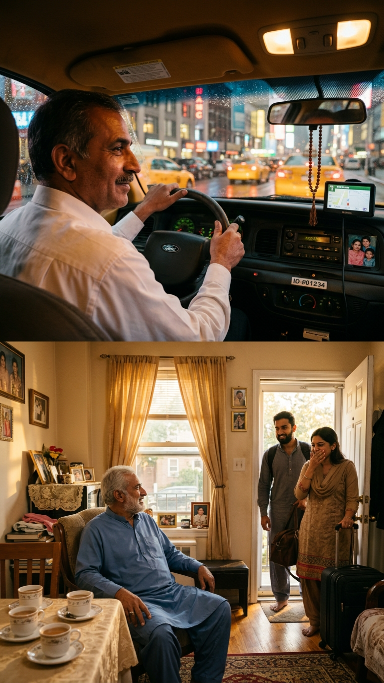
The cab idled at the curb for a long moment before the door opened.
Khalid watched from his window the way he always did — more habit now than hope, the watching. A reflex left over from twenty years of reading streets.
The man who stepped out was young. South Asian. He stood on the sidewalk looking up at the building with the expression of someone checking an address they weren’t certain about.
Then he looked up at Khalid’s window.
He waved.
Khalid didn’t move. Nobody waved at his window. Nobody even looked at his window.
The young man came upstairs anyway. Knocked. Introduced himself as Tariq — a journalism student at Columbia working on a piece about immigrant taxi drivers in New York. Someone had given him Khalid’s name. He had three questions and an hour.
He stayed for four hours.
Khalid told him everything. The forty dollars. The cousin’s address. The twelve-hour shifts. Lahore. The weddings he paid for from a distance. Amir’s graduation suit. The window he sat beside every evening.
Tariq wrote it all down in a small notebook, asking questions with the careful attention of someone who understands that a person’s story is the most valuable thing they own.
The article was published six weeks later in the university paper. A professor shared it. Then a journalist. Then it traveled the way things travel now — far and fast and beyond anyone’s prediction.
Amir read it in Seattle on a Thursday morning before work.
He called his father that same day for the first time in seven months.
Then he booked a flight.
Sana called from Chicago an hour after Amir. She booked a flight too.
They arrived on the same weekend — not coordinated, just simultaneous, the way guilt and love sometimes move at the same speed.
Khalid opened the door and found both his children on the landing with their bags.
Nobody spoke for a moment.
Then Sana said — quietly, in Urdu, the language of the home Khalid had built before either of them existed: “We forgot how to come back. We’re sorry, Baba.”
Khalid stepped back from the door to let them in.
On the kitchen table he had already, instinctively, set three cups for tea.
He had never stopped expecting them.
— For every parent who kept the light on. And every child who found their way back.