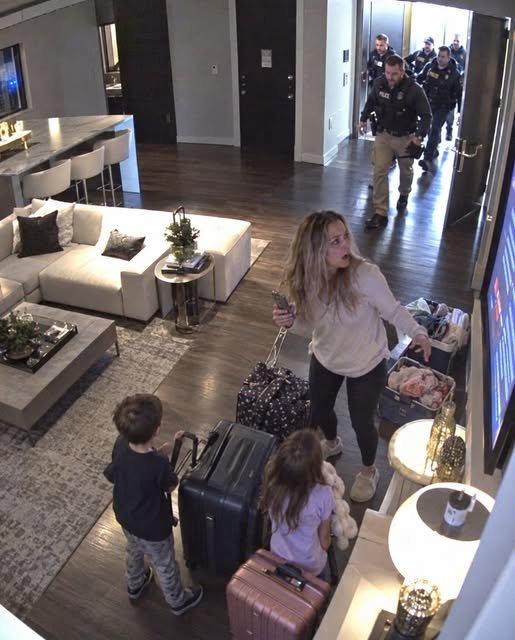
Paige lowered the poker so slowly it seemed to weigh a hundred pounds. It clattered on the hardwood, and the sound echoed through the dark penthouse.
“This is a misunderstanding,” she said. “I’m her sister. This is my family’s home.”
The man in the dark jacket stepped forward. His credentials read Special Agent Thomas Brandt, U.S. Marshals Service, Fugitive Task Force. “Ma’am, I’m going to need you to step away from the door and keep your hands where I can see them. Is anyone else in the unit?”
“Just my kids.” Her voice cracked. “Please don’t scare them.”
“Nobody is going to scare them,” said the younger of the two Arlington officers. She was already crouching beside Lily, speaking in a low, gentle voice. “Hi, sweetheart. I like your bunny. What’s his name?”
“Biscuit,” Lily whispered.
“That’s a great name. Can you and your brother come stand with me?”
Noah hadn’t let go of his sister’s hand. He looked at his mother, then at the officers, and then, in a small, shaking voice, said what I would replay in my head for weeks.
“Aunt Marissa told us not to come. Mom said it was okay.”
Paige closed her eyes.
I watched all of it from a hotel room in London, laptop balanced on my knees, my own pulse loud in my ears.
My supervisor, Deputy Chief Amara Okafor, had joined the secure line by then. She had worked with me for nine years. She was not a woman who raised her voice, and she didn’t now.
“Marissa,” she said, “I need you to hear me. The children are safe. The scene is controlled. You did everything right.”
“I didn’t want this,” I said. “I never wanted my own sister arrested.”
“I know. But I need you to understand what she actually damaged.”
I swallowed. “The keypad.”
“The keypad on a secure federal workspace. We’re not talking about a home office, Marissa. Your unit houses a secure communications terminal and case files we are legally required to protect. If she had gotten through, it wouldn’t have been a family dispute. It would have been a federal offense, and it could have compromised an active investigation.”
I closed my eyes. That was the part I had never told my family. Six years ago, when the Marshals Service approved my home as an authorized workspace for off-site case review, the security upgrades had been mandatory. I had never mentioned it, because nobody had ever asked what I actually did.
In Arlington, the officers led Paige into the hallway, not in handcuffs, not yet. Agent Brandt read her the situation plainly: unauthorized entry, property damage, and attempted breach of a secured federal area.
“I didn’t know it was federal,” Paige said.
“Ma’am, you used a service code that didn’t belong to you,” Brandt said. “You were warned by the system. You were told by the owner, in writing, to leave. And you struck a security panel with a fireplace poker. Whether you knew its purpose is something a judge will weigh. But you knew you weren’t allowed in.”
Paige’s phone rang again. It was Mom. Brandt gestured, and she answered with a shaking hand, the speaker accidentally on.
“Paige, are you inside? Did Marissa call? Your father says the lawyer said—”
“Mom,” Paige said. “There are police here.”
Silence.
“Mrs. Keane?” Brandt said into the phone. “This is Special Agent Thomas Brandt. We’d like to speak with you and your husband in person tomorrow morning. Please don’t delete any messages or documents relating to this property.”
The line went dead.
My parents arrived at the Arlington field office the next morning at nine, with the attorney Dad had consulted. His name was Gerald Sutter, and he had the look of a man who’d taken a retainer and was beginning to regret it.
I wasn’t there. I was on a flight home. But Deputy Chief Okafor sent me a summary that afternoon, and I read it three times on the tarmac.
My father had met with Sutter two weeks earlier. He’d asked a hypothetical question: if a family member and her children lived in a property for thirty days, could the owner remove them without a formal eviction? Sutter had said, carefully, that in some cases, yes, it could become complicated.
He had not advised my parents to do it. In fact, according to his own notes, he had advised against it. But my father had heard what he wanted, and my mother had texted Paige a plan.
Those texts were the heart of the file. Once the kids are settled, she’ll have no choice. Don’t answer any calls from Marissa. Say you have nowhere else to go.
Paige did have somewhere else to go. She had a lease, three months paid, on a two-bedroom in Alexandria. She had let it lapse on purpose.
I met my family at my own kitchen table four days later. Okafor had cleared it, and a victim advocate named Ruth Delgado stayed in the next room in case I needed her. Paige, my parents, and Gerald Sutter sat across from me. The dented keypad was visible down the hall.
Nobody spoke for a long time.
Finally, my mother said, “We didn’t think you’d really press charges.”
“I haven’t,” I said. “That’s why we’re sitting here.”
My father looked up, startled.
“The U.S. Attorney’s office has the file,” I said. “They get to decide what happens on the federal side. I can’t control that. But on my side, I’ve told them I’ll ask for a resolution, not a punishment, if three conditions are met.”
My mother’s mouth tightened. “Conditions.”
“First, Paige repays the cost of the damage and signs a statement admitting what happened. Second, none of you will ever contact me again about money, property, or favors. Not a request, not a hint, not a guilt trip.” I looked directly at my mother. “I’ve paid for everything for eleven years, and in return, you tried to take my home while I was abroad.”
My mother’s face crumpled. “Marissa, we were desperate.”
“You were planning,” I said gently. “That’s different. Desperate people ask. You made a lawyer’s appointment.”
Paige had said nothing so far. She sat with her hands pressed together and her eyes on the table.
“What’s the third condition?” she finally asked.
“You get help,” I said. “Real help. A housing counselor, a budget coach, a job placement program. I’ll cover the first three months of fees, once. After that, it’s yours.”
“I don’t need your charity.”
“It isn’t charity. It’s the last thing I’m ever going to give you that you didn’t earn. Make it count.”
She looked up at me. Her eyes were red, and for the first time since childhood I saw her without armor.
“I thought you’d always say yes,” she whispered. “That’s what you did. And when you stopped, I felt like you’d abandoned us.”
“I know.”
“Noah asked me why I lied to him.” Her voice broke. “He’s nine. He said, ‘You told me Aunt Marissa said it was okay, and she didn’t.’ I didn’t have an answer.”
I had nothing to say to that, so I reached across the table. She took my hand.
It took eight months to finish. The U.S. Attorney’s office accepted a negotiated resolution. Paige pleaded to a misdemeanor, paid restitution, and completed community service. The charges against my parents were never filed, though both were required to sit for formal interviews and sign statements. Sutter withdrew from the matter.
Paige found a job as an administrative assistant at a dental office. She moved into a small two-bedroom in Alexandria. Noah and Lily, in therapy for three months, now describe the night as “the time Mom made a bad choice and then fixed it.” Children are generous that way.
My parents and I spoke twice that year, briefly, and only about their health. I was polite, and I was clear. They eventually stopped asking for things.
I replaced the keypad and added a second lock. Then, because I had not realized how much I needed to, I changed every code in the building.
On a warm evening the following June, Paige stood at my door with a covered dish.
She did not use a code. She knocked.
“It’s lasagna,” she said. “I made it. Badly, probably.”
“Come in.”
Noah and Lily rushed past her, and Lily hugged my waist so hard I almost dropped the dish. “Biscuit missed you,” she said.
We ate at my kitchen table, the same table, with the same chairs. The lasagna was a little burned on the edges. Noah told me about a science project. Lily showed me a loose tooth.
When the children were in the living room, Paige leaned toward me.
“I’ve been thinking about the thing you said,” she said. “About the last thing you’d ever give me. I wanted you to know I used it.”
“The counseling?”
“The counseling. The budget. All of it.” She smiled, small and a little crooked. “I paid my rent on time for six months. I haven’t asked anyone for a dollar.”
I looked at my sister, thirty years old, tired, steadier than I had ever seen her.
“I’m proud of you,” I said.
She wiped her eyes. “I’m sorry I smiled at the camera.”
I laughed, and it felt like setting down something heavy. “That,” I said, “was a very bad moment for you.”
“The worst.” She grinned. “But you know what? I’d say we live here now. Just not the way I meant.”
I put my hand over hers.
Through the window, the Arlington skyline glowed. For six years, this had been the one place that belonged only to me.
Now, for one evening at a time, it belonged to everyone I chose to let in.