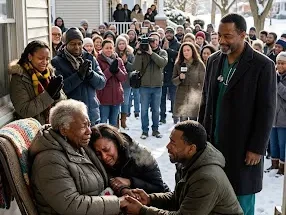
Greg sat down in the snow at the end of his driveway, in his robe and slippers, with the letter shaking in his hands.
Dear Greg,
If you are reading this, then Mr. Okafor has done what I asked. I told him to send it on Christmas morning, because I wanted you to have it on a day when a man is allowed to feel things.
You never knew where the money came from. I wanted it that way. Here is the truth.
In January, you came to me in a diner, ashamed, and told me you were about to lose your house. I sold your mother’s land. I emptied the account we had saved for forty years. Through Mr. Okafor, I paid off every dollar of your debt. The ledger enclosed shows each payment. It came to two hundred and ten thousand dollars, and I would pay it again tomorrow.
I am not telling you to make you feel small. I am telling you because I have been thinking about how a man becomes invisible to his own child. I think it happens slowly. I think it happens when a father is quiet for so long that the child forgets he is a person.
I am not angry about last night. You are under pressure. Vanessa is afraid of what people think, and fear makes everybody a little smaller. I understand more than you know.
But I need you to hear one thing. The coat I wear is the one your mother bought me the year you were born. I keep wearing it because it was hers to choose. It is not poverty. It is the only thing I own that still smells like her.
I love you, son. I have always loved you. I just wanted you to know where it went.
Dad
Greg read it twice. By the second reading, he was sobbing so hard he could not breathe.
Vanessa found him ten minutes later. She had come looking for him with a blanket and an expression that said she was ready to apologize for the night before.
She stopped at the sight of her husband on the ground.
“Greg? What’s wrong?”
He couldn’t speak. He handed her the letter.
She read it standing in the snow, one hand on the mailbox post. Her lips moved. When she reached the line about the coat, her hand flew to her mouth. She sank to her knees beside him.
“Two hundred and ten thousand,” she whispered. “Greg. The bank. You told me it was restructured.”
“I lied,” he said hoarsely. “I was terrified. I thought you’d leave.”
“I would never have…” She stopped. She looked down at the letter, then at the house behind them, with its wreaths and its glowing tree. “Greg. Your father paid for all of this. And I told him not to embarrass us.”
“I let you.”
“I said it to his face.” Her voice broke. “I looked at his coat and I was ashamed. And he was the one holding the house up.”
They sat there in the snow, in their robes, crying.
Owen found them at the end of the driveway, in his pajamas and one sock, holding the wooden train.
“Dad?” he said. “Mom? Is Grandpa coming?”
Greg pulled his son into his arms. “Not yet, buddy. But we’re going to go get him.”
“Now?”
“Now.”
Vanessa stood up first. She wiped her face with her sleeve, smoothed her robe, and said, in a voice stripped of every polite thing, “Get dressed. All of you. We’re going to his house, and I am going to apologize on his doorstep if I have to do it in the snow.”
They arrived at the small gray house at nine-fifteen. The cracked front step had been shoveled. A thin line of smoke rose from the chimney. Through the kitchen window, they could see the shape of a man at the table, drinking tea alone on Christmas morning.
Greg knocked.
Thomas opened the door in his cardigan, with his reading glasses pushed up on his forehead. He looked at his son, at Vanessa with her red eyes, and at Owen clutching the train.
“Oh,” he said. “You’re up early.”
Greg didn’t answer. He stepped forward and wrapped his arms around his father, the old brown coat hanging on a hook by the door, and held on.
“Dad,” he said into his shoulder. “Dad, I’m so sorry.”
Thomas stood stiffly for a moment. Then, slowly, his big scarred hands came up and closed around his son’s back.
“You read it,” he said.
“I read it.”
“Mr. Okafor is a punctual man.”
Greg laughed, a cracked, wet sound. “Why didn’t you tell me?”
“Because you’d have felt like you owed me,” Thomas said. “And I didn’t want a debtor. I wanted a son.”
Vanessa stood on the front step, hands clasped, trembling.
“Thomas,” she said. “I have no right to ask for anything. But I need to say it. When you came to our door, I was ashamed of you, and it was the worst thing I have ever done. You’ve been quietly holding up this family for a year, and I treated you like an embarrassment.” She took a shaky breath. “I’m sorry. I’m so sorry.”
Thomas looked at her. He had spent a lifetime reading faces across a factory floor, and he knew a real apology when he saw one.
“Vanessa,” he said gently, “everybody gets afraid of how they look. It’s not a crime. It only becomes one if you stay afraid.” He opened the door wider. “Come in. It’s cold. There’s tea.”
She burst into tears, and he put a hand on her shoulder, the way he would have for his own daughter.
They spent Christmas morning in his tiny kitchen, crowded around a table meant for two. Thomas heated the rest of the cookies. Owen unwrapped the train, and his eyes lit up when he found the little inscription.
“Grandpa,” he said. “What’s a prayer?”
“It’s a wish you say very carefully,” Thomas said.
“Then I’m going to say one for my train.”
Greg watched his father kneel beside the boy and show him how to roll the wooden wheels across the linoleum. He thought about the nineteen winters of that coat. He thought about the factory, the plant, the late nights, the quiet.
“I want to give it back,” Greg said at last. “Every dollar. It might take years.”
“No.”
“Dad…”
“You’ll pay me back a different way,” Thomas said, without looking up. “Sunday dinner. Every week. At your table, with the good plates. And I’ll wear whatever coat I like.”
Greg’s voice cracked. “Deal.”
That evening, the family drove back to Hudson together. Thomas sat in the passenger seat of Greg’s car, wearing the brown wool coat. Owen sat in the back, holding the train.
When they walked into the colonial, the tree was still glowing, and the table was still set from the night before. Vanessa had pulled out the finest china without being asked. She laid a place for Thomas at the head.
He looked at it for a long moment.
“That’s the seat for the man of the house,” he said.
“It is,” Greg said. “And that’s you.”
Thomas sat. Owen climbed into the chair beside him. The candles flickered. Vanessa brought out the cookies on a silver platter, and for once nobody was worried about how anything looked.
“Grandpa,” Owen said, “will you say the blessing?”
Thomas folded his hands. His voice was quiet, steady, a little rough.
“Thank you for the people at this table,” he said. “Thank you for the ones who aren’t. And thank you, Margaret, for making sure I never forgot what a family is.”
Outside, the snow started again, soft and slow and bright against the windows.
Inside, a retired factory worker in his late wife’s gift of a coat sat at the head of his son’s table, in the warmest room in the house, exactly where he belonged.