“Why aren’t you surprised, Vanessa?” Grant asked.
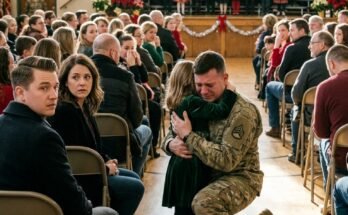
His voice was quiet, and it carried farther than any shout. Around us, two hundred mourners in black stood among the headstones, holding programs and umbrellas they no longer needed.
Vanessa’s mouth opened. “Grant, she’s twisting this. Look at her. She shows up after ten years with a handful of papers and a story.”
“I asked why you aren’t surprised.”
She had no answer. Grant turned to me, and I saw what the last ten years had done to him. He looked tired and gray at the temples, like a man who had won a prize and then discovered what it cost.
“Savannah,” he said. “Tell me.”
Here is what happened, and what I never got the chance to say.
Eleven years ago, I was thirty and married to Grant. I was also a reservist, called up for a six-week training rotation at Fort Benning. While I was gone, Grant’s firm held a regional conference at a hotel in Savannah. I was supposed to join him for the last weekend. I came a day early to surprise him.
What I found, according to a photograph delivered to Grant’s phone that same night, was me, leaving a hotel room with a man in the early morning. The man was a fellow officer who had driven me from the base because my car had broken down. The room was his. I had asked to use his shower and change before the drive, because my own room was not yet ready. Nothing happened. I told Grant exactly that.
He didn’t believe me. Someone had made sure of it. The photograph had been sent anonymously, along with a printed hotel folio showing a room charged to my card.
I never charged that room. I found out later it had been booked under my name, with a card number copied from a receipt in my own purse.
Grant gave me ten minutes in the kitchen to explain. When I tried, he held up the folio and said, “Don’t insult me.” The papers were signed within the month, in a lawyer’s office, with Vanessa sitting beside him as his “support.”
I walked out with a suitcase and a secret I had not yet told anyone.
I was seven weeks pregnant.
“Five children,” Grant said now, staring at them. “But the divorce was ten years ago.”
“I was pregnant when I left,” I said. “Ethan is ten and a half. Noah and Luke were born two years later, and Rose and Emma are the twins who came after that.”
“Five children with who?”
I looked at him. “Grant. Count the years. Look at their faces.”
“You remarried?”
“I never did.”
He stared at me. Then he looked at Ethan, who stood very straight, with Grant’s jaw and Grant’s dark eyes. Noah had Grant’s habit of squinting at the sun. Emma tilted her head exactly the way he did when confused.
“They can’t all be mine,” he whispered.
“They are.” I held out the envelope. “And there’s proof that I’m not lying.”
He opened it with unsteady hands. The first page was a paternity test completed three years ago, after Ethan’s school nurse asked about family medical history and I decided he deserved the truth in writing. Probability of paternity: 99.99 percent. The second page was a series of matching reports for the other four children, collected from a lab in Atlanta.
He read them standing in the wet grass, flipping pages faster and faster.
“How?” His voice broke. “We were divorced.”
“We were divorced in March,” I said. “I found out I was pregnant in April. And I tried to tell you.”
“You didn’t.”
“I wrote you four times. Once through your lawyer, once by certified mail, and twice to your office. Each time the letter came back unopened, or marked refused.”
His head snapped up. “I never got any letters.”
“I know,” I said. “That’s the other part of the envelope.”
The third document was the notarized statement.
It was from a woman named Marcy Dunn, who had worked at the front desk of that Savannah hotel. Seven years ago she had called me, out of the blue, after a conscience-stricken year, and offered to testify. She told me that a woman had come to the desk the night of the conference and asked to book a room under my name. She paid cash, and she had the card number written on a slip of paper. The woman wore sunglasses indoors. Marcy had picked her out of a photo lineup three years later, and signed her statement before a notary.
The woman in the photograph was Vanessa Hale.
Grant looked from the page to her. The color had drained from Vanessa’s face until she looked like marble.
“You said you were at the airport that night,” he said.
“Grant…”
“You told me you flew in the next morning. You told me you’d been in Chicago.”
“I was trying to help you.” Her voice cracked. “She was going to ruin you. I saw the way that officer looked at her, I just…”
“You booked a room under her name. You paid cash. You took a photograph.” He read the last line aloud. “And she told me, ‘If anyone asks, I was never here.’“
“I loved you,” Vanessa said, and it came out thin and desperate. “I was always going to be better for you.”
The crowd let out a collective, horrified breath.
Then the part I hadn’t planned for.
Grant’s mother, Constance, who had barely spoken to me in a decade, stepped forward from the front row of mourners. She was seventy-two, in a black hat and pearls, with her chin quivering.
“Vanessa,” she said. “Did you intercept her letters?”
Vanessa said nothing.
“Margaret at the front desk of Grant’s firm told me, last year, that you offered to handle his mail while he was traveling. For nine years.” Constance’s voice went hard. “I assumed it was kindness.”
“I was protecting him!”
“You were stealing his children.”
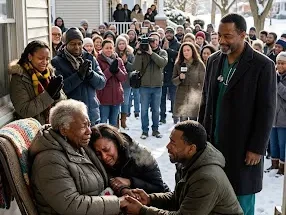
Grant sank slowly onto a stone bench near his father’s grave. He covered his face with both hands. When he lowered them, he was weeping openly, not the quiet dignified weeping of a funeral, but the helpless sound of a man who had lost ten years and found them all at once.
He looked at Ethan.
“I’m so sorry,” he said. “I didn’t know. I swear to God, I didn’t know.”
Ethan studied him gravely. He was ten, and he had rehearsed what he would say for days. “Mom says you’re not a bad person,” he said. “She says you were lied to.”
Grant nodded, unable to speak.
“I’d like to hear you say it back,” Ethan said. “That you weren’t lying.”
“I wasn’t,” Grant whispered. “I loved your mother. I was fooled.”
Ethan thought about it. Then he walked forward and, with great formality, offered his hand. Grant took it in both of his and held on.
Vanessa left the cemetery alone, escorted by a cousin who had heard enough. The Whitmore family closed ranks around me and my children with a tenderness I had not expected. Constance embraced me, shaking.
“I failed you,” she said. “We all did.”
“You didn’t know.”
“We didn’t ask.” She pulled back. “We didn’t ask because it was easier to believe a story that required nothing of us.”
The legal consequences came quietly. Vanessa was sued by Grant for fraud and interference, and I filed a separate civil claim. She settled before trial, with a public acknowledgment, and left Georgia within the year. I never heard from her again.
Grant did not try to take my children, or ask for things he hadn’t earned. He asked, instead, what he could do. I told him what I told every man I’d ever trained on the base: show up, and keep showing up.
He did. He moved into a small house near ours. He learned how to braid Rose’s hair from videos. He came to every school recital, every Little League game, every Saturday morning. Noah, the shyest of them, asked him one day to teach him how to throw a curveball, and Grant stood in the backyard for three hours, grinning like a boy.
We did not remarry. Too much had broken. But there was a gentleness between us, eventually, that I had not expected to feel again. A kind of peace.
On the first anniversary of William’s funeral, I took the children back to the cemetery. Wildflowers had grown over the fresh earth. Emma set a small drawing on the headstone. Grant knelt in the grass beside it, and the five children gathered around him, one by one, until all of them were touching him.
I stood back in my uniform, watching.
I thought of the Christmas card in my Bible, the handwritten note from the only man in that family who had remembered me. Savannah, I hope you are well. Wherever you are, the door here is always open.
I had walked through it at last.
My eldest looked up and caught my eye.
“Mom?” Ethan called. “Are you coming?”
“I’m coming,” I said.
And for the first time in ten years, I walked toward the family I had been missing, and nobody asked me to stay quiet.