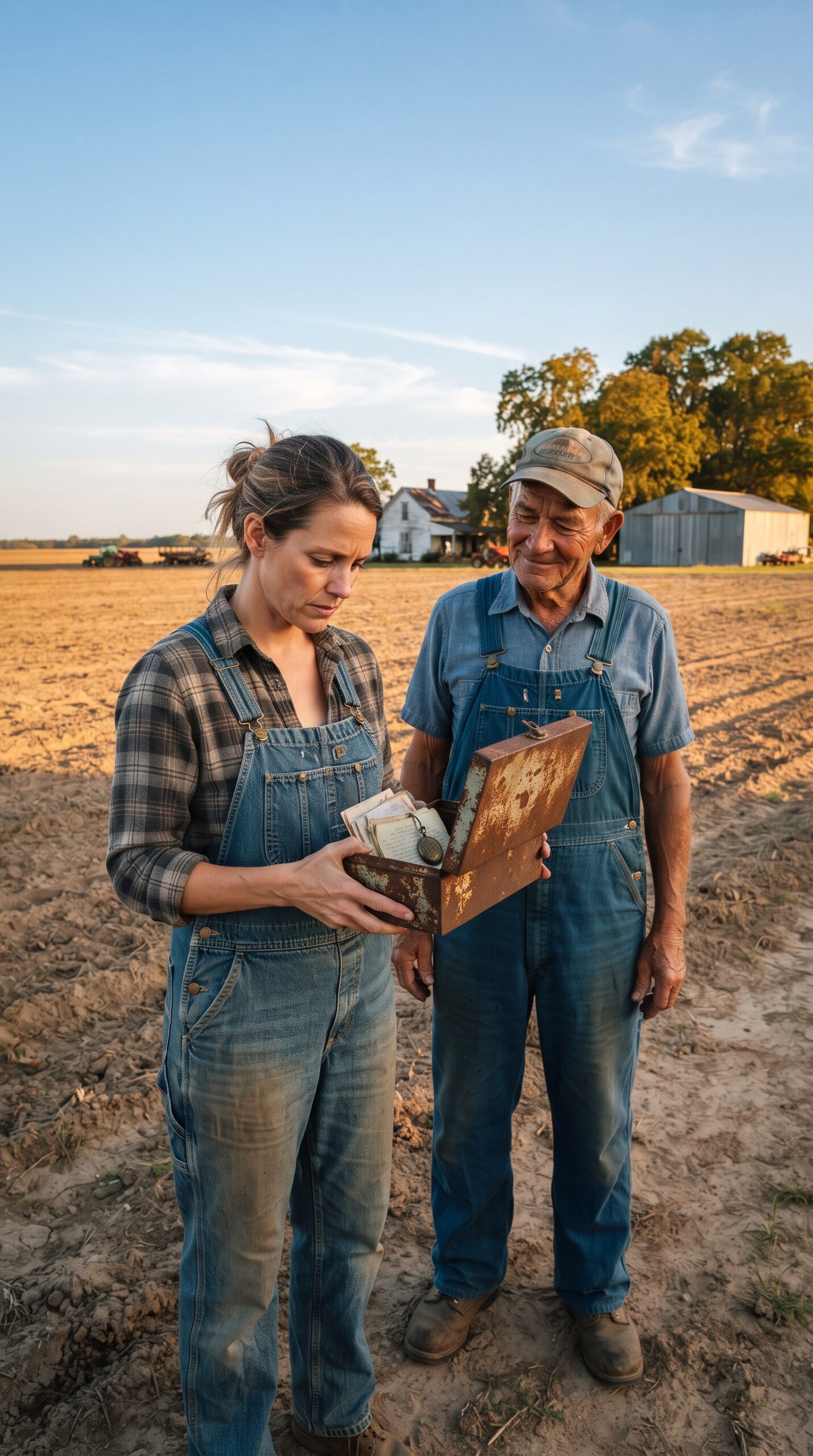
The box was locked, the small key long gone, so Carol Ann pried it open with a flathead screwdriver in the dim light of the barn, dust drifting down around her in the afternoon sun cutting through the slats.
Inside were old ledgers — her grandfather’s handwriting, faded but legible, dating back nearly fifty years. Alongside them was a folder of letters and financial notices Carol Ann had never seen before, documents her grandfather had apparently kept separate from the farm’s main records for reasons that became clear the more she read.
The ledgers told a story she hadn’t fully understood before: the farm had survived several near-failures over the decades, each one papered over by decisions nobody had ever told her about. In the late 1980s, during an earlier farm crisis, her grandfather had taken out a private loan from an uncle to avoid foreclosure — a debt technically still listed, decades later, as an unresolved liability buried in old paperwork nobody had thought to close out. In the 1990s, a bad drought year had been survived only because her grandmother quietly sold a small piece of inherited jewelry and never told her husband where the emergency cash had actually come from.
More than that, the letters revealed something Carol Ann hadn’t known about her own father’s final years running the farm, before his hands started shaking too badly to continue. He’d taken out a line of credit against the land itself, five years before she came home, to cover two consecutive bad seasons — a debt he’d managed to keep current through sheer force of will and eighteen-hour days, but a debt that had never fully gone away. It had simply been rolled forward, restructured, managed quietly enough that by the time Carol Ann took over the books, it looked like ordinary operating debt rather than what it actually was: a farm that had already been running on borrowed time for the better part of a decade before she ever came home to save it.
She sat on an overturned bucket in that dusty barn for a long time, the ledgers open in her lap, feeling something complicated settle into place. She had spent the last several months blaming herself — replaying every decision, every contract, every year she should have refinanced sooner or diversified faster — as if the farm’s failure were purely a story about her own shortcomings during her decade at the helm.
The ledgers told a different, more honest story. This farm had been fragile for far longer than she knew, propped up across generations by quiet loans, secretly sold jewelry, and unspoken debts nobody wanted to burden the next generation with. Carol Ann hadn’t failed to save something stable. She had, in fact, kept something structurally fragile standing for nearly ten years longer than it might otherwise have lasted, simply by working harder than anyone should have to.
She called her mother that evening and read her some of what she’d found. There was a long silence on the line before her mother finally said, quietly, “Your father never wanted you to know how close we always were to losing it. He wanted you to think it was solid ground so you’d feel like you had something worth fighting for.”
Carol Ann understood, in that moment, that the farm’s ending wasn’t really the failure she’d been grieving all spring. The real story was that four generations of her family had fought, in increasingly desperate and increasingly hidden ways, to hold onto something the numbers had been quietly working against for decades — and that she, without knowing the full weight of what she was inheriting, had simply been the one standing there when the math finally ran out.
She and Mark have since moved into town. She’s taken a full-time position with an agricultural nonprofit, of all things, helping other farm families navigate exactly the kind of financial crisis she lived through firsthand. She kept her grandfather’s ledgers, and the metal box that held them, on a bookshelf in her new living room — not as a monument to failure, she says, but as proof of exactly how long and how hard four generations fought before the ending finally came.
“I used to think I lost the farm,” she told me recently. “Now I understand I was just the last person standing when a hundred years of quiet, careful survival finally ran out of road. That’s not the same thing as failing. Some days, that distinction is the only thing that lets me sleep.”