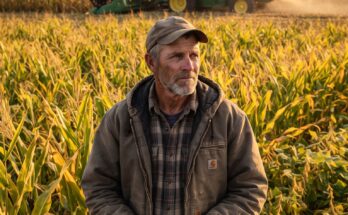
Jason Kurtz wasn’t standing in an empty field.
He was standing in the middle of a harvest that represented an entire year’s work.
The corn and soybeans growing around him had required planning, money, labor, machinery, fuel, fertilizer and chemicals.
Long before the combine entered the field, Jason had already spent heavily to get there.
Then the cost of fuel suddenly became another threat.
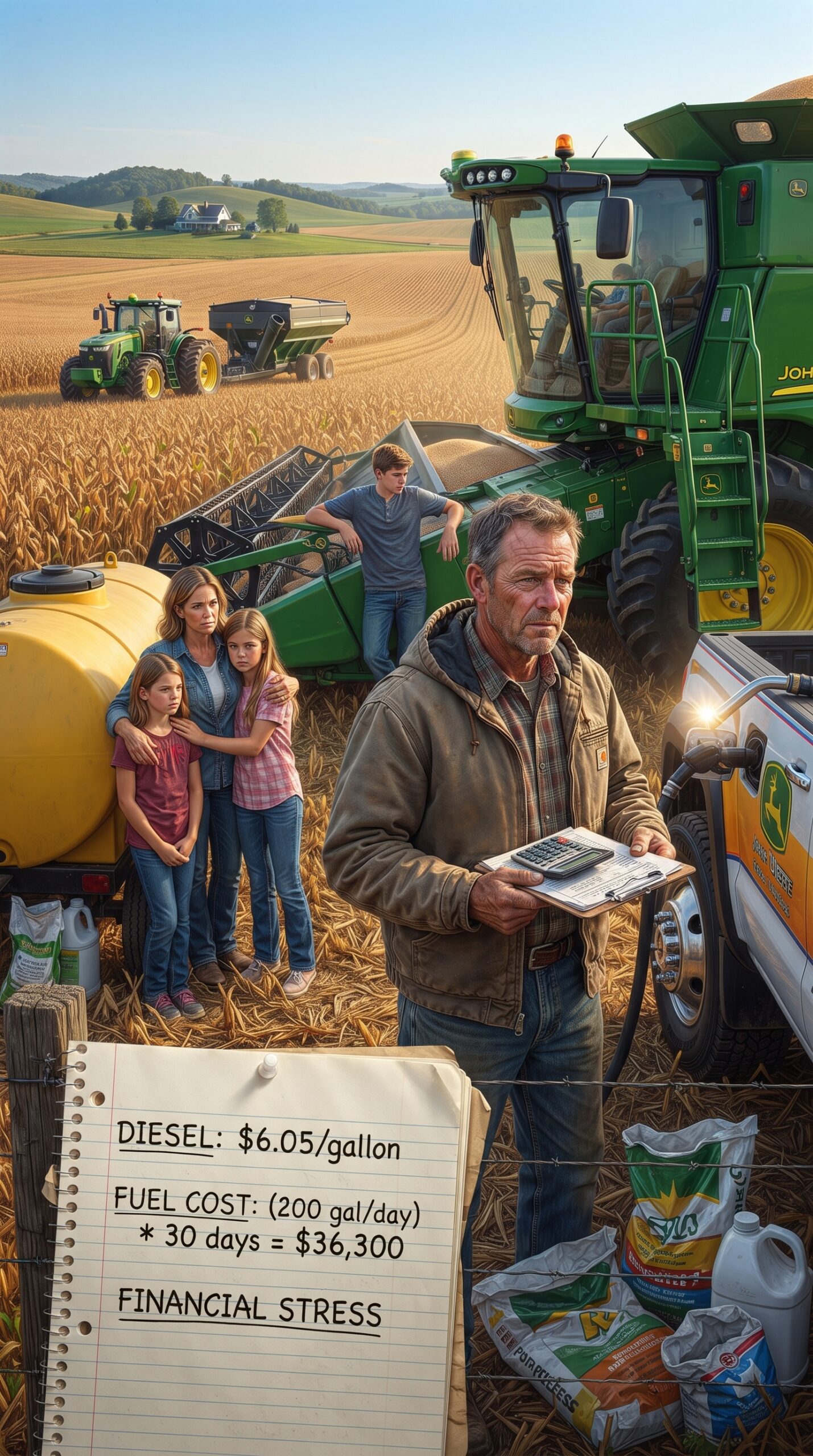
The Associated Press reported that U.S. diesel prices reached about $6.05 per gallon on September 11, 2026, compared with approximately $3.76 per gallon in February.
That represented an increase of roughly 60%.
For an ordinary driver, higher diesel prices are painful.
For a farmer, the consequences are much bigger.
Diesel isn’t simply something used to drive to work.
It powers the work itself.
It moves tractors.
It powers combines.
It moves grain.
It carries crops from fields to farms and from farms to elevators or other buyers.
University of Wisconsin-Madison agricultural economist Paul Mitchell explained that the increased fuel cost affects much more than harvesting itself.
For Jason, the numbers were particularly painful.
His combine consumed approximately 200 gallons of fuel each day.
He expected to operate that combine for around 30 days.
That’s approximately 6,000 gallons of diesel for the combine alone.
At $6.05 per gallon, 6,000 gallons would represent roughly $36,300 in diesel.
And that doesn’t include the fuel required for his tractor and trucks.
It also doesn’t include fertilizer.
It doesn’t include chemicals.
It doesn’t include seed.
It doesn’t include equipment repairs.
It doesn’t include land costs.
It doesn’t include interest.
It doesn’t include the countless other expenses that keep a modern farm operating.
This is where the story becomes especially painful.
Jason couldn’t simply decide to stop.
His crop was ready.
Harvesting late can create its own risks.
Weather can change.
Fields can become too wet.
Crops can deteriorate.
Equipment can break.
And every additional day brings another bill.
So he had to keep moving.
The combine had to enter the field.
The grain had to be collected.
The trucks had to move.
And the diesel had to be purchased.
For farmers whose finances were already stretched, every additional expense mattered.
Mitchell warned that cash-strapped farms were the ones having to make the hardest decisions about what expenses they could cut.
Jason was already feeling that pressure.
His farm’s finances were tight before the diesel spike.
Now the cost of keeping his equipment operating had jumped.
That meant decisions had to be made.
Some work could be delayed.
Some expenses could be postponed.
Some farmers might have to hope that fuel prices eventually come down before they perform work that isn’t immediately necessary.
Jason planned to delay some farm work because he hoped diesel prices would fall later.
But there was one thing he couldn’t postpone forever.
The harvest.
That’s what makes farming different from many other businesses.
A factory can sometimes shut down a production line.
A store can reduce its opening hours.
A company can postpone an expansion.
But a farmer has a crop growing in the ground.
The seasons don’t negotiate.
The weather doesn’t negotiate.
And the crop doesn’t wait for the farmer’s bank account to recover.
Jason’s story also reveals something larger happening across American agriculture.
Farmers were already dealing with expensive fertilizer, seeds and equipment.
Then fuel costs surged.
And transportation costs were also being pushed higher.
On September 14, 2026, Reuters reported that fuel surcharges on U.S. rail shipments of grain had risen dramatically, adding another burden during the corn and soybean harvest season.
That means the pressure doesn’t necessarily stop when the crop leaves the field.
A farmer can spend enormous amounts of money producing a crop.
Then spend more money harvesting it.
Then spend more money transporting it.
And after all of that, the farmer still has to sell it at whatever price the market offers.
That’s the brutal part.
The farmer doesn’t control the price of diesel.
The farmer doesn’t control fertilizer prices.
The farmer doesn’t control international oil markets.
The farmer doesn’t control transportation costs.
And the farmer often doesn’t control the price received for the crop.
Yet the farmer has to absorb the difference.
For Jason Kurtz, the immediate answer wasn’t to walk away.
He kept farming.
He kept harvesting.
He kept looking toward the next day.
And perhaps that is one of the most revealing parts of his story.
Despite everything, he still had hope.
He expressed the idea that tomorrow could be different.
That is the strange contradiction of farming.
A farmer can be exhausted, worried about debt, frightened by rising expenses and still wake up the next morning believing that things might improve.
Because farming isn’t only a business.
For many American families, it is a way of life.
It is land passed through generations.
It is machinery maintained year after year.
It is early mornings and long nights.
It is watching the sky and worrying about rain.
It is putting money into the soil months before knowing what the harvest will bring.
And sometimes, it is sitting behind the wheel of a tractor knowing that every hour the engine runs costs more money—yet continuing because stopping could cost even more.
Jason Kurtz’s story isn’t simply about expensive diesel.
It is about how quickly a farmer’s margin for survival can disappear.
One price rises.
Then another.
Then another.
And eventually, the person standing in the field has to decide what can be sacrificed to keep the farm alive.
Jason’s story is real.
His struggle is real.
And his situation reflects a much larger pressure facing American agriculture.
Behind every field of corn and every truck carrying soybeans is a farmer making calculations that most consumers will never see.
How much can I spend?
How much can I borrow?
Can I afford the fuel?
Can I afford the fertilizer?
Can I repair the tractor?
Can I wait?
Can I harvest now?
And, perhaps the hardest question of all:
Can I keep doing this next year?
For Jason, the answer was still yes.
The machines kept running.
The harvest continued.
And he kept looking toward tomorrow.
Because when you are an American farmer, sometimes hope isn’t about knowing that everything will be okay.
Sometimes hope is simply climbing back into the cab the next morning…
Starting the engine…
And going back into the field.