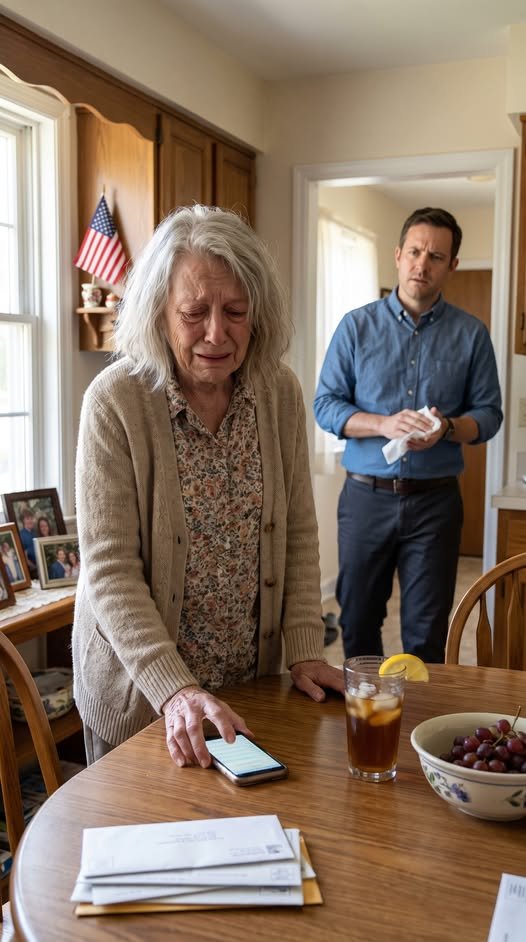
“Elise,” I said gently, “would you like to read it aloud, or shall I?”
Her hands were flat on the table, as if she were steadying it. “I’ll do it,” she said. Her voice was barely there. “But Marcus needs to hear it from the beginning, because he doesn’t know all of it either.”
Marcus turned in his chair. “Know all of what?”
She picked up the sheet and read the handwritten note at the bottom.
Do not tell Mrs. Miller who is paying. She would refuse. Please just make the house safe for her.
Then she set it down and looked at me.
“I’m the one paying, Eleanor. I have been for eleven months.”
I had expected many things. Not that.
“I don’t understand,” I said. “Why would you hide it?”
“Because of what I thought you thought of me.” She laughed shakily. “You never warmed to me, and I never knew how to fix it. I’m not good at saying things. I’m good at doing them. So I did them.”
Marcus stared at her. “You told me the repairs were being covered by a home-improvement grant.”
“I lied to you too. I’m sorry.”
She explained slowly. Two years earlier, when I slipped on the ice, she had sat in the hospital waiting room while Marcus parked the car. A nurse told her that falls like mine, in women over seventy, often lead to a second fall, and that the second is usually worse. Elise had watched her own grandmother die that way. She went home and started a spreadsheet of every hazard in my house: the porch steps, the worn basement railing, the gravel driveway, the slick bathroom tile.
“I couldn’t afford all of it at once,” she said. “I started saving from my salary. Marcus and I had an agreement to split household costs, but I didn’t tell him how much I was putting into your house. I didn’t want you to feel like a project.”
“And the message?” I asked. “Don’t let your mother read page three.”
Her eyes filled. “Page three has the payment authorization with my name on it. The contractor had warned me that if you saw it, you’d likely cancel. Marcus knew I wanted it private. I texted him that morning because he mentioned wanting to ‘just get it signed.’ I was afraid he’d explain too much.”
Marcus looked as though someone had pulled a chair out from under him. “You told me to hide page three from my own mother. I thought there was something wrong with it.”
“I know how it sounded. I didn’t think.”
I sat back. The kitchen clock ticked. Outside, a mourning dove called from the porch rail Elise had been paying to fix.
“Then why were you both so evasive when I asked?”
Marcus rubbed his face. “Because I thought you’d be angry we’d gone behind your back. And because…” He hesitated. “Mom, I’m the one who should have noticed all of this. Elise did. She noticed that the stairs scared you, that your knee was getting worse, that you were skipping the grocery store because carrying bags hurt. I was bringing you grapes and checking tires, and she was reading your life. I was embarrassed.”
“The knee brace?”
“Elise researched it,” he admitted. “I just bought it. I took credit for that too. I said it was from a friend because it sounded better than admitting I hadn’t thought of it.”
I looked at my daughter-in-law, who had been so quiet for three years that I had taken her silence for coldness.
“The gray scarf,” I said slowly.
She blinked. “What about it?”
“You asked whether I got cold sitting by the living room window. I put the scarf in the closet and never wore it. I thought you hadn’t chosen it with care.”
Elise let out a tiny sound, half laugh, half sob. “I bought it because you always pulled your cardigan tight by that window. I spent an hour in the shop picking the softest one.”
I pressed my hand against my mouth. When I could speak, I said, “I’m so sorry.”
“Please don’t be,” she said. “You didn’t know.”
“I should have asked.”
“We both should have.”
I stood and walked to the hall closet. The scarf was folded on the top shelf, still in its tissue paper. I came back and wrapped it around my shoulders, and it was as soft as she’d promised.
Elise began to cry then, quietly, with her hand over her eyes. Marcus put his arm around her, and for a moment nobody said anything.
“I have a condition,” I said at last.
They both looked up warily.
“Nothing about this house gets paid for secretly again. If you want to help me, you tell me, and I get to say yes or no. But I’ll tell you now: I’d like to say yes.” I smiled. “On the condition that I contribute. I’ve been saving, and I’d like to put in half.”
Marcus began to protest. Elise shook her head.
“Fair,” she said. “More than fair.”
“And the second condition is for you, Elise.” I took her hand across the table. “I’d like to know you. Not the polite version. Come for coffee. Tell me what you’re reading, what annoys you at work, what you were afraid of when you were small. I’ve spent three years deciding who you were. I’d like to be corrected.”
She nodded, tears falling freely. “I’d like that.”
I signed the agreement that afternoon, all three pages, after reading each one twice. The porch was repaired the following week. The new handrail went on the left side, as Elise had specified. A man with a ladder replaced the cracked basement railing, and a crew regraded the driveway so it would never ice into a slope.
Elise started coming on Wednesday evenings. At first we talked about repairs. Then we talked about everything else. She told me that she’d grown up in a house where affection was shown through chores, and that she’d never learned to say what she felt. I told her about Robert, and the thirty-one years of mortgage payments, and the night we finally paid it off and ate cold pizza on the porch steps because the furniture hadn’t arrived.
“Those steps?” she asked.
“The very same.”
She looked out the window at the new rail and smiled. “Then I’m glad they’re safe.”
In December, Marcus and Elise hosted Christmas for the first time. I arrived in the gray scarf. Elise saw it in the doorway and her whole face changed, the way a room does when someone lights a lamp.
At dinner, Marcus stood and raised his glass.
“I want to thank someone,” he said. “Someone who spent two years quietly making my mother’s life safer, and never asked for credit. I’m lucky to be married to her. I’m sorry it took me so long to say it out loud.”
Elise looked at her plate, blushing. I reached over and squeezed her hand.
“To page three,” I said, lifting my glass, “and the people brave enough to write it.”
Everyone laughed. Outside, snow fell quietly over the porch, and the new handrail glowed under the lamp, solid and steady.
For three years, I’d believed my daughter-in-law was keeping her distance.
She had been keeping watch.