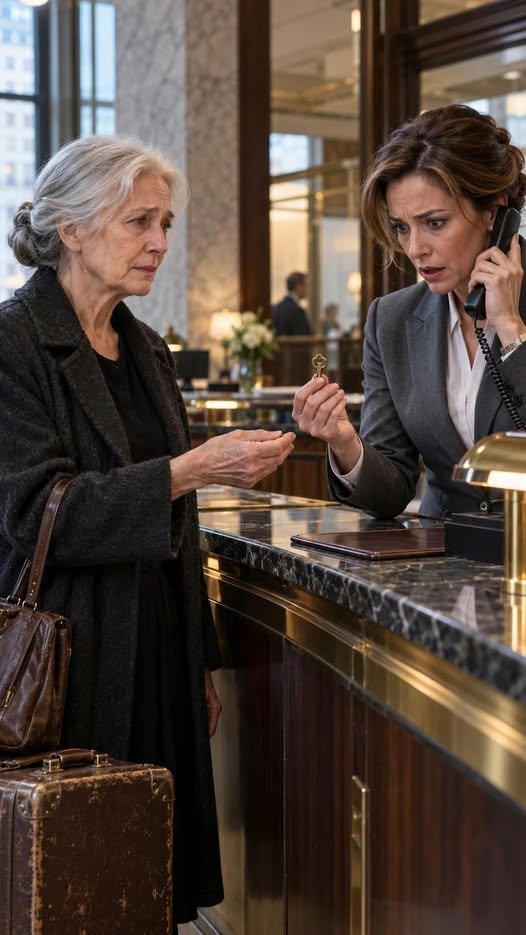
“Mrs. Calloway,” the woman in the gray suit said, “my name is Dorothy Aldridge. I’m the director of private client services. Would you please come with me? Someone has been waiting for you for a very long time.”
“Waiting?” I whispered. “I only found out about this key three weeks ago.”
“Your husband arranged this appointment four years ago,” she said gently. “He told us you would come alone, probably in mourning, and that you would not yet know why.”
She led me down a quiet corridor to a conference room with a walnut table and a window over 47th Street. A silver-haired man rose to greet me. He held a leather folder, and he did not rush me.
“Margaret, I’m Arthur Pell. I was Robert’s attorney for thirty years. Please sit. This will take some time.”
It took three hours. I’ll tell it the way it was told to me, in pieces, between cups of tea I couldn’t finish.
My husband, Robert, was a quiet man. A mechanical engineer who drove a ten-year-old Buick and clipped coupons. I had always thought of us as comfortable and careful. What I never knew was that in 1987 he had co-invented a valve component used in municipal water systems and licensed the patent. The royalties were modest at first. Then cities across the country adopted it. Robert reinvested every dollar, quietly, through trusts Arthur managed. By the time he got sick, the holdings stood at just over twenty-eight million dollars.
“Why didn’t he tell me?” I asked.
Arthur opened the folder. “He wrote you a letter. He asked that you read it in this room, before anything else.”
Maggie,
If you are reading this, I’m gone, and you’ve turned the key. I’m sorry for the secret. Let me explain it.
I watched you give everything to our son for thirty years. I loved that about you, and I feared it. I saw how David spoke to you when he thought I wasn’t listening. I saw how his wife measured every room in our house with her eyes. I wanted to believe I was wrong.
So I made a plan in case I wasn’t. I kept the money hidden so no one could love you for it. I wanted you to find out who would stand beside you when you had nothing to give.
If our son has shown you who he is, it is not your fault. You raised him with love. Love isn’t always enough.
Now it’s your turn to be looked after. The apartment on Fifth Avenue is yours. So is everything else. Spend it on joy, Maggie. You’ve earned a lifetime of it.
Forever yours,
Robert
I put the letter down and cried the way I hadn’t at the funeral, openly and without shame, while Dorothy Aldridge slid a box of tissues across the table.
The penthouse sat on the twenty-second floor of a limestone building overlooking Central Park. Robert had bought it in 2006 and kept it furnished, with a doorman who had been paid to say nothing.
I stood in the living room that afternoon in my funeral dress, my cheap suitcase beside me, looking out over the treetops. On a side table stood a framed photograph of the two of us at the shore, young and sunburned. He had put it there years ago for me to find.
“Welcome home, Mrs. Calloway,” the doorman said softly.
I did not call my son. For three months I did something I hadn’t done since girlhood. I rested. I slept until seven. I walked in the park. I took a cooking class with eleven strangers and burned the risotto, and we all laughed.
I also did one other thing, with Arthur’s careful help. I examined the papers my son and his wife had left on my kitchen table.
The transfer documents were more than an unkind request. They were a plan.
Arthur’s investigator found that my daughter-in-law, Vanessa, had met with a real estate broker two weeks before the funeral and asked how quickly the house could be sold “if the widow signed over title.” She had also taken out a bridge loan against the house using a power of attorney Robert never signed. The signature was forged, and it was not a good forgery.
David hadn’t forged it. But he had known. The emails made that clear, and so did the yellow sticky notes on my furniture, which I learned were an inventory for an estate sale.
“Margaret,” Arthur said gently, “you have grounds for a civil action and a criminal referral. The forged instrument alone is a felony.”
I thought about it for a week. Then I made my decision.
In early June, a courier brought a thick certified envelope to the house on Maple Avenue. David signed for it. He told me later that he sat on the porch steps and read every page twice.
Inside was a formal notice. The house, held in trust under Robert’s estate, was to remain under my sole control. David and Vanessa had sixty days to vacate. It included a copy of the forged power of attorney, with a note that the district attorney’s office had a copy and awaited my instruction. At the bottom, in my own handwriting, was one paragraph:
David, I did not take the key to punish you. I took it because your father asked me to, and because I needed to learn who you were when I had nothing. I have my answer. You are my son, and I will always love you. But I will not live in a house where I am treated as a guest in my own life. If you would like to talk, I’ll be at the address on the card enclosed. Come alone. Mom
He came on a Wednesday afternoon, in the rain, without an umbrella.
I stood in the foyer of the penthouse and watched him step off the elevator, thinner and older, shoulders caved in as if he’d been carrying something for months.
“Mom,” he said.
I did not hug him. Not yet. “Sit down, David.”
He sat on the edge of the sofa and looked around at the park, the books, the photograph at the shore. His eyes filled. “Dad had all of this?”
“All of it.”
“He never told me.” His voice broke. “I’m so ashamed. I stood there and let her say that to you. I’ve replayed it every night since.”
“Why were you silent?”
“Because it was easier. Because Vanessa was angry about our debts, and I was afraid, and I let fear speak for me. That’s no excuse.”
“No,” I said. “It isn’t.”
We talked for two hours. He told me Vanessa had left him in May, after the sale of the house collapsed and the bridge loan came due. He’d been sleeping in a friend’s spare room and working a second job. He said he had been trying to learn what it felt like to ask for nothing.
“I’m not here for money,” he said. “I don’t deserve it.”
“I know,” I said. “That’s why I’m talking to you.”
I told him what I had decided. I would not file a referral against him. Vanessa was a different matter, and Arthur would handle that, though the district attorney would make the final call. The house would remain in Robert’s trust, and David could rent it at a fair price if he held steady work. The rest of the inheritance would fund a foundation for retired nurses who had spent their lives on hospital floors and left with nothing.
“The Robert Calloway Fund,” I said. “Your father would have liked that.”
David wept. I let him. Then I crossed the room, sat beside my son, and put my arms around him.
“I’m still angry,” I said. “I will be for a while. But I’m here.”
“I’ll earn it,” he whispered. “I’ll spend my whole life earning it.”
“Start with Sunday dinner,” I said. “I’m learning to cook.”
Vanessa pleaded to a reduced charge of attempted fraud and received probation and restitution. She moved to Arizona. I wished her well, and I mostly meant it.
The foundation opened that fall. In its first year it paid for housing, medical care, and quiet retirements for forty-one women who had worked double shifts and missed holidays and gone home to silent houses.
On the first anniversary of Robert’s death, David and I stood on the penthouse balcony with two cups of coffee. The park was gold with autumn.
“Do you think he knows?” David asked.
I looked out at the trees and touched the brass key, which now hung on a chain around my neck.
“I think he planned it this way,” I said.
Somewhere below us, a child laughed on the path. The coffee was hot. The light was warm.
For the first time in a very long time, I was exactly where I belonged.