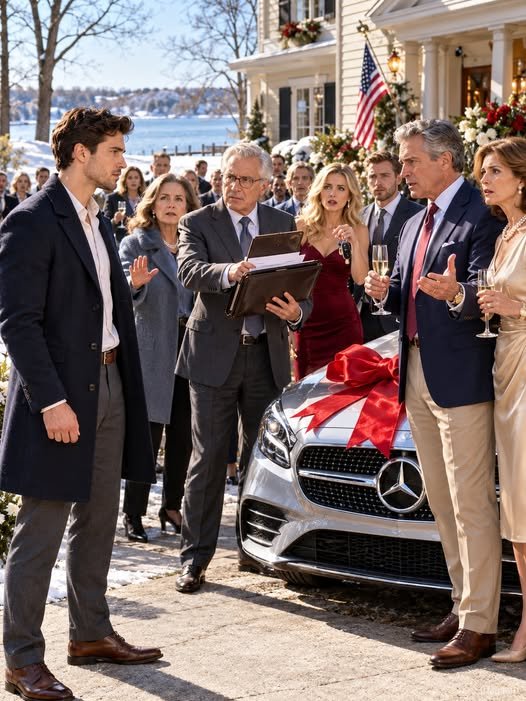
Miles Wexler did not raise his voice. He had spent forty years in probate courtrooms, and he knew that the quietest person in a room is usually the one holding the paper.
“Mr. Whitaker,” he said, “you told these guests that Loretta Whitaker chose to sell her piano. I represent Mrs. Whitaker, and I’m obliged to correct the record.”
Dad’s scotch glass tilted. “Miles, this is a family party.”
“Then the family should hear it.” Miles turned the first page toward the crowd. “In March of last year, Mrs. Whitaker transferred ownership of the Steinway concert grand, the instrument in question, into the Loretta Whitaker Music Trust. The sole beneficiary is her grandson, Everett. The piano was never your mother’s to sell, and it was certainly never yours.”
A murmur ran through the guests. Hugh Ashb lowered his glass.
“That’s absurd,” Mom said, too quickly. “She would have told us.”
“She told you,” Miles said. “Twice. Once at Thanksgiving, and once in a letter sent by certified mail, which Mr. Whitaker signed for.” He lifted a green receipt card. “Your signature, Calvin.”
Dad said nothing. Delaney’s smile had left her face.
“There’s more,” Miles said, and handed me the sealed envelope he’d given me earlier. “Everett, would you read this aloud? Loretta asked that you do.”
My hands were steady, which surprised me. Inside was a single page in Grandma’s slanting script.
To my family,
If Miles is reading this, my son has done what I feared. I have loved you all, but I have watched you measure people by what they own. Everett never owned much. He gave me his evenings, his patience, and his music. So I gave him the one thing I could not bear to see sold.
The piano is not worth ninety-five thousand dollars. It is worth every Sunday I spent teaching a seven-year-old boy that a wrong note is only a note not yet understood. Calvin, I hoped you would learn that too.
I have asked Miles to do what is lawful and fair, and nothing more. Please let him.
Mother
My voice cracked on the last word. Nobody applauded. The whole lawn was silent.
“Now the legal part,” Miles said. “The sale of trust property without the trustee’s consent is conversion. The buyer, a private collector in Chicago, paid ninety-five thousand dollars. I’ve already contacted him. He was told, in writing, that Calvin Whitaker was the lawful owner. That was a misrepresentation. The sale may be voided, and he has agreed to cooperate.”
“I’ll fix it,” Dad said, hoarse. “I’ll pay it back.”
“You’ll do more than that.” Miles turned a page. “The Mercedes was purchased with the proceeds. Under the trust terms, any asset bought with misappropriated funds is subject to recovery. The title is in Delaney’s name.”
Delaney stared at her keys. “Dad? You said Grandma agreed.”
“Delaney…”
“You told me she wanted me to have it.” Her voice rose. “You let me stand in front of everyone and take a car that wasn’t ours?”
Ryder had stepped away from her. He wasn’t cruel about it. He simply looked like a young man doing arithmetic about the family he was marrying into.
Hugh Ashb spoke for the first time, evenly. “Calvin, I did business with you because I believed you were a man of your word.”
Dad’s face went gray.
Miles had one more document, and I watched my mother’s composure finally fracture.
“Last month, Gwen Whitaker met with a physician and an elder-law attorney to inquire about challenging Loretta’s competency. I have records of the consultation. The inquiry was premature and unsupported. Mrs. Whitaker was evaluated by two independent doctors last week. Both found her fully competent.”
“We were worried about her,” Mom said weakly.
“You asked who could control her paperwork,” Miles said. “That isn’t worry.”
Aunt Joan stood and walked to Mom’s side. “Gwen. Tell the truth for once.”
Mom looked at the crowd, at the faces that had been applauding ten minutes ago, and for the first time that I could remember, she had no script. She sat down in a lawn chair and covered her mouth.
I did not want to humiliate them. I thought of Grandma’s instruction: Don’t argue. Let them show everyone who they are. They had. There was nothing left for me to add.
But I did say one thing.
“Dad,” I said. “I’m not here to take anything from you. I came for the piano.”
He looked at me, and for a moment I saw the boy he must once have been, before he learned that approval came with a price tag.
“I don’t know how,” he whispered. “I don’t know how to undo it.”
“Start by telling the collector the truth,” Miles said. “Then we’ll see.”
It took nine weeks. The Chicago collector, a retired concert pianist named Mr. Alder, agreed to return the instrument for the original price. Dad liquidated an investment account to repay him. Delaney handed over the Mercedes, and, to her credit, she drove it to the dealership herself and sat in the lobby for two hours until the paperwork was done.
When the Steinway came back to the lake house, I stood in the empty living room as movers set it down in its old corner. The pale rectangle in the carpet fit it exactly.
I sat on the bench and played the scale Grandma taught me. One note was slightly out of tune. I smiled.
Grandma lived to see it.
I brought her home from hospice for one afternoon in a wheelchair, wrapped in her lavender shawl. She sat beside the piano with her eyes closed while I played the Debussy she loved. When I finished, she was crying.
“There,” she said softly. “That’s the sound of the house.”
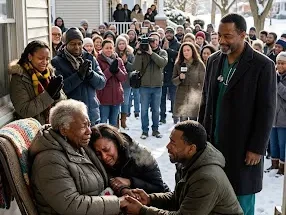
Dad stood in the doorway. He had come without being asked, hands in his pockets, eyes red. He walked slowly to her chair and knelt, which I had never seen him do.
“Mother,” he said. “I’m sorry.”
She opened her eyes. “I know, Calvin. Say it to Everett.”
He turned to me. “Son. I’m sorry. For the piano. For all of it. For not seeing you.”
I didn’t say it’s okay, because it wasn’t yet. But I said, “Thank you for saying it.”
Grandma smiled and let her head rest against the cushion.
She died in April, in her own bed, with all of us in the room. Delaney held one hand. I held the other. Dad stood at the foot of the bed, openly weeping.
The funeral was small. At the reception, Delaney found me by the piano and said quietly, “I was awful to you.”
“You were.”
“I’m working on it.” She hesitated. “Would you teach me? Not for show. Just the scales.”
I laughed. “Come Thursday.”
She came every Thursday that year. She was terrible, and she kept coming.
I kept the piano where it belonged. Every Saturday, a few of my students come to the lake house for recitals, and their parents sit in folding chairs and clap for wrong notes.
The trust Grandma set up funds a scholarship for children who can’t afford lessons. Dad contributes to it each month, quietly, without a car in the driveway or a crowd to applaud.
Some evenings I sit at the keys as the sun sets over the lake, and I play the first piece she ever taught me.
The house smells of lavender. A wrong note rings out, and I leave it there.
Because some things, as she told me, are worth more than money.