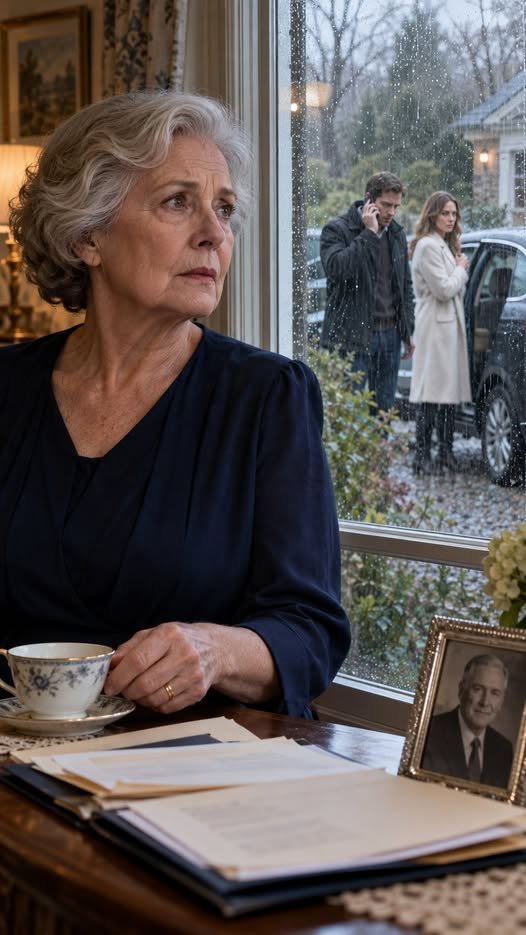
The third person was Wesley, my younger son.
He stood on the gravel in his work jacket, hands in his pockets, looking at my front door the way a man looks at a courtroom. I had not spoken to him in eleven months. Not because of anger. Because Benjamin had always been the one who “handled things,” and somewhere along the way I had let that arrangement erase my other child.
I set down my cup, smoothed my cardigan, and opened the door before anyone could knock.
“Mom,” Benjamin said, his voice cracking. “We need to talk.”
“Good morning, Benjamin. Genevieve.” I looked past them. “Wesley.”
“Hi, Mom,” Wesley said quietly. “Benjamin called me at six this morning. He said you’d done something drastic. I told him I’d drive out and see for myself.”
“Come in,” I said. “All of you. I’ll make fresh tea.”
We sat in the front room. Benjamin and Genevieve took the sofa. Wesley chose the straight chair by the window, as far from the others as the room allowed. I sat in Thomas’s armchair with the folder marked BENJAMIN on my knee.
Genevieve spoke first, in the careful voice she used for clients. “Margaret, the bank declined our mortgage payment this morning. And the insurance. And the preschool. This is a serious misunderstanding.”
“It isn’t a misunderstanding. I canceled my authorizations.”
“All of them?” Benjamin whispered.
“A hundred and seventy-four.”
Genevieve’s mouth tightened. “Over a dinner.”
“Over a message.” I took out my phone and read it aloud, evenly. “You weren’t invited. My wife doesn’t want you there.”
Benjamin flinched. Wesley looked at his brother with an expression I couldn’t read.
“I was upset,” Benjamin said. “It came out wrong.”
“What was the right way to say it?”
He had no answer. Genevieve did, and for the first time in fifteen years, the polish slipped.
“The right way,” she said, “is that you come to everything wearing the same navy dress, Margaret, and you tell the same stories about Thomas, and you ask what things cost. We have a certain circle. It’s embarrassing.”
The room was very quiet. A clock ticked on the mantel.
“Thank you,” I said.
She blinked. “For what?”
“For finally telling me the truth. I’ve paid for it long enough.”
I opened the folder and laid it on the coffee table.
“Look at it,” I said.
Benjamin turned the pages slowly. Tuition receipts. Mortgage assistance. Club dues. The preschool payments. The “temporary” home repair. The total for that year alone, in my handwriting at the bottom: ninety-three thousand six hundred dollars.
“I didn’t know it was that much,” he said.
“You never asked. I made it easy not to.”
“Mom, that’s not fair,” Genevieve said. “We never demanded anything.”
“You never had to. I saw a need and filled it, and you let me.” I looked at my son. “It wasn’t cruelty, Benjamin. It was convenience. Money arrived, so you stopped wondering where it came from.”
Then Wesley spoke, for the first time since sitting down.
“How much of it went to him, Mom? Over the years.”
I hesitated. “Close to nine hundred thousand dollars.”
Wesley let out a long breath. “And I got a hundred and fifty for the down payment on my house, once, and you made me promise to pay you back. Which I did.”
“Wesley…”
“I’m not angry at you.” He shook his head. “I just never understood why I was always the one who had to pay it back.”
Benjamin turned to stare at him. Genevieve looked at the floor.
I had not planned for that moment, and it hit me harder than anything Genevieve said.
“Because,” I said slowly, “you never asked for more. Benjamin always did. And I mistook your quiet for not needing me.” My throat tightened. “That was my failure, Wesley. Not yours.”
He didn’t answer. His eyes were wet.
Benjamin put his face in his hands. “Dad would be ashamed of me.”
“Your father would be heartbroken,” I said. “Those are different things. Shame closes a conversation. Heartbreak opens one.”
He looked up. “What do I do?”
“That depends on what you want.” I folded my hands. “I’m not leaving you to drown. I’m seventy-seven, not heartless. But I have conditions, and they aren’t negotiable.”
Genevieve opened her mouth. Benjamin lifted a hand. “Let her finish.”
“First, you take over your own expenses. All of them. If you need a bridge, I’ll cover three months of the mortgage, once, with a written budget. After that, nothing.”
“Fine,” Benjamin said hoarsely.
“Second, your daughter’s tuition stays paid, directly to the school. It will never be a punishment for her, and never a bargaining chip.”
Genevieve’s shoulders dropped slightly. Relief crossed her face.
“Third.” I turned to her. “You will not speak of me in your house or anyone else’s as if I’m a stain on your evenings. I’m not asking you to love me. I’m asking for the courtesy you’d give a stranger at a bus stop.”
She was silent. Then, very quietly: “That’s fair.”
“Fourth.” I faced my sons. “I’m changing my will. Not to punish anyone. Everything I have will be divided equally between you both, with no further advances and no further debts. What Benjamin has received will be counted as part of his share, and what Wesley repaid will be returned to him first.”
Benjamin went white. Wesley said, “Mom, you don’t have to…”
“I do,” I said. “Fairness isn’t a favor. It’s overdue.”
The sound of a small cough came from the hallway.
My granddaughter Lily stood in the doorway, holding her backpack. She had come in with her father and quietly slipped away to the kitchen. I hadn’t realized she had been listening.
“Grandma,” she said. “Did you stop paying because Mommy said you weren’t invited?”
Nobody breathed.
“I stopped,” I said gently, “because I’d said yes to everything for so long that I forgot I was allowed to say no. The dinner just showed me the door.”
Lily considered this gravely. “Can I say no sometimes too?”
“Always.”
She crossed the room and climbed into my lap. Over her head, I saw Genevieve’s eyes fill with tears, the real kind, the kind that don’t ask for anything.
It was not a tidy repair. Real ones rarely are.
Benjamin sold the club membership within the month. Genevieve took on more design work and, to everyone’s surprise, enjoyed it. They moved to a smaller place near Lily’s school. The first Sunday lunch was stiff, with too many silences and a burned casserole. The second was easier. By the fifth, Wesley had started coming too, bringing his wife and two boys, and my table, which had been quiet for years, filled with noise.
One afternoon in October, Genevieve arrived early and set a small box beside my plate.
“I thought you might want these.”
Inside were Thomas’s pearl earrings. I had left them on the mantel the night I took them off. She had found them when she came to collect Lily’s things, and kept them safe.
“I should have said this years ago,” she said. “I’m sorry, Margaret. I was afraid you saw everything I wasn’t.”
“I saw a young woman trying very hard,” I said. “I only wish she’d let me help without making me feel small.”
She cried. I held her hand. It was a beginning.
That winter, I did something I’d put off for decades. I booked a trip to the coast, a week alone with the sea, a notebook, and a good cup of tea.
The night before I left, I stood at the mantel. The silver frame was warm from the lamp. I touched Thomas’s face.
“I finally learned it, dear,” I said softly. “Giving isn’t the same as disappearing.”
I put on the pearl earrings, picked up my suitcase, and stepped out into the cold, clear air. Behind me the porch light glowed. In my pocket my phone buzzed: a message from Lily. Bring me a shell, Grandma!
I smiled and typed back: Always room for you in my suitcase.
For the first time in fifteen years, the only dinner I had to attend was my own.
I intended to enjoy every bite.