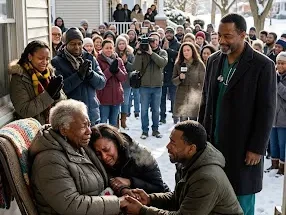
“No,” Ben said, shaking his head. “Not any of what you’re thinking. Please. Let me finish before you decide I’m someone I’m not.”
He took a breath and reached into his jacket. He pulled out a folded, soft-edged piece of notebook paper, the kind torn from a spiral binding.
“Rosie wrote this three weeks ago. She made me swear to give it to you only if something went wrong.”
I recognized the handwriting at once: big, careful letters, slanting slightly uphill, the way she’d learned to write at the kitchen table with our mother. I unfolded it with shaking hands.
Dear Lily,
You always say I will have you and Ben. I know. But I want you to have somebody too. You take care of everyone. You forgot to take care of you.
I asked Ben to marry me. Not the other way. He said yes because he is kind. But I asked because I wanted him to be family forever, so you would never be alone, even if I am not here.
Ben loves you. Not like boyfriend. Like a real brother, and he told me so. He is going to tell you the rest.
Please be happy. Love, Rosie.
I read it three times. The hallway blurred.
“She asked you?” I whispered.
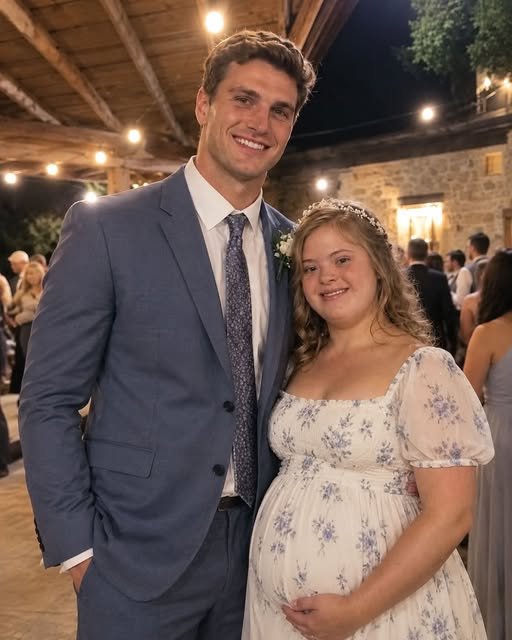
Ben gave a wet, broken laugh. “Fourth grade, Lily. I told her I’d take her to prom, and I did. She never forgot. Six years ago, she looked at me over a plate of your mom’s lasagna and said, ‘Ben, will you marry me?’ Like she was asking me to pass the salt.”
“And you said yes.”
“I said, ‘Rosie, are you sure?’ She said, ‘I know what I want.'” He wiped his face with his sleeve. “I’d been terrified of getting it wrong. I didn’t want to take advantage of anyone, or let anyone think I had. So I went to your parents. I went to her doctor. I asked a counselor who works with adults with disabilities to talk with us both, separately and together. Everyone told me the same thing. Rosie understood exactly what marriage meant, and she chose it.”
I leaned against the wall.
“But why did she say that? Why I really married her?“
“That’s the part she wanted you to hear from me.” He swallowed. “Rosie knew about your life. She told me, years ago, that you gave up the art program in Chicago to stay near her. That you turned down the job in Seattle when Dad got sick. That you stopped dating after your last boyfriend said he didn’t want to be ‘a caretaker’s partner.'”
My throat tightened. I had never told her that.
“She heard you on the phone once,” Ben said. “She understood more than you thought. She decided you were never going to leave her, and she decided that wasn’t fair to you. So she built a family big enough that you’d be free.”
I slid down the wall until I was sitting on the cold floor, and Ben sat beside me.
“I married her because I love her,” he said. “I fell in love with her sense of humor and the way she dances in the kitchen and her total honesty. When she said she wanted a husband, I realized I’d been looking for her without knowing it. But yes, Lily, she also wanted to take the weight off you. She said, ‘If Ben is my husband, Lily can go be Lily.'”
I put my face in my hands. Somewhere down the corridor, a monitor beeped and a nurse’s shoes squeaked past.
“I’ve been so afraid,” I said. “Since the wedding, sometimes I’d look at you two and wonder if I was losing my place.”
“You were never losing it.” He took my hand. “You’re her sister. You’re mine. We’re just wider now.”
The surgery took four hours and twelve minutes. I counted every one.
When the doors finally opened, a surgeon in a blue cap stepped out and pulled down her mask. Her expression was tired and unreadable until the last second, when it broke into a smile.
“She’s stable,” she said. “Both babies are alive. Two girls, four pounds each. Rosie lost a lot of blood, but she’s a fighter.”
Ben made a sound I’ll never forget, half sob, half laugh, and folded into my arms. I held him as tightly as I’d once held my sister at her wedding.
Rosie woke the next morning, groggy and annoyed about the IV in her hand.
“Where’s my babies?” she demanded in a scratchy voice.
“Down the hall,” Ben said, kissing her forehead. “They’re perfect. You were incredible.”
“I know,” she said, and the whole room laughed.
I stood at the foot of her bed, holding her note in my pocket like a stone.
“Lily?” She turned her head. “Did Ben tell you?”
“He told me.”
“Are you mad?”
“No.” I came to her side and took her hand. “I’m just… Rosie, you didn’t have to. I never needed to be rescued from my own life.”
“I know,” she said, with surprising gravity. “But you never let yourself pick it. Somebody had to push.”
I laughed through tears. “You pushed hard.”
“I’m very strong,” she said, and squeezed my fingers.
The twins, Hazel and June, came home three weeks later. The first night, the three of us sat in Rosie and Ben’s living room in a heap of blankets and bottles, and nobody slept, and it was the happiest chaos I’d ever known.
Over the next months, I did something I hadn’t done in ten years. I applied to the art program in Chicago.
I got in on a Tuesday. I called Rosie from the car.
“Chicago!” she shrieked. “You have to go!”
“It’s far.”
“It’s a train, Lily. And I have a husband who can do all the heavy stuff.” I could hear Ben laughing in the background. “We’ll come see you. The babies will be big. They’ll visit your gallery.”
I cried so hard I had to pull over.
I left that fall. Rosie and Ben drove me to the station, the twins in matching car seats, Rosie with a sign she had painted herself: LILY’S GOING TO BE FAMOUS. Our parents stood behind them, arms around each other, both crying.
On the platform, Rosie pressed a small box into my hands. “Don’t open it until you get there.”
“You always say that.”
“Because it’s always a surprise.”
On the train, I opened it. Inside was a tiny ceramic bird, hand-painted in uneven yellow and blue, with a note in her big careful letters.
For your new desk. So someone from home sits with you. Love, Rosie. P.S. I asked Ben. He said the bird looks great.
I set it on my desk in a cramped Chicago apartment, beside a stack of sketchbooks.
Three years later, I stood in a small gallery on a snowy Saturday, watching guests drift past my paintings. A series about family, about sisters, about doors left open. Near the back, three people had gathered in front of the largest canvas: a tall man holding two toddlers, and a woman in a bright yellow coat, pointing at the painting and explaining it to everyone nearby.
“That’s me,” Rosie announced. “And that’s my sister. She painted us.”
The canvas showed two women on a porch, one with her arm around the other, and between them an empty space where a third person could stand.
“Who’s the third?” a visitor asked.
“Whoever needs to,” Rosie said grandly. “Everybody gets a turn.”
I walked across the gallery and slid my arm around her. Ben grinned at me over Hazel’s head. June reached out and grabbed my hair.
“You came,” I said.
“Of course,” Rosie said. “You always have me and Ben.”
And I laughed, and cried, and finally understood the promise I’d been making her my whole life.
It had never been one-way. We had been keeping it for each other the entire time.